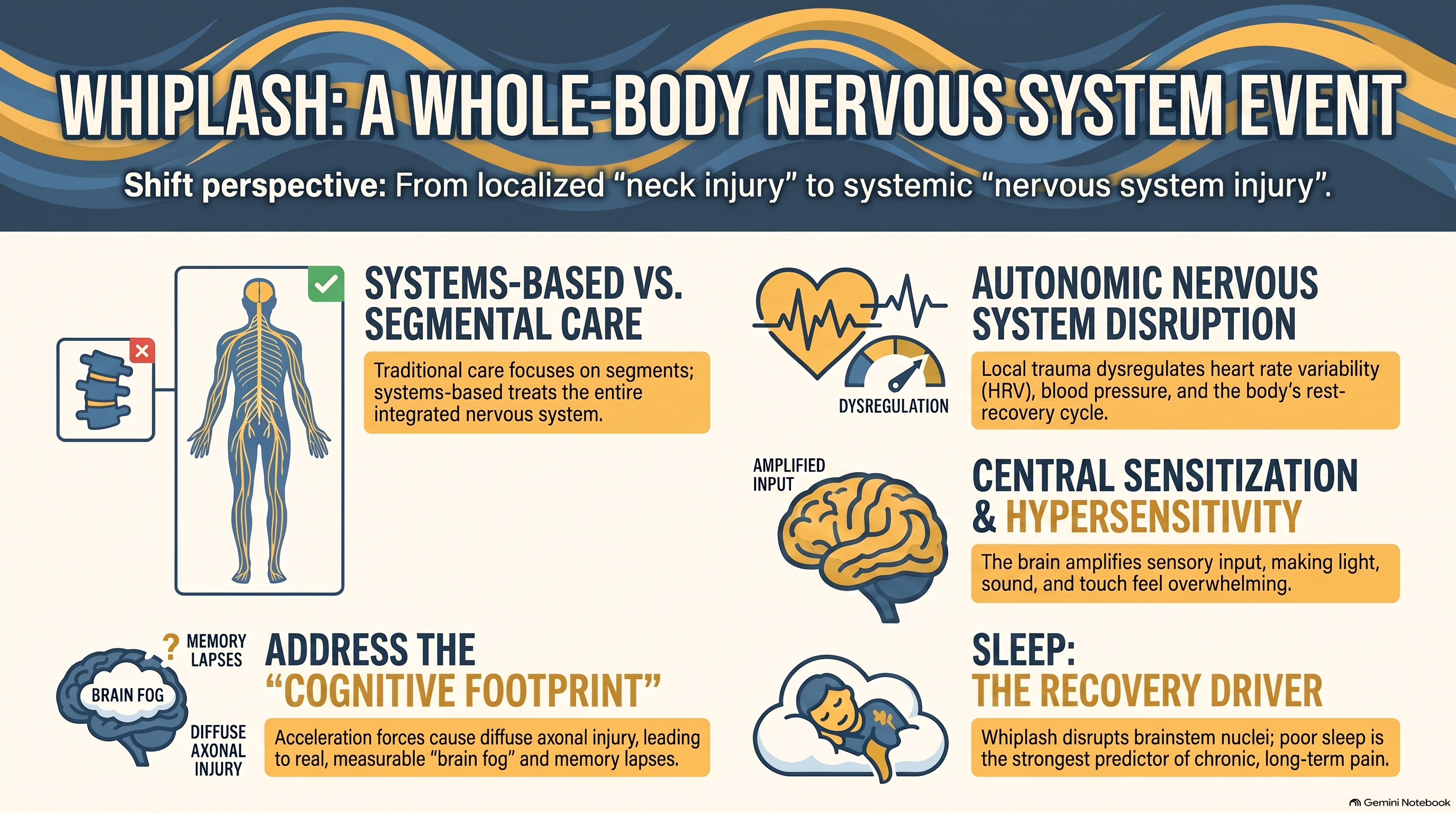
Beyond the Segment: Why Whiplash Is a Whole-Body Event and What That Means for Treatment
The standard clinical framework for whiplash begins with a radiograph and ends with a discharge note. In between: a sequence of segmental assessments, motion palpation findings, and range-of-motion measurements that produce a tidy anatomical picture of what happened to the neck. C4-5 restricted. Left facet tender. Upper trapezius in spasm. Treatment plan: manipulate the restricted segment, release the muscle, prescribe a home exercise program, reassess in six weeks.
The patient, meanwhile, can’t sleep. Has been waking at 2 a.m. for eleven weeks. Can’t follow a conversation at work. Forgets words mid-sentence. Is exhausted in a way that makes the neck pain feel almost secondary. Cries in the car on the way to appointments and isn’t sure why.
These are not psychological symptoms. They are not exaggeration. They are the predictable, mechanistically understood global effects of a local trauma that disrupted a system far more integrated than the segmental model acknowledges. The problem is not the neck. The problem is that the treatment model was built for a neck and the patient is a nervous system.
The Reductionist Default and Its Clinical Costs
Reductionism — the analytical framework that understands complex systems by breaking them into component parts — is genuinely useful in medicine. It is how we identify which disc is herniated, which nerve root is compressed, which muscle is in spasm. The ability to isolate and treat a specific anatomical structure has produced real clinical progress, and no serious argument against reductionism asks us to abandon it entirely.
The argument is narrower: when reductionism becomes the default mode of analysis for a systemic injury, it produces a therapeutic model that is structurally incapable of explaining or treating the full clinical picture. In whiplash-associated disorder, that structural incapacity has measurable consequences. Patients are undertreated. Symptoms are dismissed. Cases are contested on the basis of a clinical picture that was never comprehensive enough to represent what actually happened.
The reductionist model of whiplash assessment does several things well. It identifies bony injury. It documents disc pathology. It quantifies range-of-motion deficits. These are legitimate clinical data points that matter for diagnosis and treatment planning.
What it systematically fails to capture is everything that happens downstream of the mechanical injury in the nervous system, the autonomic system, the sleep architecture, and the cognitive processing centers of the brain. These downstream effects are not sequelae in the loose sense — things that happen later because the neck still hurts. They are mechanistically direct consequences of the initial trauma, operating through pathways that are increasingly well characterized in the neuroscience literature and almost entirely invisible to a treatment model that begins and ends at the spinal segment.
The clinical cost of this failure is substantial. Patients with documented fatigue, sleep disruption, and cognitive impairment following whiplash routinely have these complaints attributed to anxiety, depression, poor coping, or simple exaggeration — particularly in medicolegal contexts where reductionist defense medicine has every incentive to draw the injury as small and as local as possible. The patient who presents with a three-month history of insomnia, word-finding difficulty, and pervasive fatigue combined with neck pain and restricted motion is carrying a clinical picture that demands a systems-based explanation. A treatment model that focuses exclusively on the cervical segment provides none.
What Whiplash Actually Does — The Global Footprint
The research on the systemic impact of whiplash injury is considerably richer than the average personal injury intake process reflects. Understanding what the literature actually shows changes what you look for, what you document, and how you explain a complicated case to the patient, the attorney, and the reviewing physician.
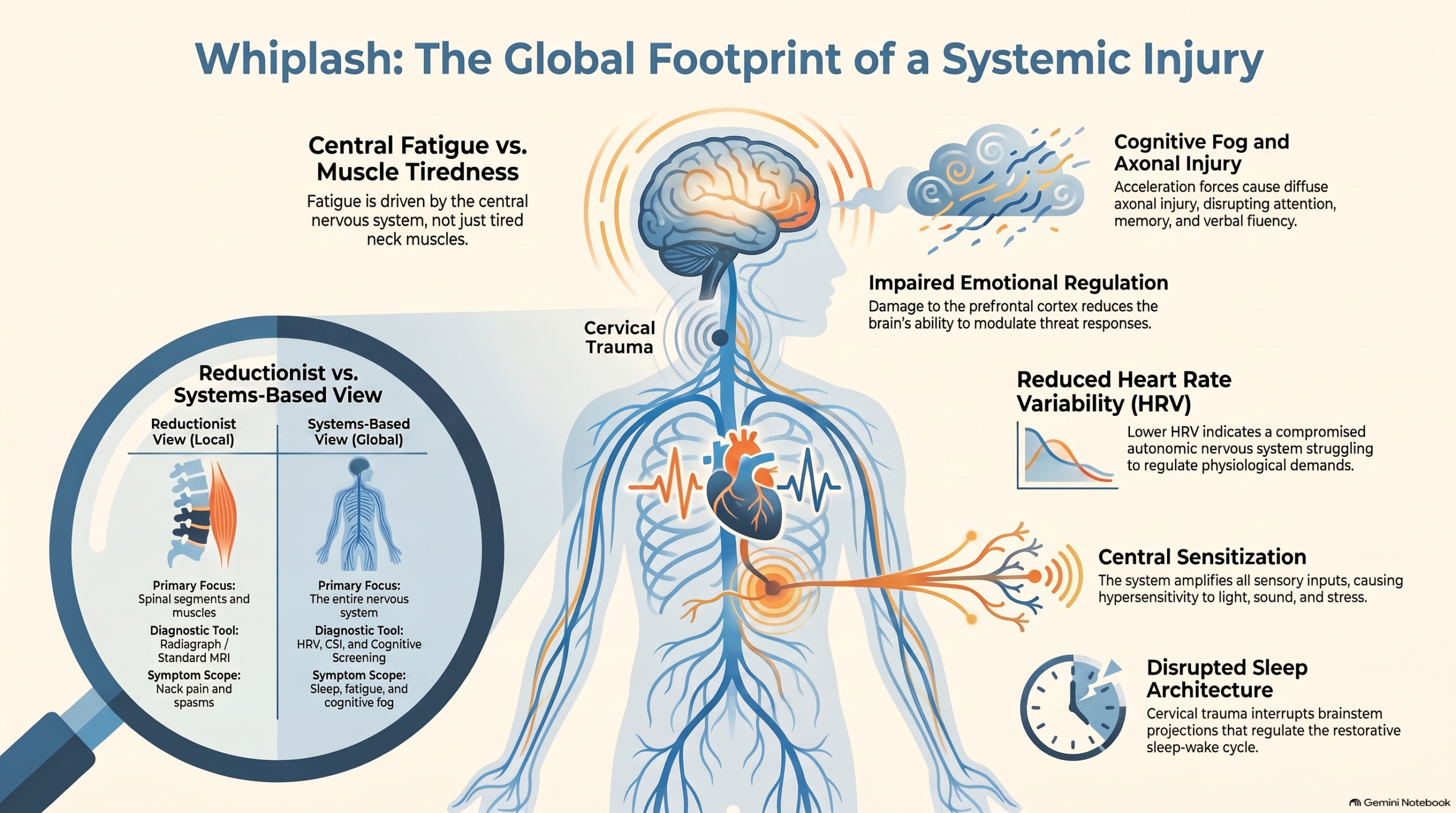
Fatigue following whiplash is not peripheral. It is not the simple muscular tiredness that comes from holding a tense neck all day. It is central. Studies examining patients with whiplash-associated disorder consistently find elevated fatigue scores on measures that distinguish central from peripheral fatigue, and the magnitude of that fatigue correlates not with neck pain intensity but with other markers of central nervous system involvement: sleep quality, cognitive performance, and autonomic dysregulation. The nervous system is tired, not just the muscle.
Sleep disruption is one of the most consistently documented and most consistently underaddressed sequelae of whiplash injury. Multiple prospective studies have shown that disturbed sleep is present in a significant proportion of acute whiplash patients and predicts poor recovery outcomes at both short- and long-term follow-up. The mechanism is not primarily psychological. The cervical spine has dense projections to the brainstem nuclei that regulate the sleep-wake cycle, including the locus coeruleus and the reticular activating system. Trauma that disrupts cervical afferent signaling disrupts these projections, and the result is not simply insomnia — it is a qualitative change in sleep architecture that compromises restorative sleep stages and compounds every other symptom the patient is managing.
Cognitive fog has a neurological substrate. The difficulty concentrating, the memory gaps, the word-finding failures — patients describe these accurately, and the research confirms that the description reflects something real. Acceleration-deceleration injury produces shear forces within the brain even in the absence of direct head impact, and these forces can produce diffuse axonal injury in the white matter tracts that connect prefrontal processing areas to other regions. The result does not appear on a standard MRI. It is a subtle but functionally significant disruption of the neural circuits that support sustained attention, working memory, and verbal fluency.
Emotional dysregulation follows from the same mechanisms. The irritability, the emotional lability, the fear of driving, the hypervigilance in traffic — these are not personality responses to stress. The prefrontal cortex, which provides top-down regulation of the amygdala’s threat-detection circuits, is among the brain regions most susceptible to diffuse axonal injury from acceleration-deceleration forces. When this regulatory system is impaired, the amygdala runs hotter. The patient is not overreacting to their situation. Their brain’s capacity to modulate its own threat response has been reduced by the injury.
The Autonomic Nervous System: The Variable Nobody Measures
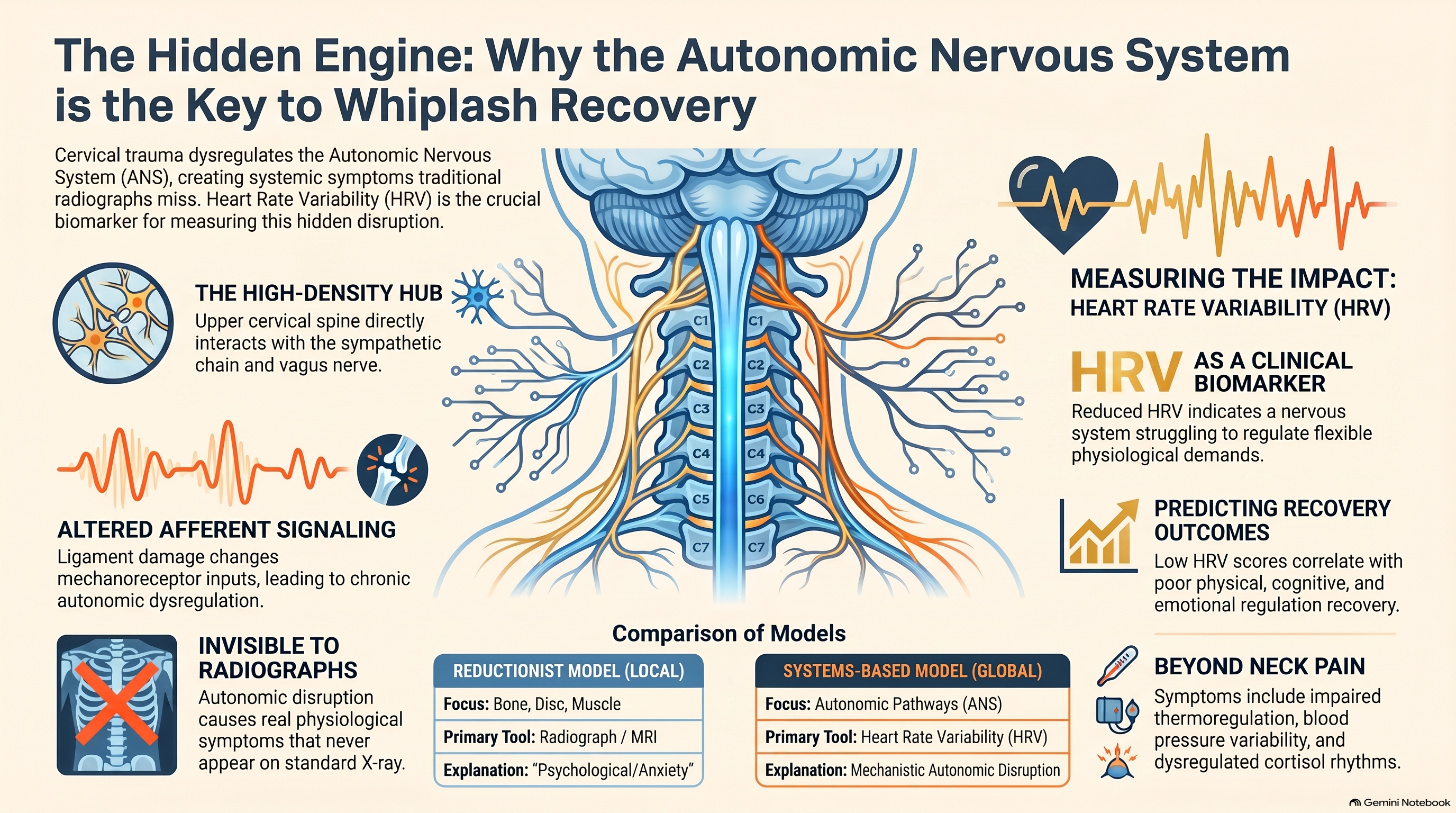
Whiplash injury to the cervical spine is also injury to one of the most densely autonomically innervated regions of the body. The upper cervical spine has direct anatomical relationships with the sympathetic chain, the vagus nerve, and the cervical ganglia that regulate cardiovascular function, immune response, gastrointestinal motility, and the broad physiological state we call arousal or rest.
Disruption of normal cervical afferent signaling — which occurs whenever ligamentous damage alters the mechanoreceptor inputs from the facet joint capsules and the deep cervical stabilizers — dysregulates these autonomic pathways. The clinical consequences include resting heart rate variability changes, altered blood pressure regulation, impaired thermoregulation, and dysregulated cortisol rhythms that affect both energy and sleep. None of these findings appear on a cervical radiograph. All of them are mechanistically connected to the injury.
Heart rate variability (HRV) deserves specific attention because it is an objective, measurable biomarker of autonomic function that has been studied in whiplash populations with consistent results. Patients with chronic whiplash-associated disorder demonstrate significantly reduced HRV compared to controls — meaning their autonomic nervous system has less capacity for flexible regulation across changing physiological demands. This reduced HRV predicts not only physical recovery but cognitive function and emotional regulation, because the same vagal tone that supports cardiovascular flexibility also supports the prefrontal regulation of the limbic system.
Autonomic dysregulation is not a side effect of whiplash. It is a core mechanism through which local cervical trauma produces global physiological consequences. A patient with post-whiplash fatigue, sleep disruption, and cognitive difficulty who also shows reduced HRV, postural blood pressure variability, and temperature dysregulation is not presenting with multiple unexplained symptoms. They are presenting with the predictable consequences of autonomic disruption following cervical injury. The explanation is mechanistic, not psychiatric.
Central Sensitization: When the System Amplifies Everything
Central sensitization — the process by which repeated or sustained nociceptive input from a peripheral injury produces lasting changes in the central nervous system that lower pain thresholds, expand pain referral patterns, and impair descending inhibitory pathways — is now widely accepted in the pain neuroscience literature as a primary mechanism in chronic whiplash-associated disorder.
What is less widely appreciated is what central sensitization means for the experience of non-pain symptoms. The same central changes that produce pain disproportionate to peripheral findings also produce hypersensitivity to other stimuli: light, sound, vibration, temperature, emotional stress. The patient who is sensitive to noise, who can no longer tolerate busy restaurants, who finds fluorescent lighting unbearable, is not describing anxiety symptoms. They are describing the sensory processing consequences of a nervous system whose amplification has been turned up across the board.
This broad sensory hypersensitivity is one of the clearest clinical markers of central sensitization, and it matters for two reasons. First, it explains a symptom cluster that the reductionist model cannot account for — why does neck pain from a car accident make someone unable to tolerate grocery store lighting? Second, it identifies a therapeutic target that requires a fundamentally different approach than segmental manipulation. You cannot adjust away central sensitization. You cannot stretch a centrally sensitized nervous system back to normal. Recovery requires approaches that directly address central nervous system function: graded sensory exposure, education about sensitization mechanisms, sleep restoration, autonomic regulation, and — where indicated — pharmacological support for the central nervous system during the recovery period.
Clinical tool: The Central Sensitization Inventory (CSI), a validated patient-reported measure, can identify patients who meet the clinical threshold for central sensitization at intake — before weeks of ineffective segmental treatment reveal the mismatch between the problem and the intervention. Used as a routine intake tool, it stratifies patients who need a different care pathway from those with acute, non-sensitized pain.
Sleep Disruption: The Cascade Nobody Addresses
Sleep is not a passive state. It is the period during which the brain performs critical maintenance functions — clearing metabolic waste products via the glymphatic system, consolidating memories, regulating inflammatory markers, and resetting the pain-modulating systems that determine next-day pain sensitivity. When this maintenance is disrupted, everything degrades: pain is worse, cognition is impaired, emotional regulation deteriorates, and the central sensitization that may have been manageable during the day becomes overwhelming by evening.
In the context of whiplash recovery, sleep disruption is not a downstream complication to be addressed after the neck pain resolves. It is a primary driver of the pain-sensitization-fatigue cycle that defines chronic, treatment-resistant cases. A patient who is sleeping poorly is running on a nervous system that is not performing its own recovery work. No amount of segmental treatment can compensate for this failure.
“Poor sleep quality in the acute phase is one of the strongest predictors of chronic pain at 12-month follow-up — stronger than initial pain intensity, stronger than psychological distress scores measured at the time of the accident.”
The prospective literature on sleep in whiplash outcomes is unambiguous: poor sleep quality in the acute phase is one of the strongest predictors of chronic pain at 12-month follow-up — stronger than initial pain intensity, stronger than psychological distress scores measured at the time of the accident. This means that a patient who presents with significant sleep disruption in the first weeks after a collision is telling you, more clearly than any other single indicator, that they are at high risk for a complicated and prolonged recovery.
Addressing sleep disruption directly — not as an afterthought, not by attributing it to anxiety and referring out, but as a primary clinical target with specific interventions — changes the recovery trajectory. Sleep hygiene education, blue light management, consistent sleep-wake timing, and — when indicated — pharmacological support for sleep architecture restoration are not peripheral concerns in whiplash recovery. They are core interventions whose effects on the pain-cognition-fatigue triad exceed what most segmental treatments can achieve.
Cognitive Dysfunction: The Neurological Footprint of Whiplash
The cognitive complaints that follow whiplash — difficulty concentrating, memory lapses, slowed processing speed, word-finding failures — reflect a neurological footprint that is increasingly visible through advanced imaging modalities and neuropsychological testing.
Diffusion tensor imaging (DTI) maps the structural integrity of white matter axons throughout the brain. Studies using DTI in whiplash populations have found reduced fractional anisotropy — a marker of white matter disruption — in tracts connecting prefrontal regions to other cortical and subcortical areas. These disruptions occur in the absence of direct head impact, from the acceleration-deceleration forces of the collision alone, and in the absence of any abnormality on standard MRI. The regions most affected are precisely those that support sustained attention, working memory, and executive function.
Neuropsychological testing provides the clinical correlate. Patients with chronic whiplash-associated disorder consistently underperform matched controls on measures of processing speed, working memory, and divided attention. Critically, these deficits persist when pain intensity is statistically controlled — meaning they are not simply the result of pain degrading performance. There is an independent neurological contribution that pain alone does not explain.
The patient who says their brain doesn’t work the way it used to is describing something real, measurable, and mechanistically connected to the injury they sustained. The medicolegal implications are significant. Cognitive impairment that interferes with work performance, parenting, or daily activities represents a category of functional loss that falls entirely outside the segmental model’s ability to document or explain. An impairment evaluation that addresses only range of motion, pain, and extremity neurological deficit is systematically incomplete for a patient with post-whiplash cognitive dysfunction. The patient’s functional loss exceeds what the standard examination captures, and the documentation — and the impairment rating — should reflect that reality.
What a Systems-Based Clinical Model Looks Like in Practice
The argument for a systems-based model is not an argument for abandoning spinal assessment and treatment. It is an argument for expanding the clinical frame so that what is assessed matches what was injured, and what is treated matches what needs treatment.
In practical terms, a systems-based approach to whiplash includes several elements the segmental model typically omits:
Autonomic screening at intake. Resting heart rate variability assessment, orthostatic blood pressure testing, and a structured inquiry about thermoregulation and gastrointestinal function can reveal autonomic involvement not captured in a standard neck pain intake form. A patient who reports dizziness on standing, cold extremities, or irregular bowel function after the collision is describing autonomic disruption, not multiple unrelated complaints.
Systematic sleep quality assessment. The Pittsburgh Sleep Quality Index provides a validated baseline against which treatment can be calibrated and progress tracked. Sleep quality should be reassessed at meaningful intervals, not noted once and forgotten.
Cognitive screening with validated instruments. The Symbol Digit Modalities Test or the Montreal Cognitive Assessment (MoCA) can establish whether cognitive function is within normal limits or shows the processing speed and working memory deficits typical of post-whiplash cognitive dysfunction. Either result is clinically useful — and both results are documentable.
Central sensitization inventory at intake. The CSI establishes whether the patient is already in a sensitized state, which identifies those who need a treatment approach centered on central nervous system recovery rather than peripheral tissue management.
Treatment planning that integrates these findings. For the patient with autonomic dysregulation, cervical correction addresses one source of afferent disruption but may need to be supplemented with vagal tone exercises, paced breathing protocols, and activity pacing. For the patient with sleep disruption, sleep restoration is managed as a primary clinical priority — not referred away. For the patient with documented cognitive dysfunction, neuropsychological referral is not a psychiatric deflection. It is an appropriate specialty referral for a documented neurological finding.
Documentation for the Whole Patient
In the personal injury context, the documentation failure of the reductionist model is not merely a clinical problem. It is an evidentiary one. When a patient’s record documents neck pain, restricted range of motion, and muscle spasm — and nothing else — the legal and administrative evaluation of that patient’s case is constrained by the record. The treating provider who did not document the sleep disruption, the cognitive complaints, or the autonomic symptoms has effectively erased those injuries from the case.
You can only defend what you measured. And you can only measure what your clinical model is designed to capture.
A complete medicolegal record for a whiplash patient with systemic involvement includes:
Baseline cognitive assessment with follow-up at meaningful intervals, documenting the presence of dysfunction or its resolution. Either outcome is relevant — resolution documents recovery; persistence documents chronic impairment.
Sleep quality tracking through validated questionnaires, establishing the timeline of disruption relative to the collision and the clinical response to treatment.
Functional capacity documentation that addresses cognitive demands, not only physical activities. Can the patient sustain attention through a work day? These questions determine whether earning capacity has been reduced by the injury.
A clear causation statement that links systemic symptoms to the mechanism of injury — not as speculation, but as mechanistic reasoning grounded in the established literature connecting cervical trauma to autonomic disruption, central sensitization, and diffuse axonal injury.
The reviewing physician, the defense expert, and the insurance adjuster are all working within a reductionist framework that asks: where is the disc herniation? Where is the fracture? What structure was damaged? The answer to that question, when it produces a normal MRI, is frequently used to minimize or deny the claim. The systems-based framework answers a different question: what did the trauma do to the organism? That answer — when it is documented, measured, and explained mechanistically — is far harder to dismiss.
Conclusion
Whiplash is not a neck injury that happens to produce some other symptoms. It is a systemic injury whose most visible manifestation is neck pain, but whose clinical footprint extends through the autonomic nervous system, the sleep architecture, the cognitive processing networks, and the sensory amplification mechanisms of the central nervous system.
The reductionist model that treats whiplash as a problem of disordered spinal segments is not wrong about the segments. It is wrong about the boundary of the problem. The segment is where the visible damage is. The system is where the patient lives.
Therapeutic models that mirror the complexity of the organism produce outcomes that symptom-focused, segmental models cannot — not because they are philosophically superior, but because they address more of what was actually injured. The patient who sleeps through the night again, who can follow a conversation at work, who no longer dreads grocery stores, is not experiencing a psychological recovery. They are experiencing what happens when a whole-system injury receives a whole-system treatment.
References
- Jull G, Sterling M, Falla D, Treleaven J, O’Leary S. Whiplash, Headache, and Neck Pain: Research-Based Directions for Physical Therapies. Churchill Livingstone Elsevier, 2008.
- Sterling M, Jull G, Vicenzino B, Kenardy J. Sensory hypersensitivity occurs soon after whiplash injury and is associated with poor recovery. Pain, 2003; 104(3):509–517.
- Holm LW, Carroll LJ, Cassidy JD, et al. The burden and determinants of neck pain in whiplash-associated disorders after traffic collisions. Spine, 2008; 33(4 Suppl):S52–59.
- Walton DM, Pretty J, MacDermid JC, Teasell RW. Risk factors for persistent problems following whiplash injury: results of a systematic review and meta-analysis. Journal of Orthopaedic & Sports Physical Therapy, 2009; 39(5):334–350.
- Curatolo M, Petersen-Felix S, Arendt-Nielsen L, et al. Central hypersensitivity in chronic pain after whiplash injury. Clinical Journal of Pain, 2001; 17(4):306–315.
- Krakenes J, Kaale BR. Magnetic resonance image assessment of craniovertebral ligaments and membranes after whiplash trauma. Spine, 2006; 31(24):2820–2826.
- Bosma RL, Mojarad EA, Bhatt DL, et al. FMRI of spinal and supra-spinal correlates of temporal pain summation in fibromyalgia patients. Human Brain Mapping, 2015.