A Patient I’ll Call Elena
Elena was thirty-four when she came into our Petaluma office. She had been in a rear-end collision fourteen months earlier — a routine-looking accident on a surface street, the kind where both drivers exchange insurance information and go home expecting to feel fine in a week. Her neck had been stiff for a few days. Then the stiffness had mostly resolved. What hadn’t resolved was harder to describe.
She couldn’t read a restaurant menu without the words moving slightly on the page. Not dramatically — just enough to require extra concentration, to make her feel like her eyes were working harder than they should. She felt unsteady when she walked through a busy grocery store. She had nausea when riding in the passenger seat of a car, which she had never experienced before the accident. She felt, in her words, “like the world has a very slight wobble that nobody else seems to notice.”
She had been to her primary care physician, who ordered an MRI of the brain and cervical spine. Both were normal. She had been to a neurologist, who ran a battery of vestibular tests and found nothing actionable. She had been referred to a vestibular rehabilitation specialist, who had worked on her with balance exercises for six weeks without much improvement. At some point, someone had suggested that her symptoms might be anxiety. She wasn’t sure she disagreed, because she had become anxious — about the symptoms that no one could explain.
What none of her providers had looked for, and what turned out to be the source of her entire symptom picture, was a dysfunction in the sensory organs inside her cervical spine. Specifically, the proprioceptors — the position-sensing mechanoreceptors packed into her deep cervical muscles and joint capsules — had been disrupted by the collision. The disruption had thrown off the calibration of her eye-head coordination system. The wobble she felt wasn’t anxiety. It was the biomechanical consequence of a neck that was no longer sending accurate position signals to a brain that depends on those signals to keep the world stable.
Her symptoms made complete sense. But they required a clinician who was looking for the right thing.
What the Cervical Spine Actually Does
When most people think about the cervical spine, they think about the bones — seven stacked vertebrae that hold the head up and protect the spinal cord. That is accurate as far as it goes. What it leaves out is the sensory function, which is arguably more sophisticated than the structural one.
The cervical spine is home to one of the densest concentrations of mechanoreceptors in the human body. Mechanoreceptors are sensory nerve endings that respond to mechanical stimuli — pressure, stretch, deformation, and position change — by generating electrical signals that travel to the brain. In the cervical spine, these receptors are found in four distinct locations: the muscle spindles inside the deep cervical muscles, the Golgi tendon organs at the muscle-tendon junctions, the encapsulated receptors inside the facet joint capsules, and the free nerve endings distributed throughout the surrounding connective tissue.
The suboccipital muscles — the small muscles that connect the first and second cervical vertebrae to the base of the skull — deserve particular attention. These muscles are the most proprioceptively dense in the entire body. A 2002 histological study by Boyd-Clark, Briggs, and Galea compared the muscle spindle density of deep cervical muscles to limb muscles. The suboccipital group showed a spindle density of approximately 36 spindles per gram of muscle — among the highest recorded anywhere in the human body. For comparison, limb muscles that perform gross motor tasks typically show spindle densities of 2 to 5 spindles per gram.
PMID 11818924 — Boyd-Clark LC, Briggs CA, Galea MP. Spine. 2002.
Muscle spindle density in the suboccipital muscles was among the highest recorded in the human body at approximately 36 spindles per gram — far exceeding the density found in limb muscles designed for gross motor function. This density reflects the precision of cervical proprioceptive input, not just postural support.
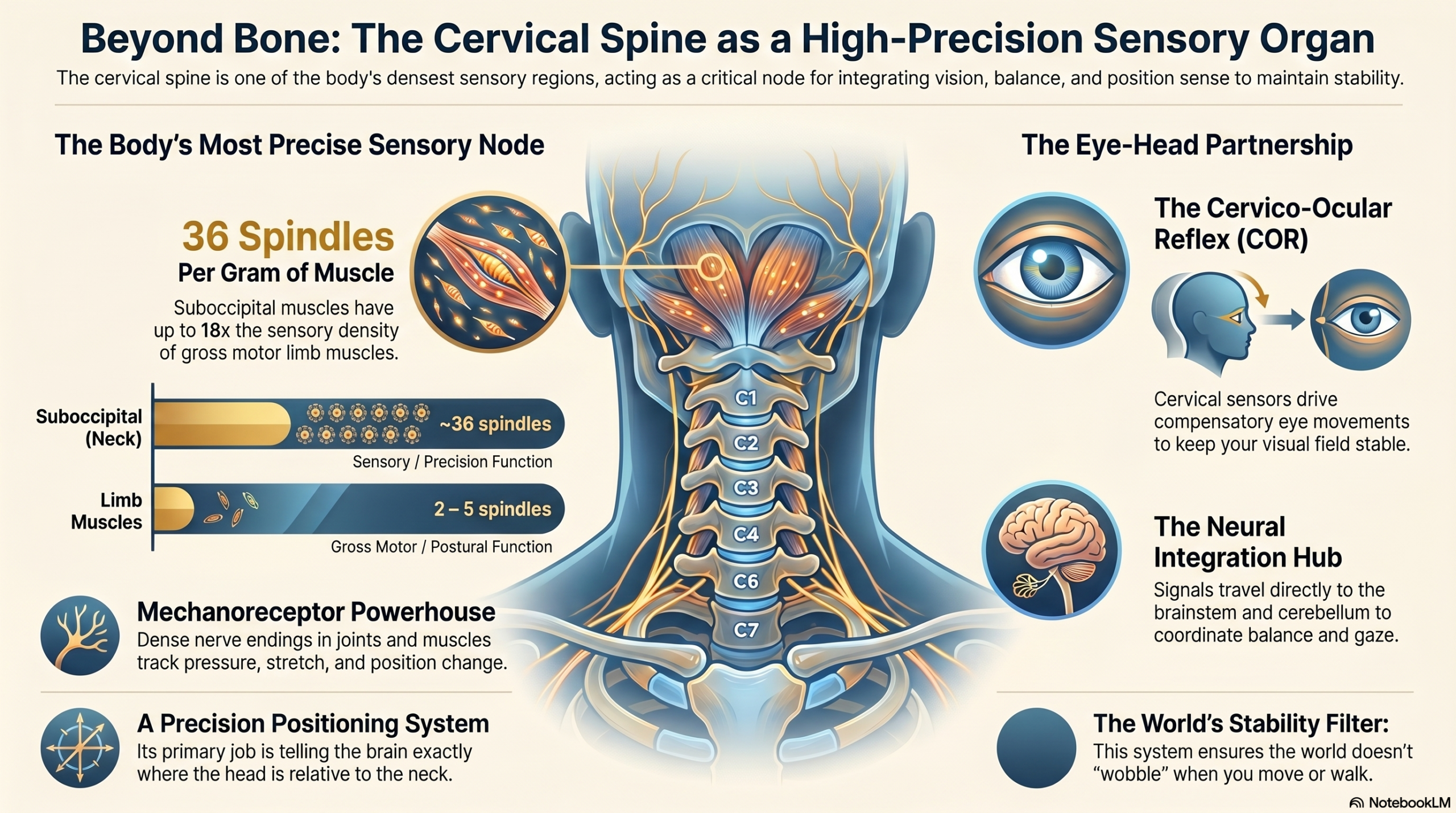
Why would four small muscles at the base of the skull need thirty-six spindles per gram? Because those muscles are not primarily postural stabilizers. They are sensory organs. Their dominant function is to tell the brain, with extreme precision, where the head is positioned relative to the neck at every moment of every movement. That information feeds into a set of reflex arcs — the cervico-ocular reflex, the cervico-collic reflex, and the tonic neck reflex — that coordinate the eyes, the balance system, and the rest of the body around the head’s orientation in space.
The long spinothalamic and spinocerebellar tracts that carry this information travel directly to the vestibular nuclei in the brainstem, to the cerebellum, and to the cortex. The cervical spine is not just a structural column. It is a critical node in the sensory network that keeps you upright, keeps your gaze steady, and keeps the world looking stable while your body moves through it.
The Eye-Head Partnership
To understand why Elena’s world had a wobble, it helps to understand what the eye-head partnership actually involves.
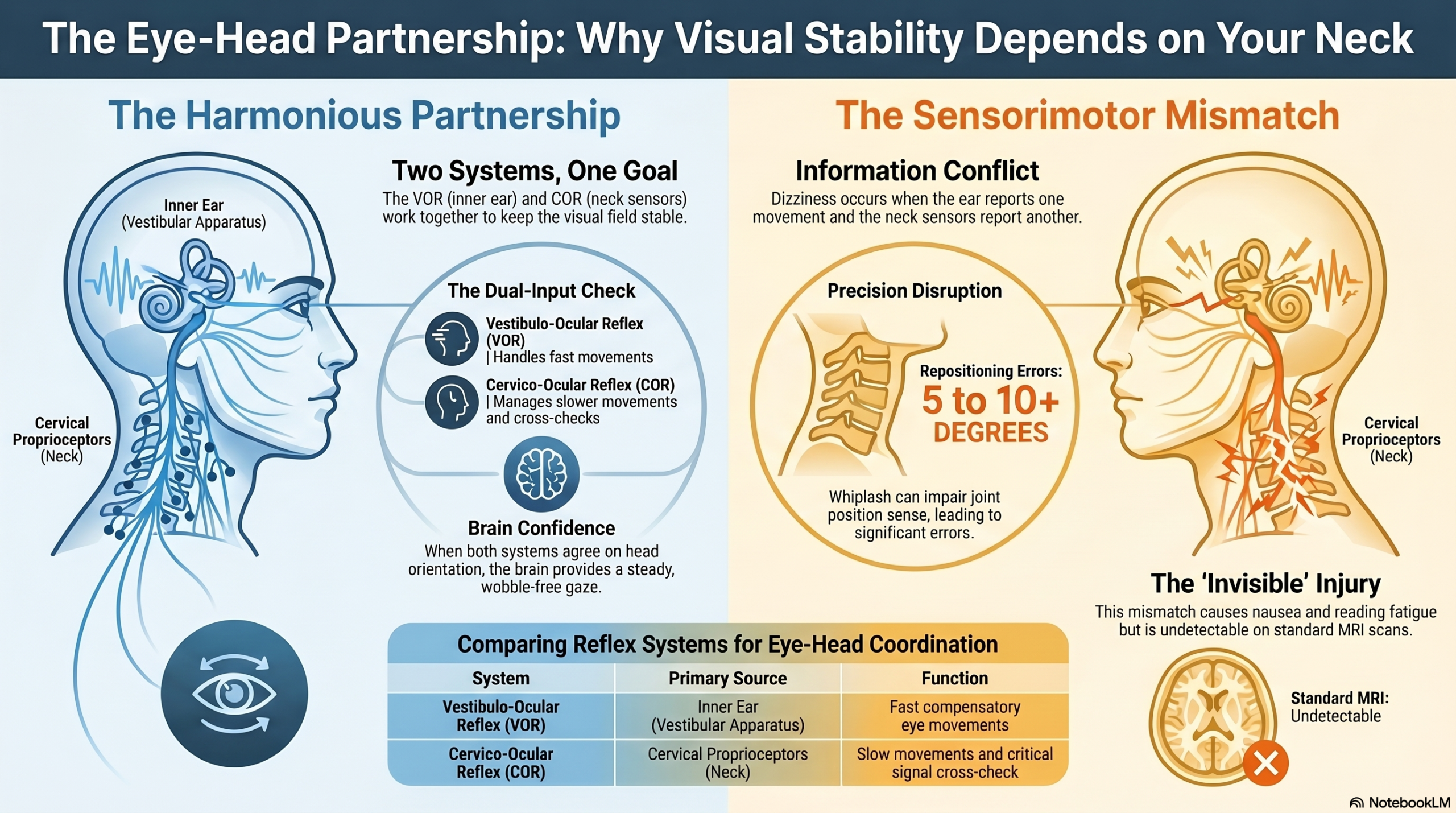
When you turn your head, your eyes need to move in the opposite direction at exactly the right speed and amplitude to keep the visual field stable. This is accomplished by two coupled reflex systems: the vestibulo-ocular reflex (VOR) and the cervico-ocular reflex (COR). The VOR uses input from the vestibular apparatus — the fluid-filled canals of the inner ear — to drive compensatory eye movements. The COR uses input from the cervical proprioceptors — primarily the suboccipital muscles and the facet joint capsules — to do the same thing.
In a healthy nervous system, these two systems work together seamlessly. The vestibular system is fast and handles rapid head movements. The cervical proprioceptive system handles slower movements and provides a critical cross-check. When both systems agree about how the head is moving, the brain is confident, the visual field stays stable, and you can read a menu, walk a grocery store aisle, or ride in a car without nausea.
When they disagree — when the vestibular system says the head moved four degrees and the cervical proprioceptors say it moved seven degrees — the brain receives a sensorimotor mismatch signal. That mismatch feels like dizziness. It can produce nausea. It can make stationary objects appear to shift. It produces the exact symptom picture that Elena described and that her neurological testing could not find, because standard neurological testing does not test the cervico-ocular reflex.
This is not a theoretical construct. Joan Treleaven and colleagues at the University of Queensland have produced some of the most important clinical research on cervicogenic sensorimotor disturbances, demonstrating repeatedly that people with chronic whiplash-associated disorders show measurable deficits in cervical joint position sense, smooth pursuit eye tracking, and postural stability — deficits that are not present in people with non-traumatic neck pain and that correlate specifically with the traumatic origin of the injury.
PMID 17904868 — Treleaven J. Man Ther. 2008.
Individuals with whiplash-associated disorders demonstrate measurable deficits in cervical joint position sense, smooth pursuit eye movement, oculomotor control, and postural stability compared to both healthy controls and people with non-traumatic neck pain. These deficits reflect disruption of cervical sensorimotor function specifically associated with trauma.
What Whiplash Does to These Sensors
The forces involved in a rear-end collision are transferred to the cervical spine in a characteristic pattern. The lower cervical spine is forced into extension while the upper cervical spine simultaneously flexes — an S-shaped deformation that occurs within approximately 100 milliseconds of impact and is over before the occupant can consciously respond. The maximum tissue strain occurs at the facet joints of C4 through C7, and at the suboccipital segment.
For structural tissues — bone, disc, ligament — this loading pattern is well understood. What is less widely discussed is what it does to the sensory tissues.
The muscle spindles inside the suboccipital muscles are stretch-sensitive transducers. They are designed to respond to slow, controlled stretching during normal movement. The eccentric loading that occurs during whiplash — a rapid, forceful stretch that exceeds the protective range of the tissue — can produce a specific type of spindle injury that has been documented in animal models and is consistent with what we observe clinically in post-whiplash patients.
Mats Panjabi, the Yale biomedical engineer whose work on spinal stability has been foundational to the field, proposed a model in which the proprioceptive tissues of the cervical spine — specifically the mechanoreceptors in the facet capsules and the muscle spindles in the deep cervical muscles — can be injured at force levels below what is required to damage structural tissues like bone or disc. In his neutral zone model, small injuries to the mechanoreceptor population alter the quality of sensory feedback, which in turn alters muscle activation patterns, which in turn places the joint under greater mechanical stress during ordinary movement — a self-reinforcing cycle that can perpetuate symptoms long after the acute inflammatory phase has resolved.
PMID 1490034 — Panjabi MM. J Spinal Disord. 1992.
The spinal stabilizing system depends on three interacting subsystems: the passive osteoligamentous spine, the active musculotendinous system, and the neural control system. Injury or dysfunction in any of these — including the sensory receptors that provide feedback to the neural control system — can destabilize the entire system even when structural tissues appear normal on imaging.
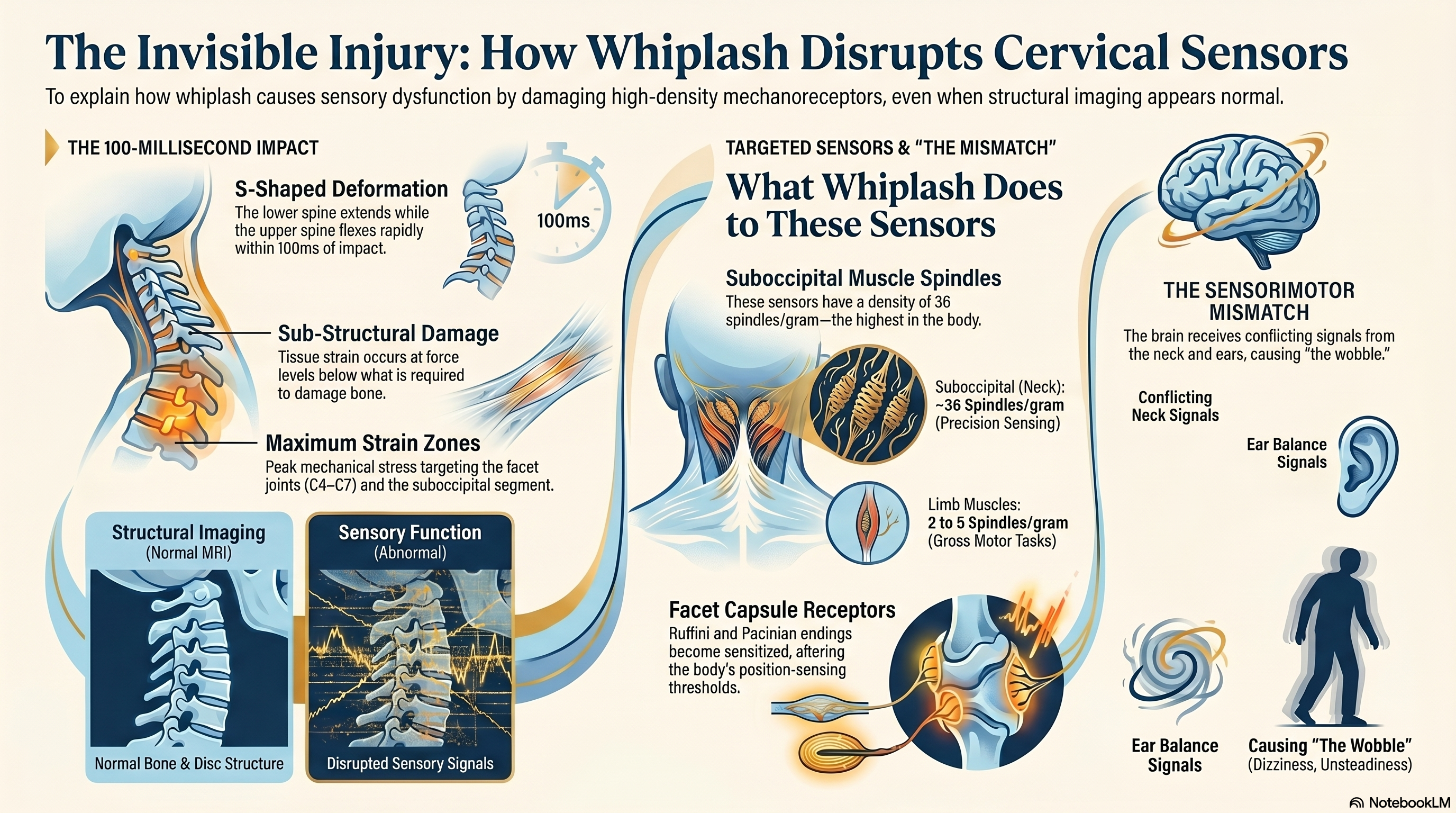
The facet joint capsules contain a high density of Ruffini endings and Pacinian corpuscles — encapsulated mechanoreceptors that respond to joint position and rate of movement change. These receptors feed directly into the reflex arcs that coordinate head and eye movement. When the capsule is stretched beyond its normal range, as it is during a whiplash loading event, the mechanical distortion can alter receptor threshold, sensitize the receptor population, or disrupt the precise calibration that normal sensorimotor function requires.
What makes this injury pattern particularly difficult to detect is that it is invisible on standard imaging. An MRI can show disc herniation, cord compression, ligament rupture, or bone marrow edema. It cannot show a muscle spindle that is no longer firing with the right timing, or a facet capsule receptor that has become mechanically sensitized. The imaging is normal. The sensory function is not.
The Symptoms No One Explains
Elena’s symptom picture — dizziness, visual instability, nausea in moving vehicles, unsteadiness in busy environments — is one of the most consistent and most frequently undiagnosed presentations in post-whiplash care. It has several names in the clinical literature: cervicogenic dizziness, cervical vertigo, post-whiplash sensorimotor syndrome, and — most precisely — whiplash-associated oculomotor and proprioceptive dysfunction.
The dizziness is not the rotational dizziness of benign paroxysmal positional vertigo (BPPV), which is caused by displaced calcium crystals in the inner ear. It is not the vertigo of Ménière’s disease, which involves endolymphatic pressure. It is the subtle, persistent sense of unsteadiness that comes from a mismatch between what the vestibular system is reporting and what the cervical proprioceptors are reporting — two information streams that normally agree with each other and now do not.
The visual symptoms — difficulty tracking moving objects, increased effort required for sustained reading, slight apparent movement of stationary objects — are the direct consequence of the cervico-ocular reflex mismatch described above. The brain depends on continuous, precisely calibrated input from the cervical proprioceptors to drive compensatory eye movements. When that input is degraded, the visual field is not fully stabilized. The effect is subtle enough that it doesn’t manifest as obvious visual blur, but it imposes a cognitive and attentional load that the person experiences as fatigue, difficulty concentrating, and what is sometimes described as “brain fog.”
The nausea in moving vehicles is a particularly instructive symptom. Motion sickness — the ordinary kind — occurs when vestibular input (the body is moving) conflicts with visual input (the visual field appears stationary because the person is looking at the inside of the car). The post-whiplash version adds a third element to the conflict: cervical proprioceptive input that is already miscalibrated. The brain is trying to reconcile three information streams that don’t agree, and the autonomic response to that unresolvable conflict is nausea.
These symptoms are almost never explained to patients. They are told their MRI is normal, their vestibular tests are normal, their neurological exam is normal. No one explains that there is a category of sensory dysfunction that standard testing is not designed to detect, and that this dysfunction is a well-documented consequence of the forces applied to the cervical spine during a rear-end collision. The result is that patients like Elena end up wondering whether their symptoms are psychological — not because they are, but because no one has given them a mechanistic account of what is actually wrong.
The tissue that is sensitive enough to detect a position error of three degrees is sensitive enough to be disrupted by a loading event that produces no visible structural damage. The fragility and the gift are inseparable.
The Research: Five Lines of Evidence
1. Cervical proprioceptive deficits are measurable and specific to whiplash
The cervical joint position error test — in which the patient wears a laser pointer headset, moves the head to a target position, returns to neutral, and attempts to relocate the target — is a validated clinical measure of cervical proprioceptive accuracy. In healthy individuals, the repositioning error is typically less than 4.5 degrees. In people with chronic whiplash-associated disorders, errors of 5 to 10 degrees or more are common.
Treleaven, Jull, and Sterling published a landmark study in 2003 documenting that dizziness and unsteadiness in whiplash patients was specifically associated with impaired cervical joint position sense — not with vestibular pathology, not with anxiety, and not with the severity of the initial structural injury. The cervical proprioceptive deficit was the distinguishing variable.
PMID 12937025 — Treleaven J, Jull G, Sterling M. J Rehabil Med. 2003.
Dizziness and unsteadiness in whiplash patients were significantly associated with impaired cervical joint position sense, measured by laser repositioning error. The relationship was specific to traumatic whiplash and was not explained by vestibular pathology or psychological factors.
2. Eye movement control is disrupted after whiplash
Smooth pursuit eye tracking — the ability to follow a slowly moving target with the eyes while holding the head still — depends on intact coordination between the visual system, the vestibular system, and the cervical proprioceptive system. Post-whiplash patients show consistent deficits in smooth pursuit accuracy. They also show increased gaze instability during static head postures, suggesting that the resting proprioceptive output from the cervical muscles is aberrant even when the head is not moving.
A comprehensive review by Treleaven in 2008 synthesized the evidence across multiple studies and concluded that sensorimotor disturbances — including oculomotor dysfunction, postural instability, and cervical joint position error — were a consistent feature of whiplash-associated disorders and should be assessed systematically in post-whiplash evaluation.
3. Deep cervical muscle dysfunction alters sensory output
The deep cervical flexors — longus colli and longus capitis — are the functional partners of the suboccipital muscles in the cervical sensorimotor system. After whiplash, these muscles consistently show delayed activation, reduced endurance, and altered recruitment patterns compared to both healthy controls and patients with non-traumatic neck pain. Gwendolen Jull and colleagues at the University of Queensland have documented this pattern across multiple studies using fine-wire electromyography and the craniocervical flexion test.
PMID 12553500 — Sterling M, Jull G, Vicenzino B, Kenardy J, Darnell R. Pain. 2003.
Motor system dysfunction — including altered activation of the deep cervical flexors and increased superficial muscle activity — developed progressively following whiplash injury and was more severe in patients who developed chronic symptoms. These changes were not present in non-traumatic neck pain, indicating a trauma-specific disruption of cervical motor control.
The loss of deep cervical flexor control is not merely a weakness problem. These muscles are packed with muscle spindles, and their activation pattern contributes critically to the quality of the proprioceptive signal reaching the brainstem. When they are inhibited — as they reliably are after whiplash — the proprioceptive information entering the cervical-vestibular-ocular integration system becomes less accurate and less reliable.
4. The autonomic nervous system is altered after whiplash
The upper cervical spine has a direct anatomical relationship with the sympathetic nervous system through the superior cervical ganglion and the vertebral artery plexus. Irritation or dysfunction in the upper cervical segment can affect autonomic regulation, producing symptoms including heart rate variability changes, altered sudomotor function, and thermal dysregulation.
Sterling and colleagues documented autonomic nervous system changes in whiplash patients — specifically, altered sympathetic nervous system responsivity — that were present early after injury and correlated with poor outcome. Patients who went on to develop chronic symptoms showed greater autonomic dysregulation at the time of initial assessment than those who recovered. This finding supports the idea that the cervical injury is not confined to the structural or sensorimotor systems but extends into the autonomic regulation network that runs through the same anatomical territory.
PMID 12927623 — Sterling M, Jull G, Vicenzino B, Kenardy J. Pain. 2003.
Early post-whiplash assessments revealed altered sympathetic nervous system responses — including changes in pressure pain thresholds and thermal sensitivity — that predicted poor long-term outcomes. These autonomic changes were not present in patients with non-traumatic neck pain, marking them as a specific signature of the traumatic injury mechanism.
5. Targeted rehabilitation of cervical sensorimotor function improves outcomes
The reversibility of cervical proprioceptive dysfunction is well established. When treatment specifically targets the sensorimotor components of the injury — cervical joint repositioning exercises, smooth pursuit training, gaze stability exercises, and progressive loading of the deep cervical flexors — outcomes are substantially better than when treatment addresses only pain and range of motion.
Röijezon and colleagues reviewed the evidence base for proprioceptive rehabilitation in musculoskeletal conditions and concluded that cervical sensorimotor training was both feasible and effective, with consistent improvements in joint position sense, postural stability, and self-reported symptoms in post-whiplash populations.
PMID 25703454 — Röijezon U, Clark NC, Treleaven J. Man Ther. 2015.
Proprioceptive rehabilitation targeting cervical sensorimotor function — including joint repositioning practice, gaze stabilization training, and deep cervical flexor activation — produced consistent improvements in position sense accuracy, postural stability, and clinical outcomes in patients with whiplash-associated disorders.
The Fragility That Is Also a Gift
There is a quality to the cervical spine’s sensory organization that deserves acknowledgment before we get to the clinical section. The density of mechanoreceptors in the suboccipital muscles — thirty-six spindles per gram, more than almost anywhere else in the body — did not evolve by accident. It reflects the extraordinary precision that the nervous system requires from this particular piece of anatomy.
Think about what the cervical spine is managing. It has to track the head’s position in three dimensions, continuously, at resolutions fine enough to guide the eye movements that allow you to read a single line of text, the balance adjustments that allow you to walk across an uneven surface, and the postural coordination that allows you to reach for an object while your head is turning. This is not a crude structural function. It is a precision sensing operation that runs continuously in the background of every waking moment.
That precision is why whiplash is, at its core, a sensory injury as much as a structural one. The same biological investment that allows us to thread a needle, track a moving object, or feel the exact pressure of a handshake is the investment that becomes vulnerable when the cervical spine is suddenly loaded beyond its operating range. The fragility and the gift are inseparable. The tissue that is sensitive enough to detect a vibration of three micrometers is sensitive enough to be disrupted by a collision force that produces no visible structural damage at all.
This is also why the “clean MRI” argument — the implicit suggestion that normal imaging means no significant injury — is so clinically and scientifically indefensible. An MRI cannot image a muscle spindle. It cannot measure the firing threshold of a mechanoreceptor population. It cannot quantify the error in a cervico-ocular reflex arc. The absence of structural damage on imaging has never been a meaningful statement about the integrity of the sensory system.
What This Looks Like in Clinic
When a patient with dizziness, visual disturbance, or unsteadiness comes into our Petaluma clinic following a motor vehicle collision, the evaluation is organized around a different set of questions than the ones being asked by the neurologist or the ENT.
The cervical joint position sense test. We use a laser pointer headset to quantify repositioning error across the three planes of movement — flexion/extension, lateral flexion, and rotation. A consistent error greater than 4.5 degrees suggests proprioceptive dysfunction. We note whether the error pattern correlates with the patient’s symptom pattern — whether the movements that produce the most error are the same movements that provoke their dizziness.
Smooth pursuit and gaze stability assessment. We observe the quality of eye tracking during slow target movement, looking for saccadic intrusions — the micro-jerks that indicate the pursuit system is struggling to maintain smooth tracking. We test gaze stability: can the patient hold a fixed gaze target while making head movements, and does the effort provoke symptoms? We compare eye movement quality with the head fixed versus with gentle cervical perturbation, to identify whether the cervical input is contributing to the dysfunction.
The craniocervical flexion test. Developed by Jull and colleagues, this test assesses the activation pattern of the deep cervical flexors using pressure biofeedback. We look for the ability to perform graded, incremental segmental flexion using the longus colli and longus capitis without substitution from the superficial sternocleidomastoid and scalenes. Failure to activate these muscles at the correct stage is one of the most consistent findings in post-whiplash evaluation.
Cervical segmental mobility and neurodynamic assessment. We palpate and assess segmental movement through the upper cervical spine, looking for the stiffness, guarding, and altered tissue texture that are the clinical signatures of mechanical dysfunction in the C0–C2 region. We assess whether suboccipital palpation reproduces any of the patient’s dizziness or visual symptoms.
Postural stability under dual-task conditions. We test standing balance with eyes open and closed, on stable and unstable surfaces, and — critically — while performing a cognitive task. The cervical sensorimotor system is most stressed when attentional resources are split, and the dual-task instability is often the most clinically informative finding.
Treatment. For Elena, the treatment plan involved four overlapping components. First, manual therapy to the upper cervical segment, specifically targeting the restricted mobility and altered tissue tone in the suboccipital region. Second, deep cervical flexor rehabilitation using graded craniocervical flexion exercises to restore the activation quality of the longus colli and longus capitis. Third, gaze stability and smooth pursuit training — progressively more demanding oculomotor tasks performed with controlled cervical movement. Fourth, progressive sensorimotor integration training — head-on-trunk repositioning practice, balance on unstable surfaces, and eventually dual-task balance with visual tracking components.
Elena required eleven treatment sessions over nine weeks. Her laser repositioning error dropped from a consistent 8 degrees to 3 degrees. Her smooth pursuit saccadic intrusion frequency normalized. She could read a menu without difficulty. She could ride in a car. The wobble was gone.
She told me at her last visit that what she found most helpful was not the exercises — though she felt those had worked — but being told, for the first time, what was actually wrong. She had spent fourteen months being told that her tests were normal. What she needed was someone to explain that a normal MRI and a normal vestibular test and a normal neurological exam were entirely consistent with a cervical sensorimotor injury — that there was a specific, documented mechanism for her specific, documented symptoms — and that it was treatable.
The Takeaway
The cervical spine is not just a structural element of the musculoskeletal system. It is a sensory organ of extraordinary precision, packed with mechanoreceptors whose primary job is to tell the brain where the head is, how fast it is moving, and how to coordinate the eyes and balance system around that information in real time.
When that sensory system is disrupted — and whiplash is one of the most efficient ways to disrupt it — the consequences extend far beyond the neck. They extend into vision. Into balance. Into nausea. Into cognitive function. Into the quality of every movement the body makes. And they do so without leaving a mark on any standard imaging study.
The fragility and the gift are the same thing. The tissue that is sensitive enough to detect a position error of three degrees is sensitive enough to be disrupted by a loading event that produces no visible structural damage. The same biological investment that allows the finest sensory discrimination in the body is the investment that becomes vulnerable under traumatic force.
If you have been in a collision and you are experiencing dizziness, visual disturbance, unsteadiness, or nausea that no one has been able to explain, the explanation is almost certainly not anxiety and it is almost certainly not imaginary. It is the consequence of a precision sensory system that was built to be sensitive — and was.
What to Do Now
If you are experiencing dizziness, difficulty with visual tracking, nausea in moving vehicles, or unsteadiness following a motor vehicle collision — even one where your MRI was normal — book a cervical sensorimotor evaluation. These symptoms have a specific, treatable mechanical origin. In our Petaluma clinic, this evaluation is a standard part of post-collision care.
The nervous system can be recalibrated. The proprioceptors can be retrained. The cervico-ocular reflex can be restored to its normal precision. This is not a passive process — it requires specific, targeted rehabilitation — but it is a reliable one. The body that was sensitive enough to be disrupted is, with the right guidance, sensitive enough to find its way back.
References
- Boyd-Clark LC, Briggs CA, Galea MP. Muscle spindle distribution, morphology, and density in longus colli and multifidus muscles of the cervical spine. Spine. 2002. PMID 11818924.
- Treleaven J. Sensorimotor disturbances in neck disorders affecting postural stability, head and eye movement control. Man Ther. 2008. PMID 17904868.
- Treleaven J, Jull G, Sterling M. Dizziness and unsteadiness following whiplash injury: characteristic features and relationship with cervical joint position error. J Rehabil Med. 2003. PMID 12937025.
- Panjabi MM. The stabilizing system of the spine. Part I. Function, dysfunction, adaptation, and enhancement. J Spinal Disord. 1992. PMID 1490034.
- Sterling M, Jull G, Vicenzino B, Kenardy J, Darnell R. Development of motor system dysfunction following whiplash injury. Pain. 2003. PMID 12553500.
- Sterling M, Jull G, Vicenzino B, Kenardy J. Sensory hypersensitivity occurs soon after whiplash injury and is associated with poor recovery. Pain. 2003. PMID 12927623.
- Röijezon U, Clark NC, Treleaven J. Proprioception in musculoskeletal rehabilitation. Part 1: Basic science and principles of assessment and clinical interventions. Man Ther. 2015. PMID 25703454.