Key Takeaway
Muscle is not a vanity tissue. It is a metabolic organ and a mobility insurance policy. The goal is to build high-quality, symmetric, functional muscle so you keep strength, power, and independence for decades.
I used to think “muscle” was mostly about aesthetics and performance. I thought of it as something you built when you were young, something you tried to keep if you cared about sports, and something you accepted you would lose as you got older.
Then I listened to a long, deeply practical lecture by muscle physiologist Andy Galpin. It was the kind of talk that doesn’t just give you a list of exercises. It gives you a new way to see the body. Galpin spends his career studying muscle from the cellular level down to the molecular level, including invasive research techniques like muscle biopsies, single-fiber analysis, and 3D imaging. In other words, the claims are not coming from “gym culture.” They are coming from a lab that has cut muscle open, measured it, mapped it, and followed what changes when people train.
What hit me most was not any one statistic. It was the central thesis: if you have healthy muscle, you have a strong chance to be healthy; if you don’t, you are in trouble. That statement applies to world-class athletes, to working adults, to older adults focused on longevity, and to anyone who wants to keep their mind and body resilient under real life.
Attention: The Moment You Realize Muscle Is Not Just “Strength”
Imagine this: a tiny chunk of muscle tissue that was inside someone’s thigh 90 seconds ago is now sitting in a dish, and you can see individual fibers with the naked eye. You can pull one fiber out at a time. You can image it in 3D. You can literally count the nuclei that hold DNA and drive repair and growth.
That is how Galpin’s lab (and many others like it) builds confidence that training recommendations are not superstition. You can see what changes. You can track muscle quality, not just how someone “feels.”
Most people, when asked about muscle, default to three frames:
- Look: muscle equals physique.
- Feel: muscle equals tightness, pain, or stiffness.
- Performance: muscle equals sports.
All of those are real. But they are incomplete. The last five years of research have expanded the muscle conversation into something much larger: mental health, metabolic health, recovery capacity, immune function, hormones, cognitive decline risk, and mortality risk.
That expansion creates a new question: if muscle is doing all of that, what does “healthy muscle” actually mean?
Need: The Real Problem Is Not Aging. It Is a Shrinking Strength Buffer.
There is a common narrative that aging is mostly out of your hands: you get older, you slow down, you get weaker, you accept it.
The problem is that weakness is not just an inconvenience. It is often a turning point. Once you drop below the strength required for everyday life, everything else becomes harder:
- Getting off the floor becomes a risk.
- Recovering from illness takes longer.
- A small fall becomes a catastrophic event.
- Chronic pain becomes more limiting.
- Metabolic health becomes harder to manage.
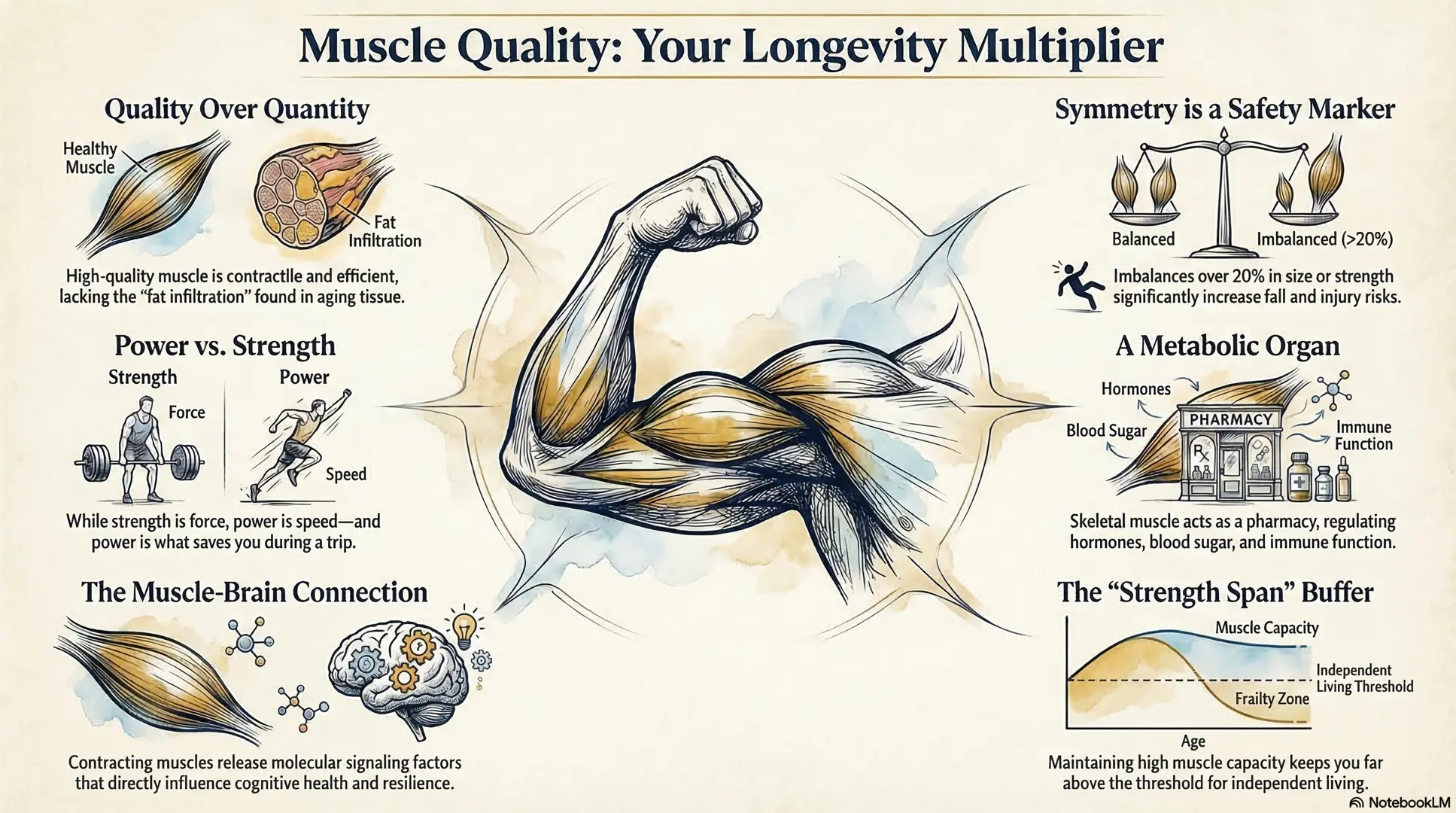
Galpin uses the phrase “strength span”: not just how long you live, but how long you live with enough strength to do what you want. A useful way to picture it is a line: if the minimum strength needed for independent living sits at a certain threshold, you want your capacity line far above it for as long as possible. That buffer is what makes a person hard to break.
Here is the uncomfortable part. Muscle loss is common. But the loss of power is often faster. And power is the thing that saves you when you trip, slip, or need to catch yourself. That means you can feel “fine” and still be quietly losing the most protective capability you have.
Satisfaction: The Four Dimensions of Muscle Health (Size, Symmetry, Quality, Function)
In the talk, the most useful practical framework is this four-part model. It turns the vague idea of “muscle health” into measurable targets.
1) Size: how much muscle should you have?
There is strong research linking muscle mass to health outcomes. But it is easy to misunderstand the data if you do not separate muscle from body size. Some studies that claim “too much muscle is harmful” are actually comparing obese individuals (who can have higher absolute lean mass) against healthier populations. When you isolate the variable properly, the practical conclusion becomes simpler: if you can build and maintain muscle through training and a healthy lifestyle, more is generally better until you hit a plateau of benefit.
Practically, one way people assess this is with a DEXA scan. It is widely available, relatively affordable, and it can show an estimate of lean mass distribution. DEXA is not “the truth,” but it can be a useful baseline and a way to track change over time.
2) Symmetry: does one side lag behind the other?
No one is perfectly symmetrical. Handedness is normal. Skill dominance is normal. But large asymmetries in muscle size or performance can be a warning sign, especially for the lower body.
One point from the talk stands out: small differences in function are often less concerning than meaningful differences in size. In other words, it is normal to be slightly stronger or more coordinated on one side. But if a major muscle group is substantially smaller on one side than the other, that can increase risk.
Grip strength is one of the simplest screening tools. Even more interesting than raw grip strength is grip strength asymmetry. Recent research has linked grip asymmetry to fall risk and functional impairment in aging populations.
3) Quality: what is your muscle made of?
This is the “future” category, and it matters more than most people think. Two people can have the same lean mass but different muscle quality. One can have more connective tissue and fat infiltration within the muscle itself (think “marbling”), and that person tends to have worse functional performance and higher health risk.
The key insight is that muscle quality is not the same as being lean in general. It is possible to be relatively lean and still have meaningful fat infiltration in specific muscles, especially after injury, inactivity, or aging-related changes.
High-quality muscle is tissue that is contractile, efficient, and well-organized. Low-quality muscle is tissue that is increasingly “filled in” with fat and scar-like connective tissue. Functionally, that changes force production and movement economy.
4) Function: are you strong and powerful enough for real life?
Function includes strength, endurance, balance, coordination, and power. In research, grip strength has been studied heavily because it is fast, cheap, and correlates with many outcomes. But the talk emphasizes an additional point: lower-body power is critical because it ties directly to mobility and fall prevention.
If you want the simplest test that reflects real life, sit-to-stand performance is one option. It does not require fancy equipment, and it connects to how well you can stand up, stabilize, and move through the world.
What the New Research Suggests: Muscle Is Connected to Brain Health
One of the most compelling themes in recent research is that the muscle–brain connection is not only correlation. Increasingly, researchers are identifying causal mechanisms, including molecular signaling pathways where contracting skeletal muscle releases factors that influence brain function.
You do not need to be a molecular biologist to benefit from this. You only need to see the strategic implication:
If you want your brain to hold up, your muscle has to hold up.
This is why strength training is not “optional self-improvement.” It is foundational maintenance for a system that is designed to communicate internally.
Strength Training: The Closest Thing to a Broad-Spectrum “Anti-Aging Drug”
One reason the muscle conversation is so persuasive is that resistance training has an enormous research base. Galpin notes that there are tens of thousands of papers on resistance exercise and health outcomes. Across that body of literature, resistance training is associated with lower risk of major chronic diseases and improved function, even when controlling for aerobic exercise.
Here is the bigger point: people often think strength training “just builds muscle.” But the downstream benefits include improvements in many systems:
- Metabolic health markers
- Blood flow and endothelial function
- Inflammatory profiles
- Pain and arthritis outcomes in many populations
- Mitochondrial density and function within muscle
When you line up the diseases most associated with aging and then compare them with the direction of change seen with resistance training, the overlap is striking. This is why people who want longevity should treat resistance training as a “non-negotiable,” not as an optional hobby.
The Cardio-Only Trap: Why Active People Can Still Get Weak
Some of the most surprising research comes from studies of lifelong endurance training. Endurance exercise is beneficial in many ways. But endurance training does not reliably preserve the muscle features most associated with strength and power, especially as aging progresses.
The practical problem is simple: you can be “fit” and still be weak. You can have good aerobic capacity and still have insufficient force production to protect joints, stabilize movement, and prevent falls.
Endurance Training
Strong for heart and metabolic markers. Often insufficient for maintaining maximal strength and power across decades.
Resistance Training
Directly preserves strength, power, and muscle quality. Acts as structural “armor” for mobility and aging resilience.
The best longevity plan is not “cardio versus strength.” It is cardio plus strength, with power preserved intentionally.
Mechanical Tension: The Core Driver of Muscle Growth (and Why You Don’t Need Perfect Programming)
Fitness culture loves complexity. The research story is simpler: the main driver of hypertrophy is mechanical tension. If muscle fibers are contracting under meaningful load and the work is progressed over time, muscle adapts.
This matters because it protects you from “over-optimization.” You do not need a perfect split, the perfect rep range, or the perfect exercise selection to get real results. You need a plan that is:
- Safe for your current level
- Progressive over time
- Repeatable week after week
It also protects you from misinformation. For example, the talk pushes back against the idea that women must drastically change training style across different phases of the menstrual cycle for muscle growth. If symptoms require adjustment, adapt. But the fundamentals do not change: mechanical tension, progressive loading, and consistency.
Asymmetry: How to Address It Without Becoming Neurotic
Predicting injury is notoriously hard because injuries have many causes. You can have perfect symmetry and still get injured if something external happens (for example, someone landing on your ankle in sports). But that does not mean asymmetry is irrelevant. It means asymmetry is one risk factor among many.
A useful practical heuristic from the broader literature is this:
- If you are over 20% asymmetrical in size, strength, power, or quality (especially in the legs), treat it as actionable.
- If you are around 10%, context matters, but it can still matter for performance.
If you are trying to perform at a high level, the threshold is stricter. Asymmetry costs efficiency. If you burn more energy for the same output, you fatigue faster. In sport, that matters. In life, it shows up as “things feel harder than they should.”
Correcting asymmetry is often boring:
- Improve movement quality and positioning.
- Use unilateral work (split squats, single-leg RDLs, single-arm pressing/rowing).
- Add slightly more volume to the weaker side.
- Keep getting stronger overall, because weakness amplifies imbalance.
Muscle Power: The “Need for Speed” That Most People Ignore
Strength is important. But power is often the limiter. Power declines faster with age. World records in sprinting and explosive sports tend to belong to younger athletes, while endurance performance can stay competitive later. That contrast is a clue: power is fragile.
For longevity, this creates a strategy: you do not train power because you want to dunk a basketball. You train power because you want to keep the ability to move fast, stabilize fast, and recover fast when life surprises you.
Power training does not have to be reckless. It can be safe and scaled. Examples include:
- Fast concentric intent on leg presses or squats
- Step-ups performed explosively with control
- Sled pushes
- Low-level jumps or hops (only if appropriate for joints and skill)
Exercise Snacks: The Minimum Effective Dose When Life Is Chaotic
If you are busy, tired, or overwhelmed, there is a concept worth stealing: resistance exercise snacks. These are short daily bouts (often around 10 minutes) of basic movements that can produce measurable improvement in previously sedentary adults.
Did You Know
If you can give ten minutes a day of consistent resistance work, you can change your strength trajectory. You might not get “jacked,” but you can get meaningfully harder to break.
A simple snack routine looks like this:
- 10 sit-to-stands or squats
- 10 incline push-ups
- 10 band rows
- 10 hip hinges (light kettlebell or dumbbell)
Repeat it five days a week. Progress by making the movement harder, adding load, or adding a second round. The aim is not perfection. The aim is momentum.
Visualization: Two Futures You Can Choose
Let me make this personal and concrete. Picture two versions of you ten years from now.
You build muscle size, symmetry, quality, and function
- You keep a buffer of strength above daily demands.
- You recover faster from illness and stress.
- You move with more confidence.
- You are less likely to fall, and more likely to catch yourself if you do.
- You feel more capable in your own body.
You neglect those four dimensions
- Normal tasks gradually cost more effort.
- You get injured more easily and recover more slowly.
- Your metabolic health becomes harder to manage.
- A fall becomes more likely, and more expensive.
- You spend more time “managing decline” than building capacity.
Aging happens either way. But the experience of aging is negotiable.
Action: A Simple Weekly Training Template (Built From the Four-Part Model)
If you want a simple plan aligned with the talk’s themes, here is a template. Adjust it to your level, injuries, and preferences.
Strength (2–4 days/week)
- Lower body push: squat, leg press, split squat
- Lower body hinge: deadlift pattern, RDL, hip thrust
- Upper body push: press pattern (dumbbells, barbell, machines)
- Upper body pull: row and pull-down/pull-up patterns
- Accessory unilateral: 1–2 movements to reduce asymmetry
Power (1–2 days/week, often paired with strength)
- Fast concentric intent on a safe lower-body movement
- Short bouts of sled pushing or step-up power work
Endurance (2–4 days/week)
- Zone 2 work (walk, bike, incline treadmill)
- Optional intervals based on goals
Assessment (every 12 weeks)
- Grip strength left vs. right (or a simple unilateral strength proxy)
- Sit-to-stand time or reps
- Subjective: energy, confidence, joint tolerance
The simplest success metric: are you getting stronger over time, and are your side-to-side differences narrowing rather than widening?
Conclusion: “Just Keep Lifting” Is Not a Cliché. It Is a Strategy.
At the end of the talk, the most honest takeaway was also the simplest: keep lifting.
Not because everyone needs to chase aesthetics. Not because everyone needs to be an athlete. But because healthy muscle is one of the strongest predictors of how well you will live in the future.
If you want to treat your future self with respect, build tissue quality now. Build symmetry now. Build power now. Those are the capabilities that keep your options open later.
Important
If you are starting from zero or returning after injury, the smartest move is not intensity. The smartest move is consistency and progressive ramp-up.
References and Research Notes (Selected PubMed Studies)
Below are peer-reviewed PubMed-indexed studies that reinforce the main claims in this article.
Resistance training and reduced mortality / major disease risk
- Resistance Training and Mortality Risk: A Systematic Review and Meta-Analysis (systematic review/meta-analysis). Findings support an association between resistance training and lower all-cause, CVD, and cancer mortality.
- The association of resistance training with mortality: A systematic review and meta-analysis (systematic review/meta-analysis). Reports lower mortality risk with resistance training, especially when combined with aerobic exercise.
- Muscle-strengthening activities are associated with lower risk and mortality in major non-communicable diseases (systematic review/meta-analysis; PubMed-indexed, full text). Reports lower risk of all-cause mortality, CVD, total cancer, diabetes, and more with muscle-strengthening activity.
Strength training and glycemic control (HbA1c)
- Effect of resistance training on HbA1c in adults with type 2 diabetes (systematic review/meta-analysis). Reports a statistically significant reduction in HbA1c with resistance training.
Strength vs. mass (why function matters)
- Associations of Muscle Mass and Strength with All-Cause Mortality among US Older Adults (observational, full text). Shows mortality risk is strongly related to low strength, even when low mass is not present.
Grip strength asymmetry as a functional risk marker
- Handgrip Strength Asymmetry Is Associated with Future Falls in Older Americans (observational, full text). Reports higher odds of future falls with greater handgrip asymmetry.
- Handgrip strength asymmetry increases risk of all-cause and cardiovascular mortality (dose-response analysis across multiple countries). Finds even minor asymmetry is linked to higher mortality.
Muscle quality (fat infiltration) and mobility decline
- Muscle Quality and Muscle Fat Infiltration in Relation to Incident Mobility Disability and Gait Speed Decline (AGES-Reykjavik cohort). Links poorer muscle quality and fat infiltration to mobility disability and gait speed decline.
- Muscle Quality and Muscle Fat Infiltration in Relation to Incident Mobility Limitation (full text). Summarizes evidence that fat infiltration is associated with poorer performance and mobility limitation, independent of muscle mass.