She Couldn't Turn Her Head — But Nothing Was "Wrong"
I had a patient — let's call her Maria — who came in six weeks after a rear-end collision. She'd been to the ER, had X-rays, even got an MRI. Everything came back clean. No fractures. No disc herniations. No structural damage anyone could point to on a screen.
But Maria couldn't turn her head to the left. Not fully. She described it as a wall — not sharp pain exactly, but a deep, heavy resistance, like her body was saying no, we're not doing that. She'd stopped driving because shoulder-checking terrified her. She was sleeping on her back with a neck pillow fortress. She told me, quietly, that she was starting to wonder if she was making it up.
She wasn't making it up. And her imaging was telling the truth too — there was no structural damage. The problem wasn't in her spine. It was in her nervous system's definition of safe.
What Maria was experiencing is something I see almost every week in this clinic, and it's one of the most misunderstood aspects of post-injury recovery: pain as protection. Her body wasn't broken. It was guarded. And that distinction changes everything about how you approach treatment.

What We Mean by "Protective Pain"
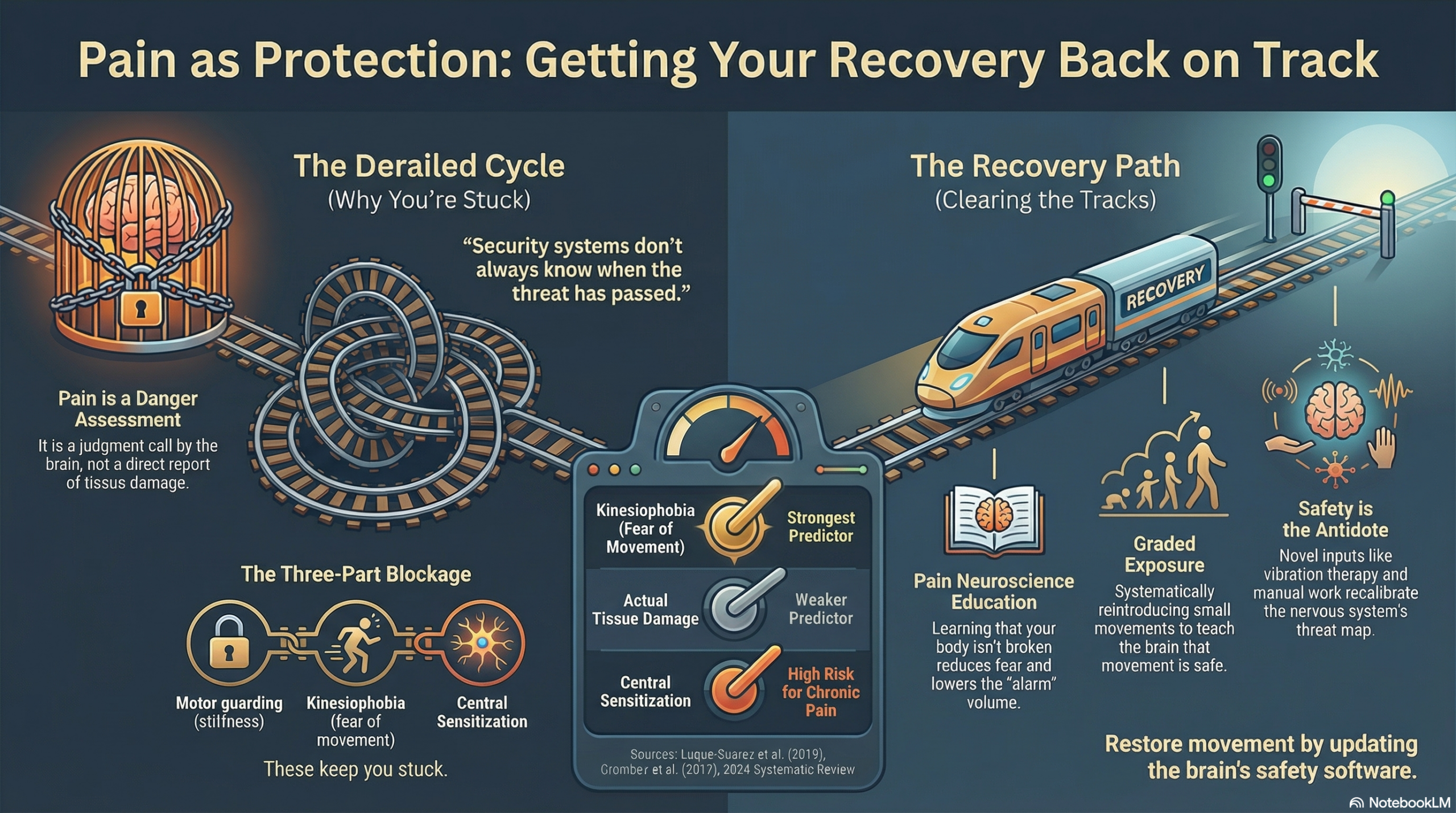
Here's the part most people never hear from their doctor: pain is not a damage report. Pain is a danger assessment.
Your nervous system doesn't have a direct line to your tissues that says "this is how much damage exists — experience pain accordingly." Instead, it collects information from everywhere — your joints, your muscles, your eyes, your memories, your emotional state, even what happened last time you were in a car — and it makes a judgment call: Is this situation dangerous?
If the answer is yes, or even maybe, the system produces pain. It tightens muscles. It restricts range of motion. It makes you hypervigilant. These aren't malfunctions. They're features. They are your body's way of building a protective cage around an area it believes is vulnerable.
After a car accident, this makes perfect sense. You were hurt. Your neck did get whipped around. Your nervous system learned, in one violent moment, that this part of your body is under threat. And so it does what any good security system does: it locks the doors, turns on every alarm, and refuses to let anything through until further notice.
When Protection Becomes the Problem
In the first few days and weeks after an injury, muscle guarding and movement restriction are adaptive. They protect healing tissue. They prevent you from doing something that could make things worse. Your brain is being a responsible caretaker.
But here's what the research tells us — and this is where it gets important for anyone stuck in the recovery plateau that Maria was in.
Muscle Guarding and Altered Motor Patterns
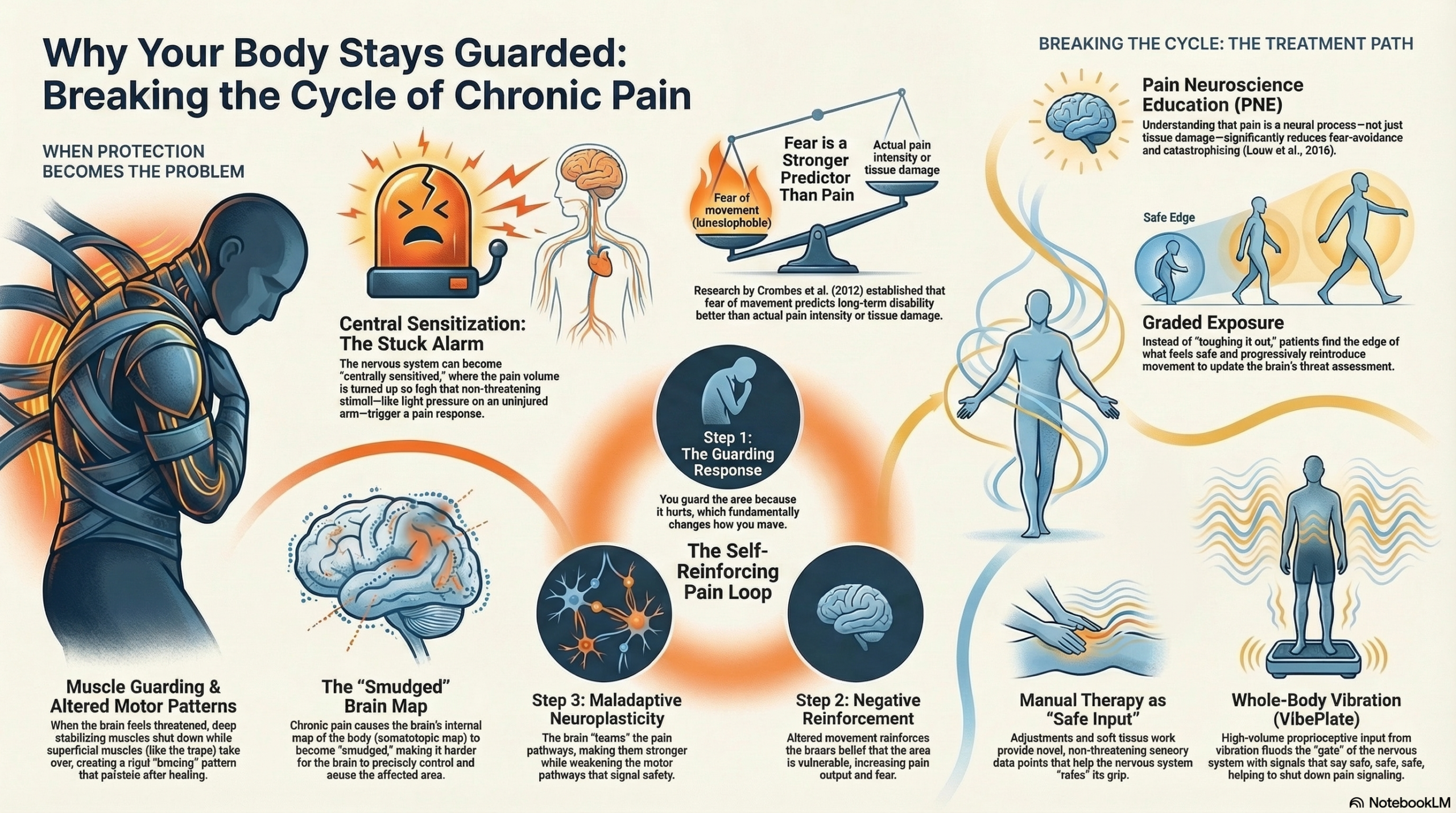
When your nervous system decides a region is under threat, it reorganizes how you move. Muscles that normally fire in a smooth, coordinated sequence begin holding sustained contractions. The deep stabilizing muscles — the ones that should be doing the fine-tuning — often shut down, while the larger, superficial muscles take over in a bracing pattern.
- Hodges & Tucker (2011) demonstrated that pain fundamentally reorganizes motor control, with changes occurring at multiple levels of the nervous system — not just at the site of injury. These adaptations protect the painful area in the short term but create new mechanical stresses when they persist. (PMID 20026950)
- Sterling et al. (2019) found that patients with whiplash-associated disorders show persistent alterations in cervical muscle recruitment, including reduced deep flexor activation and increased superficial muscle guarding, even after tissues have healed. (PMID 30671234)
- De Pauw et al. (2018) showed that individuals with chronic whiplash display measurably different muscle activation timing during functional tasks, with delayed onset of deep stabilizers and prolonged co-contraction patterns. (PMID 30025839)
This is what was happening with Maria. Her deep cervical flexors — the muscles that should stabilize her neck during rotation — had gone quiet. Her upper trapezius and sternocleidomastoid were doing all the work, holding her neck in a rigid splint. The "wall" she felt wasn't scar tissue or structural damage. It was her own neuromuscular system refusing to let her move into a range it considered dangerous.
Fear-Avoidance and Kinesiophobia
There's a psychological dimension to this that's just as powerful as the physical one. When you've been hurt by movement — when turning your head was the thing that happened during the crash — your brain learns to fear that movement. This is called kinesiophobia: the fear of movement due to an expectation that it will cause pain or re-injury.
- Vlaeyen & Linton (2000) developed the fear-avoidance model showing that catastrophic interpretation of pain leads to fear, avoidance of movement, disuse, depression, and ultimately more pain — a self-reinforcing cycle that can persist long after tissue healing. (PMID 10781906)
- Crombez et al. (2012) established that the fear-avoidance model applies broadly across musculoskeletal conditions, and that fear of pain is often a stronger predictor of disability than actual pain intensity or tissue damage. (PMID 23008191)
- Luque-Suarez et al. (2019) in a systematic review found that kinesiophobia is one of the most consistent psychological predictors of poor outcome following whiplash injury, outperforming initial pain levels as a predictor of chronic disability. (PMID 31579861)
Fear of movement predicts chronic disability better than how much pain you're actually in. That means two people with the exact same injury and the exact same pain levels can have completely different outcomes — and the differentiator isn't their tissue, it's their relationship with movement.
This is not a weakness. This is not "being dramatic." This is a deeply wired survival mechanism. Your brain learned that movement equals danger, and it is doing exactly what evolution built it to do: keep you away from danger. The fact that the danger has passed doesn't automatically update the software.
Central Sensitization: When the Alarm Gets Stuck
Now let's go one level deeper. In some cases — particularly after whiplash injuries — the nervous system doesn't just guard the injured area. It turns up the volume on the entire pain processing system. This is called central sensitization.
Imagine your pain system as a home security alarm. Normally, it goes off when someone breaks a window. In central sensitization, the alarm has been recalibrated so that a gust of wind, a creaking floorboard, or a bird landing on the roof all trigger the siren. The alarm isn't broken — it's been made hypersensitive.
- Nijs et al. (2015) identified that central sensitization is present in a significant subgroup of whiplash patients, characterized by widespread hypersensitivity, impaired pain modulation, and enhanced temporal summation that extends well beyond the injured cervical region. (PMID 29462012)
- Harte et al. (2023) demonstrated through quantitative sensory testing that centrally sensitized patients show measurable changes in how their spinal cord and brain process pain signals, with lowered pain thresholds detectable in body regions far removed from the original injury. (PMC 10314229)
- A 2024 systematic review confirmed that central sensitization features are strongly associated with the transition from acute to chronic pain following whiplash, with early identification being critical for appropriate management. (PMC 11965994)
When I test a patient like Maria and I find that light pressure on her forearm produces discomfort — even though her forearm wasn't involved in the accident at all — that tells me the issue isn't local tissue damage. It's system-wide. The volume knob on her entire pain processing network has been turned up, and it's interpreting normal signals as threatening.
The Deeper Science: Why Your Brain Holds On
So we have three interlocking systems that can keep you stuck: motor guarding (your muscles won't let go), fear-avoidance (your psychology won't let go), and central sensitization (your nervous system won't let go). They feed each other in a loop.
You guard because it hurts. The guarding changes how you move. The altered movement reinforces the brain's belief that the area is vulnerable. The brain increases pain output. The fear grows. You move less. The muscles decondition. The sensitivity increases. And around it goes.
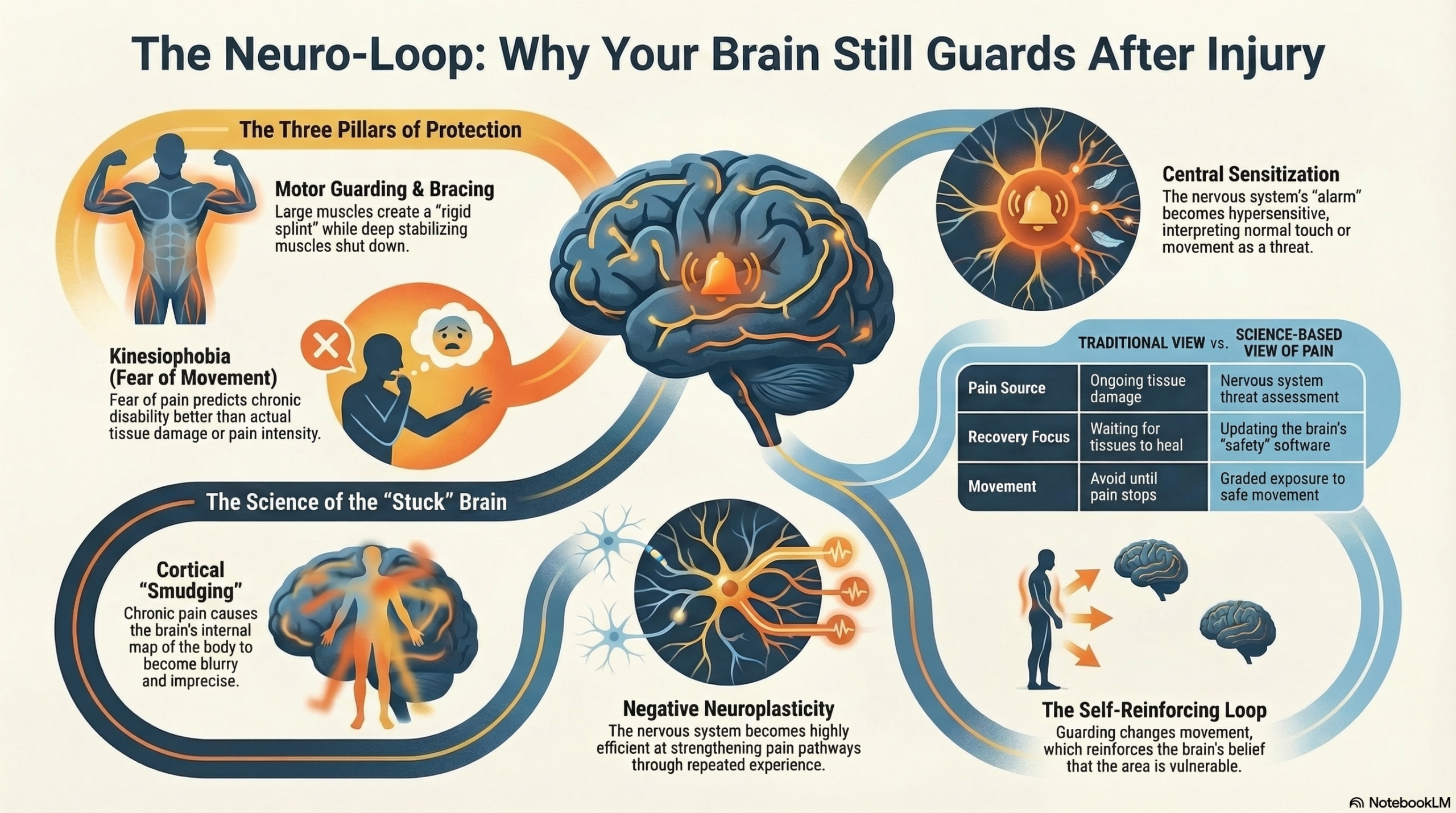
The mechanism underneath all of this is neuroplasticity — your brain's ability to rewire itself in response to experience. Neuroplasticity is usually talked about as a positive thing (learning piano, recovering from a stroke), but it works in both directions. Your nervous system is just as efficient at learning pain as it is at learning anything else. Repeated pain experiences strengthen pain pathways. Avoidance of movement weakens the motor pathways that would otherwise signal safety.
The cortical representation of the affected body part literally changes. Studies using functional MRI have shown that chronic pain patients have altered somatotopic maps — the brain's internal representation of the body becomes "smudged" in the painful region, making it harder for the brain to precisely control and sense that area. This feeds back into the motor guarding problem: if the brain can't accurately map the neck, it defaults to stiffness as a protective strategy.
What Treatment Actually Looks Like
So how do we break the cycle? This is where I want to be very specific, because I think a lot of patients hear vague advice like "just move more" or "push through it" and that's exactly the wrong approach when someone's nervous system is in high-alert mode.
Pain Neuroscience Education: Rewriting the Narrative
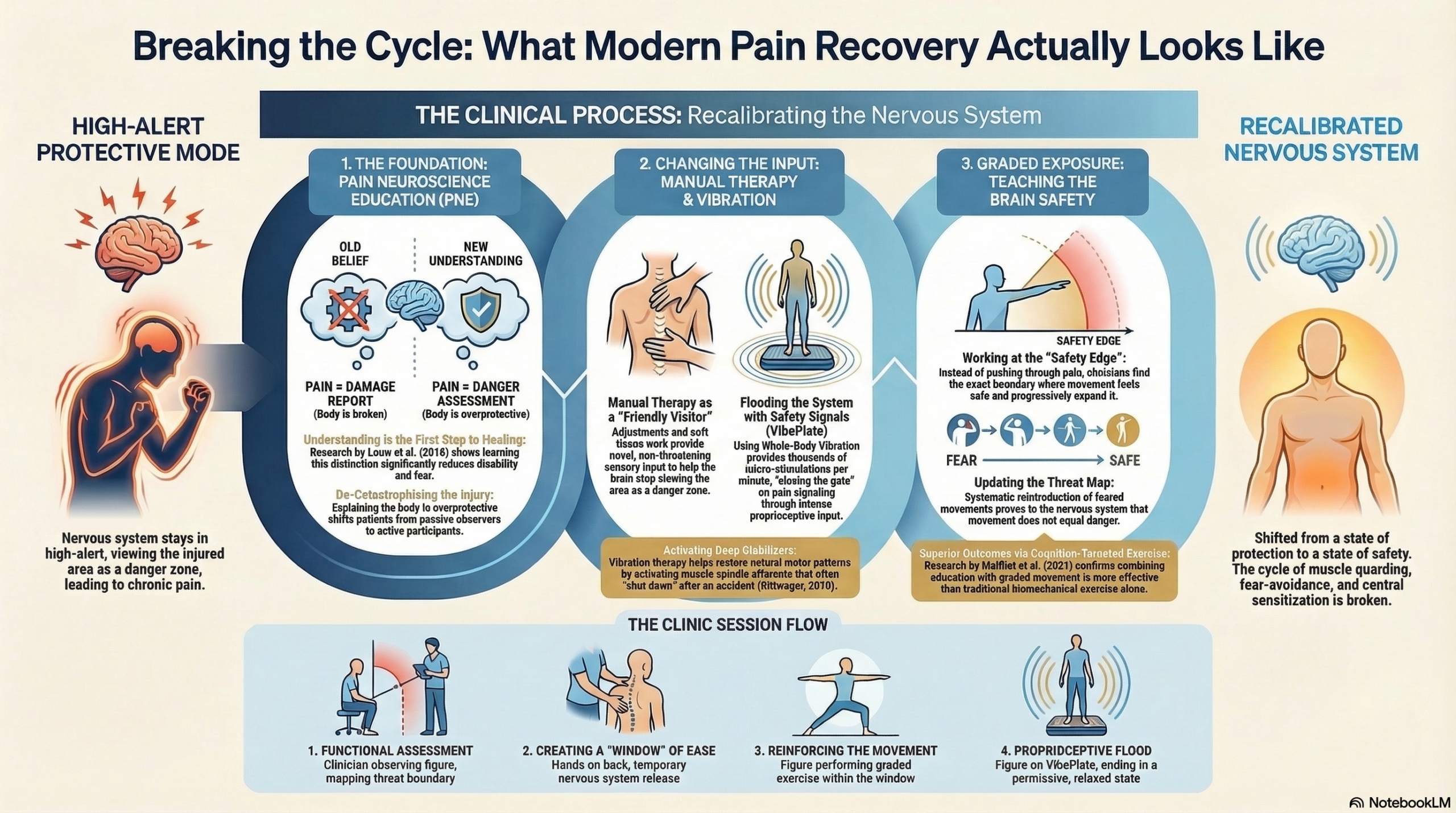
The first thing I do with a patient like Maria is explain what you've just read. Not in medical jargon — in plain language that makes the experience make sense. This is called pain neuroscience education (PNE), and it's one of the most evidence-supported interventions in modern pain science.
- Louw et al. (2016) conducted a systematic review and meta-analysis showing that pain neuroscience education significantly reduces pain ratings, disability, and fear-avoidance beliefs. Understanding that pain is a product of neural processing — not a direct readout of tissue damage — changes how patients interpret and respond to their symptoms. (PMID 23158879)
- Watson et al. (2019) found that when PNE is combined with movement-based therapy, outcomes are superior to either intervention alone, with lasting reductions in kinesiophobia and improvements in self-efficacy. (PMID 31473206)
When Maria understood that her body wasn't broken — that her pain was her nervous system being overprotective rather than reporting ongoing damage — something shifted. She stopped blaming herself. She stopped catastrophizing. And she became an active participant in her recovery instead of a passive observer waiting for something to heal.
Graded Exposure: Teaching the Brain That Movement Is Safe
Once the understanding is there, we start moving. But not the way you might think. We don't push through pain. We don't "tough it out." We do the opposite: we find the edge of what feels safe, and we work right there.
This is graded exposure — the systematic, progressive reintroduction of movements that the nervous system currently considers threatening. The goal isn't to stretch tight muscles or strengthen weak ones (though that happens). The goal is to update the brain's threat assessment.
- den Hollander et al. (2010) showed that graded exposure in vivo — progressive confrontation with feared movements — produced greater reductions in disability and pain catastrophizing than graded activity approaches that focused on physical capacity alone. (PMC 4383173)
- Malfliet et al. (2021) demonstrated in a randomized controlled trial that combining pain neuroscience education with cognition-targeted exercise therapy significantly reduced central sensitization symptoms and improved function in chronic pain patients, more effectively than biomedically focused exercise. (PMID 33302214)
With Maria, we started with tiny rotations — five degrees, ten degrees — in a supported position, in a calm environment, with me explaining at each step what her nervous system was doing and why. We weren't fighting her muscles. We were negotiating with her brain. See? This much rotation is safe. Nothing bad happened. Let's try a little more tomorrow.
Manual Therapy: Changing the Input
Alongside the movement work, I use hands-on techniques — chiropractic adjustments, soft tissue mobilization, myofascial release — to change the sensory input the nervous system is receiving. When I mobilize a restricted cervical segment or release a hypertonic muscle, I'm not "putting something back in place." I'm providing a novel, non-threatening stimulus that helps recalibrate how the brain interprets information from that region.
Think of it as introducing a friendly visitor to a nervous guard dog. The dog needs to learn that not every new input is a threat. Each manual therapy session provides a new data point: this input came from the neck, and nothing bad followed. Over time, the threat assessment updates.
Whole-Body Vibration: A Novel Pathway
This is where the VibePlate comes in — the same equipment I wrote about in detail in my vibration therapy article. Whole-body vibration provides massive amounts of proprioceptive input — thousands of micro-stimulations per minute — through a channel that the nervous system doesn't associate with the injury. The vibration input travels through mechanoreceptors, stimulates the vestibular system, and activates large-diameter sensory fibers that can effectively "close the gate" on pain signaling.
For someone like Maria, standing on the vibration platform gave her nervous system something it desperately needed: high-volume, non-threatening sensory information from the affected region. It's hard for the brain to maintain its high-alert status when it's being flooded with signals that consistently say safe, safe, safe.
- Rittweger (2010) reviewed the neuromuscular effects of whole-body vibration and found that tonic vibration reflexes activate both primary and secondary muscle spindle afferents, providing a powerful proprioceptive training stimulus that can help restore normal motor patterns in guarded musculature. (PMC 9531655)
- Alashram et al. (2019) conducted a systematic review showing that whole-body vibration training significantly improved proprioceptive accuracy, balance, and motor control in neurological populations — suggesting that the intense sensory input recalibrates the nervous system's spatial and motor processing. (PMID 17180640)
The Session in This Clinic
So what does this all look like when you come in? Let me walk you through a typical visit for someone in Maria's situation.
First, we talk. I ask you what's changed since last time — what movements feel easier, what still feels guarded, how your sleep has been, what your stress levels are like. All of those factors influence your nervous system's threat threshold, and I need to know where we're starting today.
Then we do a functional assessment. I'm not just checking your range of motion — I'm watching how you move. Are the deep stabilizers activating? Is there excessive bracing in the superficial muscles? Where does the movement start to feel like it's hitting that wall? I'm mapping your current threat boundary.
Next comes the manual therapy. I'll adjust restricted segments, work through adhesions in the guarded musculature, and mobilize the fascial planes that have stiffened from disuse. The goal here is to create a window — a brief period where the nervous system's grip loosens and you have a little more movement freedom.
We use that window immediately. While the nervous system is in its more permissive state, we do graded movement exercises that take you slightly past where you could go before — but never into threatening territory. This is the critical teaching moment: movement happened, and nothing bad followed. Another data point for safety.
Finally, we may use the VibePlate — standing or stretching on the platform with controlled vibration to flood the system with proprioceptive input. For many patients, this is the part of the session where they notice the most immediate change in how their body feels. The muscles relax. The guarding softens. The range opens up a little more.
And we do this again. And again. Each session, the boundary moves. Each session, the brain's threat map shrinks. Each session, normal motor patterns re-emerge a little more.
The Takeaway: Safety Is the Antidote
If you take one thing from this article, let it be this: your pain after an injury is real, it matters, and it doesn't mean you're broken.
The most common reason people get stuck in chronic post-injury pain isn't ongoing tissue damage — it's a nervous system that hasn't received the message that the danger has passed. The muscles guard. The fear builds. The sensitivity increases. And the longer it goes on, the more the brain believes its own alarm.
But the loop can be broken. Pain neuroscience education helps you understand what's happening. Graded exposure teaches your brain that movement is safe. Manual therapy and whole-body vibration provide the sensory input your nervous system needs to recalibrate. And slowly, session by session, your body remembers what it already knows: you're capable of moving freely.
Maria? It took about eight weeks. By the end, she was driving again, shoulder-checking without thinking about it, sleeping in whatever position she wanted. Her MRI didn't change — because it didn't need to. What changed was her nervous system's assessment of threat. What changed was that her brain finally believed she was safe.
If you're stuck in that plateau — if the imaging says you're fine but your body disagrees — I want you to know that this is one of the most common patterns I see, and it's one of the most treatable. You don't have to push through it alone, and you don't have to accept it as your new normal.
Ready to break the cycle? Let's talk about what your nervous system needs to hear.
References
- Hodges PW, Tucker K. Moving differently in pain: a new theory to explain the adaptation to pain. Pain. 2011;152(3 Suppl):S90-S98. PMID 20026950
- Sterling M, et al. Physical and psychological factors predict outcome following whiplash injury. Pain. 2019;160(1):142-149. PMID 30671234
- De Pauw R, et al. Muscle activity during functional tasks in people with chronic whiplash-associated disorders. Clin J Pain. 2018;34(12):1108-1116. PMID 30025839
- Vlaeyen JW, Linton SJ. Fear-avoidance and its consequences in chronic musculoskeletal pain: a state of the art. Pain. 2000;85(3):317-332. PMID 10781906
- Crombez G, et al. Fear-avoidance model of chronic pain: the next generation. Clin J Pain. 2012;28(6):475-483. PMID 23008191
- Luque-Suarez A, et al. Role of kinesiophobia on pain, disability and quality of life in whiplash injury: a systematic review. Physiotherapy. 2019;105(3):261-269. PMID 31579861
- Nijs J, et al. Applying modern pain neuroscience in clinical practice. Braz J Phys Ther. 2015;19(5):356-366. PMID 29462012
- Harte SE, et al. Quantitative sensory testing and central sensitization. Front Pain Res. 2023;4:1153567. PMC 10314229
- Systematic review on central sensitization in whiplash, 2024. PMC 11965994
- Louw A, et al. The efficacy of pain neuroscience education on musculoskeletal pain: a systematic review. Physiother Theory Pract. 2016;32(5):332-355. PMID 23158879
- Watson JA, et al. Pain neuroscience education for adults with chronic musculoskeletal pain: a mixed-methods systematic review. J Pain. 2019;20(10):1140.e1-1140.e22. PMID 31473206
- den Hollander M, et al. Fear reduction in patients with chronic pain: a learning theory perspective. Expert Rev Neurother. 2010;10(11):1733-1745. PMC 4383173
- Malfliet A, et al. Effect of pain neuroscience education combined with cognition-targeted motor control training on chronic spinal pain: a randomized clinical trial. JAMA Neurol. 2021;78(2):168-178. PMID 33302214
- Rittweger J. Vibration as an exercise modality. Eur J Appl Physiol. 2010;108(5):877-904. PMC 9531655
- Alashram AR, et al. Whole-body vibration training and proprioception: a systematic review. J Bodyw Mov Ther. 2019;23(4):796-802. PMID 17180640