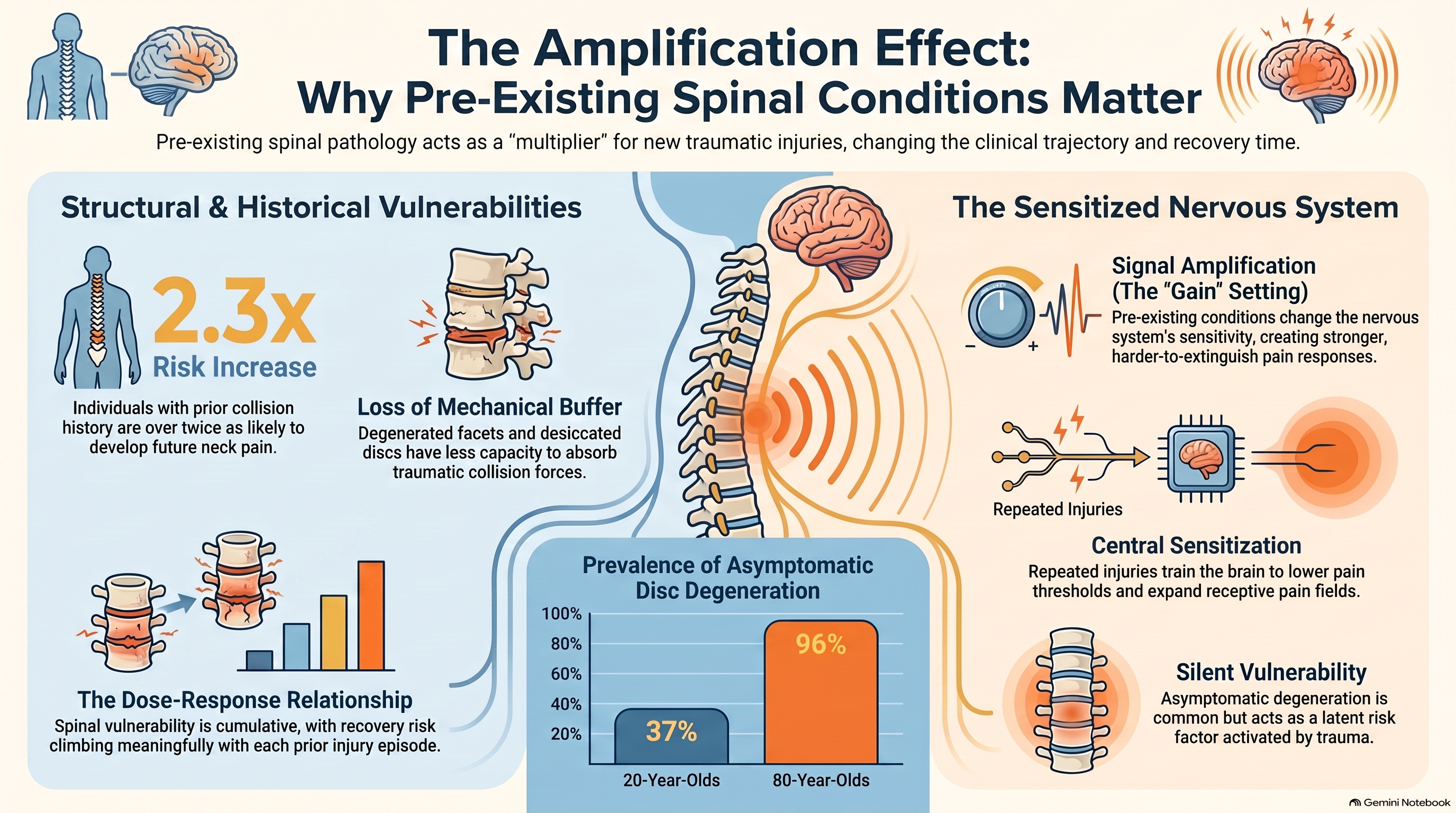
When the Crash Finds the Crack: How Pre-Existing Spinal Conditions Shape Injury Outcomes
Two patients arrive at your office the same week, referred by two different attorneys, each rear-ended at what the accident reports describe as low to moderate speed. The first came in on day three, improved steadily, and was discharged at eight weeks with full resolution. The second is still in your office four months later, describing pain that is, if anything, less predictable than it was at the start.
Same mechanism. Similar reported speeds. Completely different trajectories.
If you’ve practiced long enough, you’ve stopped being surprised by this. But your patients are often surprised — and so, frequently, are the insurance adjusters, the reviewing physicians, and the attorneys on both sides of the claim. The gap between expected recovery and actual recovery is one of the most contested spaces in personal injury medicine, and pre-existing spinal pathology sits at the center of it.
This article is a clinical and conceptual framework for understanding why pre-existing spinal conditions don’t merely coexist with a new traumatic injury — they fundamentally change what the injury is, how it behaves, and how long it takes to resolve. The goal is not to help you justify a longer case. It is to help you understand what you are actually treating — and to document it with the specificity the situation requires.
The Amplification Effect: What It Is and Why It Matters
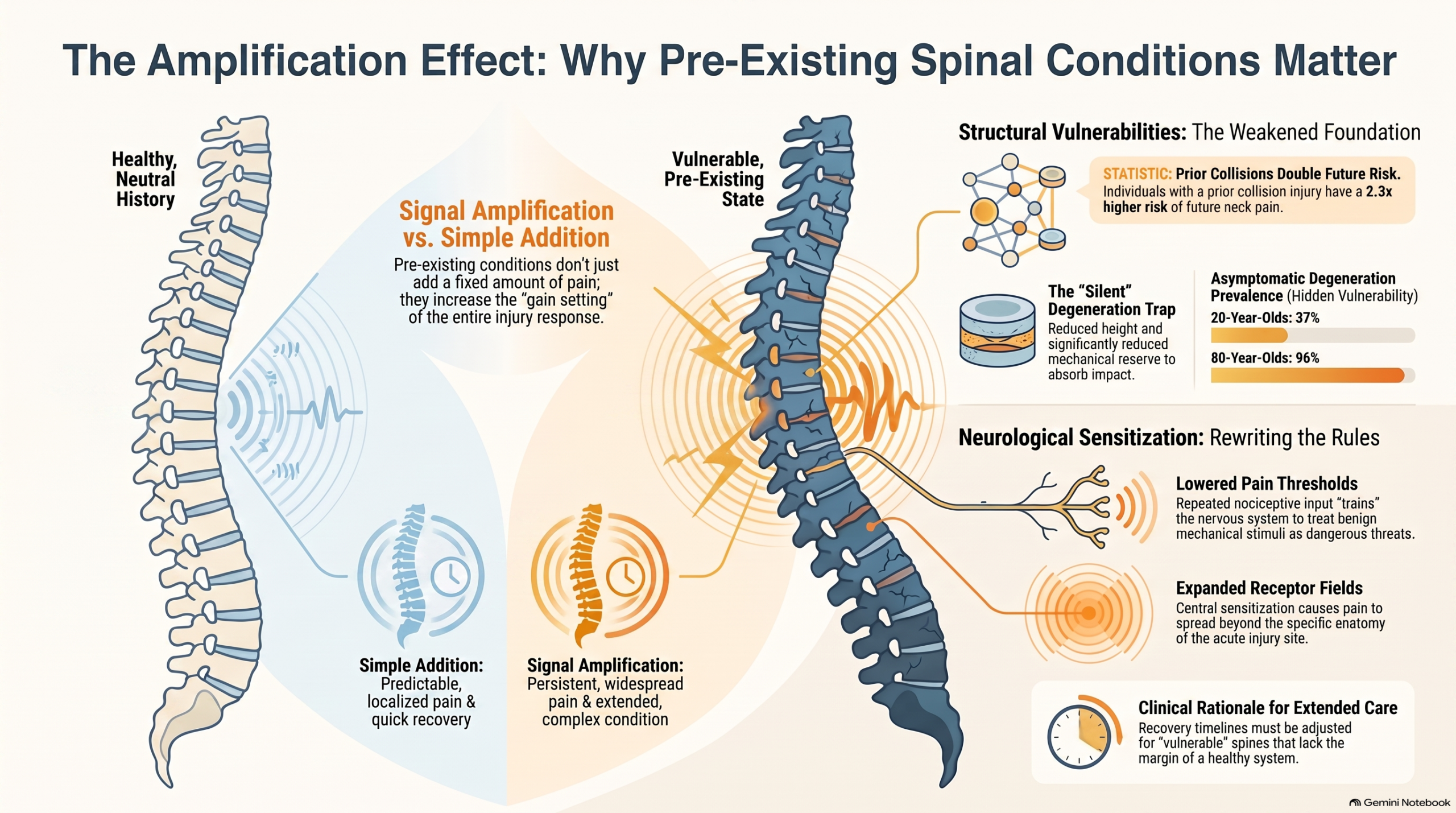
The term “pre-existing condition” is used in medicolegal contexts as though it describes something that simply preceded the accident — a neutral historical fact. Clinically, it describes something more active: a state of altered tissue tolerance, altered neurological sensitivity, and altered mechanical behavior that changes how a new insult is received.
Think of it as signal amplification rather than simple addition. The pre-existing condition doesn’t add a fixed increment of pain or disability on top of the new injury. It changes the gain setting on the system that processes and responds to injury. A collision that would generate a moderate, time-limited response in a spine with no prior history generates a stronger, more persistent, and harder-to-extinguish response in a spine that has been sensitized by prior injury or degeneration.
This is the concept the research literature has been building toward for over two decades, and it has direct consequences for clinical practice: how you take a history, how you interpret imaging, how you set prognosis, and how you document.
The Clinical Implication: A collision does not produce the same injury in every spine. It produces an injury whose character, severity, and duration are determined by the interaction between the traumatic force and the structural and neurological state of the spine that receives it.
Three Structural Vulnerabilities That Change the Injury Calculation
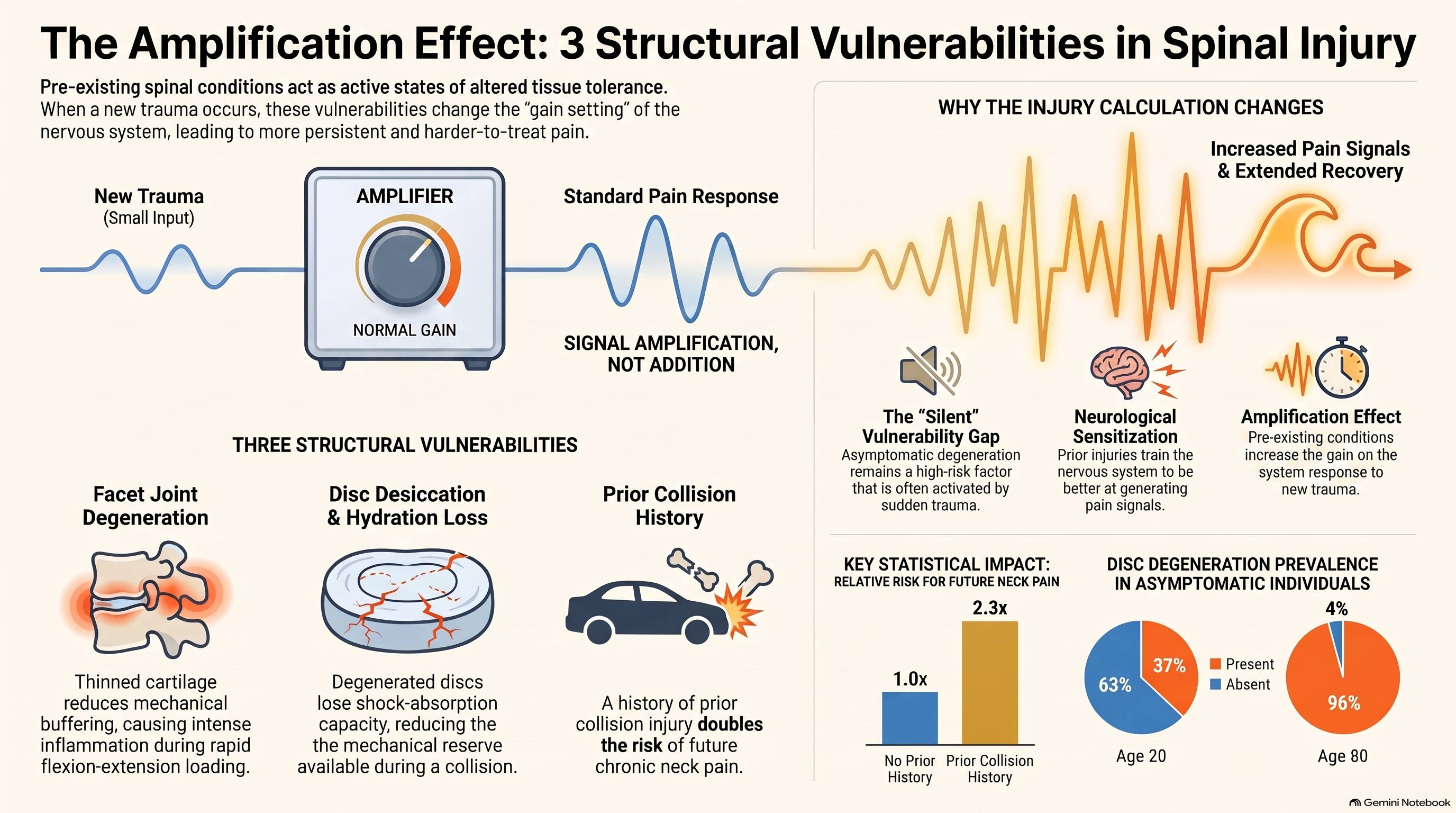
Not all pre-existing pathology carries equal clinical weight. The following three categories have the strongest evidence base for predicting altered injury response and compromised recovery.
Vulnerability 1: Facet Joint Degeneration
Facet joint degeneration — cartilage thinning, subchondral sclerosis, osteophyte formation — is among the most prognostically significant structural findings in post-collision patients. A 2021 systematic review found moderate evidence that pre-existing cervical facet joint degeneration is a negative prognostic indicator for long-lasting symptoms following whiplash-associated disorder, with degenerating facets associated with an increased likelihood of chronic, persistent pain.
The mechanism is not complicated: a facet joint with thinned cartilage has less mechanical buffer between bony surfaces. During the rapid flexion-extension loading of a rear-end collision, compressive and shear forces that a well-cushioned joint would absorb without consequence instead produce inflammation, micro-damage, and a cascade of nociceptive signaling that can persist long after the acute phase.
Vulnerability 2: Disc Degeneration and Loss of Hydration
A healthy nucleus pulposus is mostly water, maintained under hydrostatic pressure by an intact annulus. It acts as a shock absorber. A degenerated disc — desiccated, with annular fissuring — has lost much of that capacity. The mechanical reserve is reduced: the disc can absorb less load before generating pain signals, and the altered biomechanics change how forces are distributed across adjacent segments.
The epidemiology matters here: imaging evidence of disc degeneration appears in 37% of completely asymptomatic 20-year-olds, rising to 96% of asymptomatic 80-year-olds. The clinical implication is not that degeneration is irrelevant — it is that it is common, often silent, and therefore underappreciated as a vulnerability factor until something disrupts the status quo. The collision is that disruption.
Vulnerability 3: Prior Collision Injury History
A history of prior motor vehicle collision injury is, by itself, one of the most powerful predictors of future pain and complicated recovery. A 2020 systematic review found a consistent positive association between prior collision-related back injury and elevated risk of future low back pain across the highest-quality prospective studies available. For neck pain specifically, a 2019 meta-analysis found that individuals with a prior collision injury had more than double the risk of future neck pain compared with those without that history — a relative risk of 2.3 (95% CI 1.8–3.1).
This is not a soft association. It is a robust, replicated finding across multiple study designs and populations. And it has a clear clinical interpretation: the spine does not return to its pre-collision baseline simply because the acute pain resolved and the file was closed. It returns changed — more reactive, more easily provoked — and that changed state is the starting point for the next event.
The Sensitized Nervous System: When History Rewrites the Rules
Structural vulnerability explains part of the amplification effect. Neurological sensitization explains the rest — and arguably more.
Central sensitization is the process by which repeated or sustained nociceptive input causes functional changes in the spinal cord and brain that lower the threshold for pain perception, expand the receptive fields of pain-sensitive neurons, and impair descending inhibitory pathways. In plain terms: the nervous system, having been trained by prior injury to treat certain inputs as dangerous, becomes better at generating pain signals and worse at damping them.
This has several clinical consequences that are directly relevant to post-collision patients with prior history:
Pain that seems disproportionate to the visible tissue damage is not psychogenic — it reflects a nervous system that has been recalibrated by prior experience.
The same mechanical stimulus that would be processed as benign in a naive nervous system may be processed as threatening in a sensitized one.
Pain distribution may be broader than the anatomy of the acute injury would predict, because sensitization expands receptor fields.
Recovery may require addressing central sensitization directly — through education, graded exposure, and psychosocial support — not only treating the peripheral tissue.
A 2003 systematic review of prognostic factors for whiplash-associated disorder identified high initial pain intensity, poor recovery expectations, and prior neck or back complaints as the most consistent predictors of worse outcomes across prospective cohort studies. These are not independent variables. They interact: prior history increases initial pain intensity, and high initial pain intensity shapes recovery expectations, which in turn influence the trajectory of sensitization.
Reading the Evidence: Four Key Findings
The research base for pre-existing vulnerability in collision injury is substantial and has been building for decades. Four findings are particularly relevant to clinical practice.
Prior collision history doubles future neck pain risk. Nolet et al. (2019) pooled low-to-moderate risk-of-bias prospective studies and found that exposure to a prior motor vehicle collision injury was associated with a relative risk of 2.3 for future neck pain — a finding that held across multiple study populations and methodological approaches.
Degeneration is common and mostly silent — until it isn’t. Brinjikji et al. (2015) found that the majority of imaging findings labeled as “degenerative changes” appear in people with no pain whatsoever. This means providers who dismiss degeneration because it was “asymptomatic” before the crash are misunderstanding the nature of structural vulnerability — the absence of symptoms is not the same as the absence of risk.
Risk compounds with each prior episode. Cassidy et al. (2017) found that the risk of future low back pain following a collision injury climbed meaningfully with each additional prior episode — a dose-response relationship that confirms the cumulative nature of spinal vulnerability.
Prognosis is multidimensional, not just structural. Ritchie et al. (2015) found that in patients still symptomatic after the acute phase, psychological distress and elevated disability at presentation — not structural findings alone — predicted who would develop chronic disability. Structure sets the stage, but the broader clinical picture writes the outcome.
The One Question That Changes Everything
“What back or neck pain have you had before this accident — even pain from years ago that you thought was resolved?”
Given the evidence, the most important single change a provider can make to their collision intake process is this: ask about prior history with the same rigor you apply to current symptoms.
This means asking about:
- Prior neck or back pain episodes, including ones the patient considers “resolved”
- Prior motor vehicle collisions, including ones that produced no formal claim
- Chronic stiffness, limitation, or aching the patient has normalized and adapted to
- Prior imaging and what it showed
- Prior treatment and the response to it
Patients routinely omit this information not because they are concealing it, but because they don’t understand its relevance. They assume that a pain that resolved years ago is irrelevant to the pain they have today. Your job is to reframe that assumption at intake: their prior history is not a complication of their case — it is the context that makes their current presentation legible.
Obtaining prior imaging is equally important. The clinical task when reviewing old and new imaging side by side is not to use degeneration as a credibility marker — it is to identify which structures show wear, at which segments, and whether the pattern of new symptoms lines up with areas of pre-existing vulnerability that the collision has now activated.
Setting an Honest Prognosis
The evidence supports a clear clinical principle: patients with pre-existing spinal vulnerability have longer, more complex recovery trajectories than patients without it — and prognosis should be set accordingly from the first visit.
This matters for several reasons. Patients who are told they should recover in four to six weeks and don’t recover in four to six weeks internalize the mismatch as failure. They begin to catastrophize, which itself worsens outcomes. They lose confidence in their provider and in the care plan. They become uncertain about the legitimacy of their own experience.
An honest prognosis — one that acknowledges that their spine had less margin than a younger, uninjured spine, and that a longer timeline is not a sign that something has gone wrong — is clinically protective. It reduces catastrophizing, maintains therapeutic alliance, and sets expectations that the treatment plan can actually meet.
This does not mean projecting an indefinitely poor prognosis. It means being accurate rather than optimistic, and building a care plan around what this particular spine actually needs — slower graded loading, more attention to proprioceptive retraining, earlier focus on education about central sensitization, and more frequent reassessment of the trajectory.
Documentation as Clinical Obligation
In post-collision cases involving pre-existing pathology, documentation is not primarily a medicolegal protection — it is a clinical obligation to accurately represent what you are treating and why you are treating it the way you are.
The structural elements of that documentation are:
The prior history, captured in the patient’s own words and verified against prior records. What episodes did they have, when, what treatment, what resolution. This establishes the pre-collision baseline.
Imaging comparison, when available. Note which segments show pre-existing changes, the nature of those changes, and whether the current symptom distribution is consistent with those segments being activated by the new trauma.
The clinical rationale for an extended treatment plan. If your plan differs from a standard protocol, document why — with reference to the specific structural findings and clinical reasoning that justify the difference.
The aggravation analysis. The medicolegal concept of “aggravation of a pre-existing condition” has a clinical correlate: you are not treating the degeneration, you are treating the collision’s effect on a spine that had reduced tolerance because of prior degeneration. The distinction matters, and your notes should make it.
When an adjuster or reviewing physician describes a pre-existing condition as though it discounts the current injury, they are inverting the clinical logic. The research is clear: pre-existing vulnerability is a legitimate reason an otherwise “minor” collision produces a more significant and longer-lasting injury. Your documentation is what allows that argument to be made accurately.
Conclusion
The two patients at the beginning of this article are not a clinical mystery. They are a demonstration of a well-documented and mechanistically understood phenomenon: a collision does not produce the same injury in every spine. It produces an injury whose character, severity, and duration are determined by the interaction between the traumatic force and the structural and neurological state of the spine that receives it.
Pre-existing conditions are not incidental context. They are a primary variable. Facet degeneration, disc pathology, prior injury history, and the neurological sensitization that accompanies repeated pain episodes all change what a collision is, in that particular body, on that particular day.
Providers who build their evaluation and documentation around that understanding are doing something the standard protocol wasn’t designed to accomplish: treating the actual patient in front of them, rather than the average case the protocol was built for. That is, ultimately, what evidence-based practice means in a clinical setting where no two spines come in with the same history.
References
- Malik K, Eseonu KC, Pang D, Fakouri B, Panchmatia JR. Is Preexisting Cervical Degeneration a Risk Factor for Poor Prognosis in Whiplash-Associated Disorder? International Journal of Spine Surgery, 2021. PMID: 34281955
- Brinjikji W, et al. Systematic Literature Review of Imaging Features of Spinal Degeneration in Asymptomatic Populations. American Journal of Neuroradiology, 2015. PMID: 25430861
- Freeman MD, et al. Exposure to a motor vehicle collision and the risk of future back pain: A systematic review and meta-analysis. Accident Analysis & Prevention, 2020. PMID: 32438092
- Nolet PS, et al. Exposure to a Motor Vehicle Collision and the Risk of Future Neck Pain: A Systematic Review and Meta-Analysis. PM&R, 2019. PMID: 31020768
- Scholten-Peeters GGM, et al. Prognostic factors of whiplash-associated disorders: a systematic review of prospective cohort studies. Pain, 2003. PMID: 12855341
- Cassidy JD, et al. The association between a lifetime history of low back injury in a motor vehicle collision and future low back pain: a population-based cohort study. European Spine Journal, 2017. PMID: 28391385
- Ritchie C, et al. Risk factors for chronic disability in a cohort of patients with acute whiplash associated disorders seeking physiotherapy treatment for persisting symptoms. Manual Therapy, 2015. PMID: 24996567