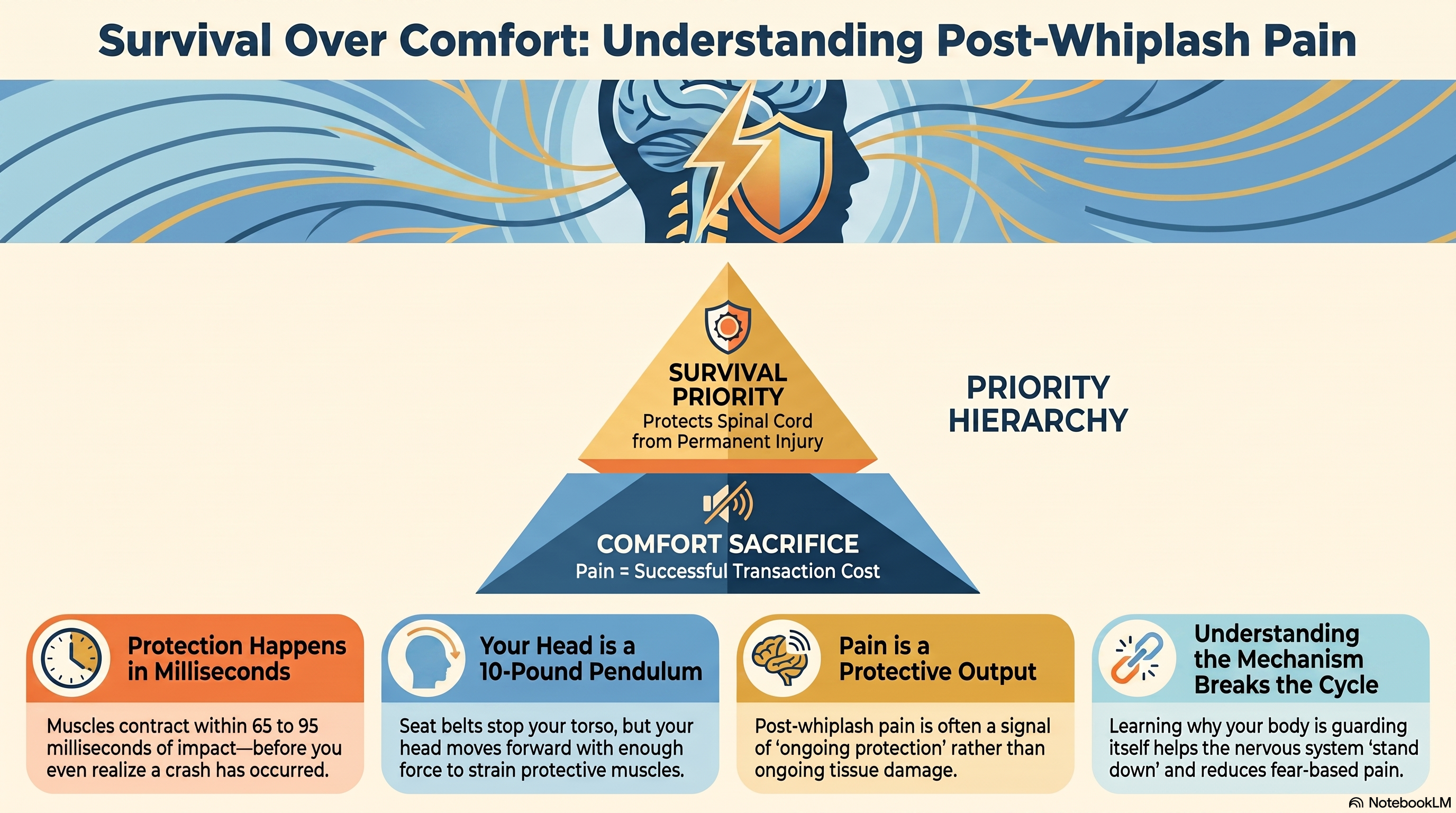
Your nervous system’s priority hierarchy has no entry for comfort. At the top sits survival — and everything else is subordinate. When a rear-end collision threatened your spinal cord, the paraspinal muscles of your neck fired a coordinated protective reflex within 65 to 95 milliseconds of impact — before you felt pain, before you felt the collision, before conscious thought was possible. The cord was protected. You walked away. And now the muscles that saved your cord are the source of your pain, your restricted range of motion, your disrupted sleep, and the persistent sense that something is wrong that no one has been able to explain.
This is not failure. This is the cost of a transaction that was completed in your favor.
Understanding the distinction between what the nervous system was trying to accomplish and what the tissue had to pay to accomplish it is the foundation of recovery from post-whiplash pain. Most patients never receive this explanation. They are told their imaging is normal, given muscle relaxants, and advised to rest. When the pain doesn’t resolve in two to three weeks as promised, they are left without a framework — wondering whether the injury is real, whether something has been missed, whether they are somehow responsible for a recovery trajectory that doesn’t match the discharge paperwork.
The pain is real. The mechanism is documented. The timeline is biological. What is missing, in almost every case, is the translation.
The Nervous System’s Priority Order
Before we can talk about what happens in a whiplash injury, we need to establish something that most patients are never told: the nervous system does not prioritize comfort. It prioritizes survival. These two goals are not always aligned.
The nervous system is organized around a strict hierarchy of threat response. Preservation of the spinal cord — the cable through which every signal between the brain and the body must pass — sits at the top of that hierarchy. The cord can be compressed, contused, or severed, and any of these outcomes can result in permanent paralysis. The nervous system is exquisitely aware of this. It has been shaped by hundreds of millions of years of evolution to treat threats to the cord as the highest-order emergency the body can face.
Below that, in descending priority, come threats to the structural integrity of the vertebrae, threats to the major blood vessels of the neck, and finally — at the bottom of the priority list — the question of whether the person is comfortable.
When a collision occurs, the nervous system does not have time to deliberate. The impact happens faster than conscious thought — the S-shaped deformation of the cervical spine during a rear-end collision is complete within approximately 100 milliseconds, well before the occupant can voluntarily respond. Everything that happens in that window is reflexive. It is the nervous system acting on its priority list without input from the person it belongs to.
The priority is survival. The cost, sometimes, is pain.
What a Seat Belt Actually Does — and Doesn’t Do
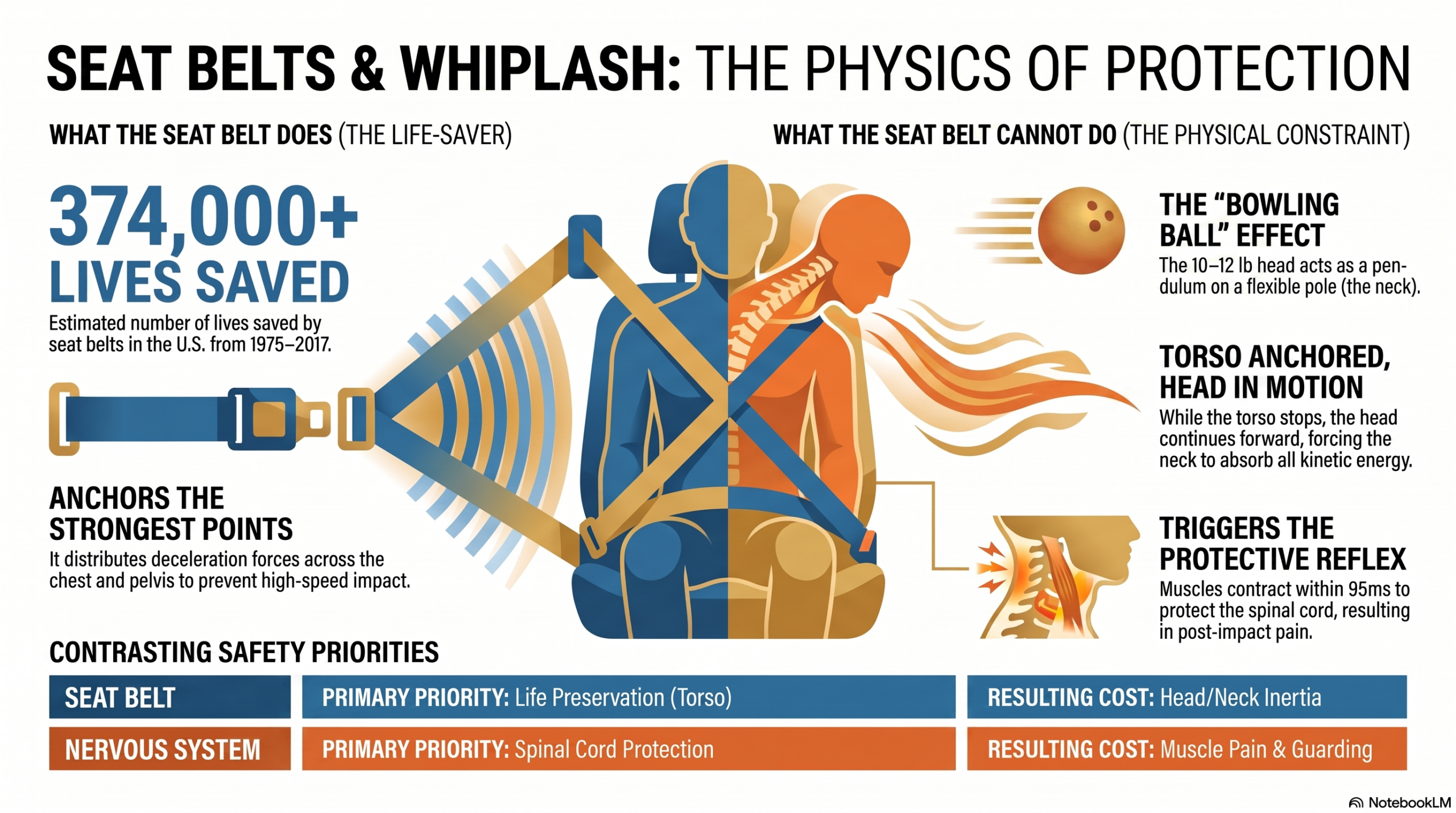
The seat belt is one of the most effective safety devices ever engineered. It has saved an estimated 374,000 lives in the United States between 1975 and 2017, according to the National Highway Traffic Safety Administration. It works by distributing the deceleration forces of a collision across the strongest parts of the body — the chest and pelvis — rather than allowing the body to continue moving at speed and impact the steering wheel, dashboard, or windshield.
What it cannot do is stop the head.
The head weighs between ten and twelve pounds in the average adult — roughly the weight of a bowling ball. It sits on top of the cervical spine like a pendulum on a flexible pole. When a seat belt arrests the motion of the torso in a rear-end collision, the head continues moving forward under its own inertia. The cervical spine — which is now anchored at the bottom by a torso that has stopped moving — is forced to absorb the kinetic energy of a ten-to-twelve-pound pendulum swinging forward.
This is not a design flaw in the seat belt. It is a physical constraint. There is no practical restraint system that can simultaneously protect the torso and prevent the head from moving forward. The head must move. The cervical spine must absorb the forces that movement generates.
What determines the severity of the outcome is not whether this happens — it always happens — but how the structures of the cervical spine respond to it, and what the nervous system does in the moments before, during, and after impact.
The seat belt saved your life. Your nervous system saved your spinal cord. The pain is what that protection cost.
The Reflexive Muscle Response: Your Body’s Last Line of Defense
In the milliseconds before the cervical spine reaches the limit of its mechanical tolerance, the nervous system executes a coordinated protective response. The paraspinal muscles of the neck — the semispinalis, splenius, longissimus, and their partners — receive an emergency activation signal. These muscles contract hard and fast, creating a rigid muscular sleeve around the cervical spine that resists further movement and protects the cord from compression.
This reflex is called the cervical protective reflex. It is one of the most ancient motor programs in the vertebrate nervous system. It does not require conscious initiation. It does not require pain. It fires automatically in response to sudden threat signals — loud noises, sudden acceleration, visual looming — and its output is always the same: contract the muscles around the most vulnerable structures.
The reflex works. It is, in large part, why the vast majority of people involved in even significant rear-end collisions do not sustain spinal cord injury. The muscular sleeve closes around the cord. The bones are held in closer approximation. The cord is protected.
But the muscles that execute this reflex are not designed for the loading pattern they experience during a collision. They are designed for gradual, controlled contraction — the kind that happens when you turn your head, reach overhead, or brace for a known impact. The emergency activation of the cervical protective reflex involves a rapid, high-force eccentric contraction — the muscles are contracting hard while simultaneously being stretched by the forward momentum of the head. This combination of high force and eccentric loading is the most physiologically stressful condition a muscle can experience.
Research by Siegmund and colleagues at the University of British Columbia has documented the biomechanics of this reflex in human volunteers exposed to controlled rear-end impacts. The cervical muscles were found to activate within 65 to 95 milliseconds of impact onset — fast enough to provide meaningful protection, but at loading rates that produce measurable strain in the muscle tissue itself.
PMID 22146280 — Siegmund GP, Blouin JS, Carpenter MG, Brault JR, Inglis JT. J Neurophysiol. 2007.
Cervical paraspinal muscles activated within 65–95 milliseconds of impact onset in controlled rear-end collision simulations. The activation pattern was consistent with a protective reflex directed at limiting cervical motion and protecting the spinal cord, but the loading rates produced measurable eccentric strain in the contracting muscle tissue.
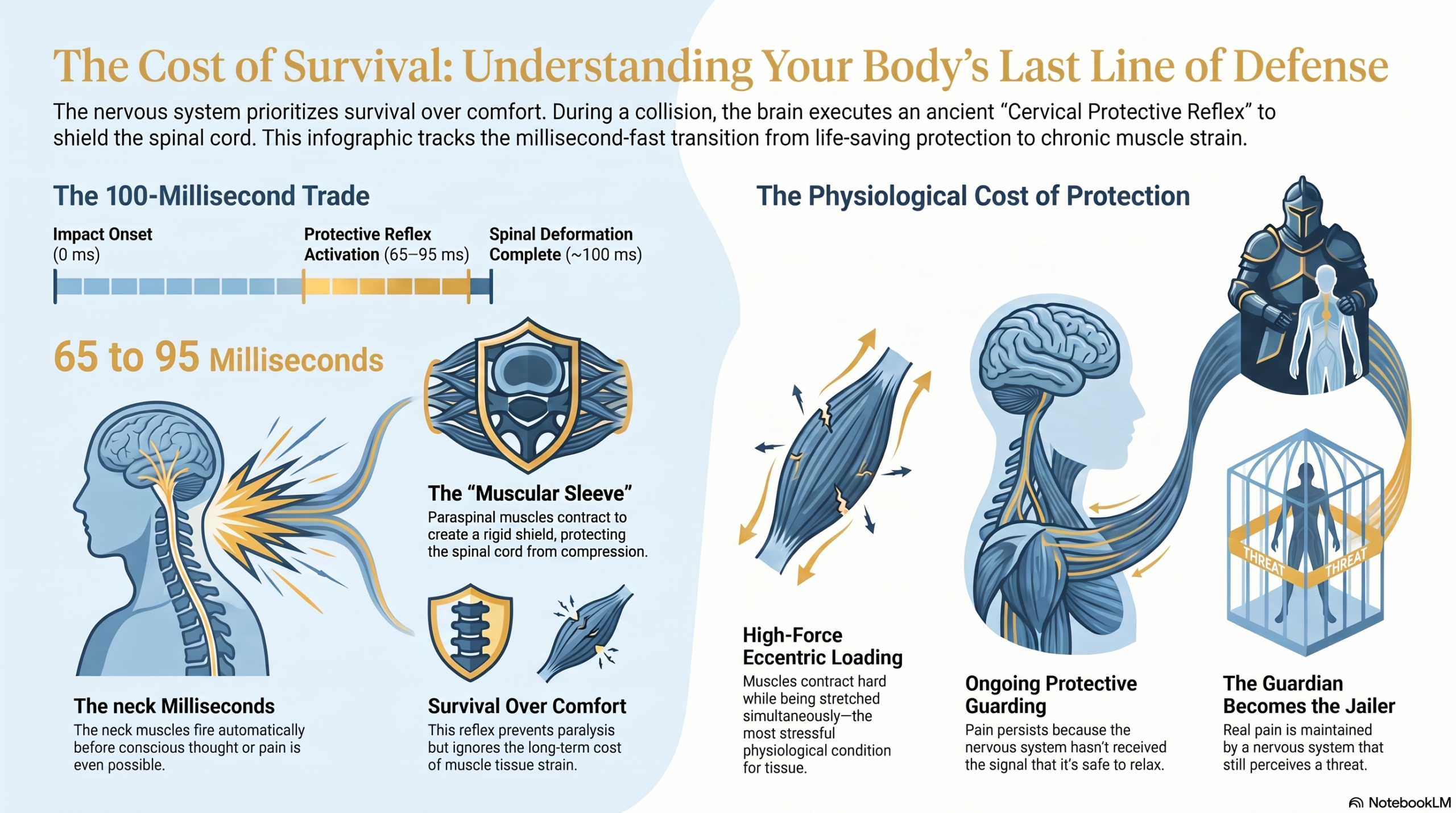
The muscles that saved your spinal cord are the same muscles that hurt afterward. The protection and the injury are not separate events. They are the same event, viewed from two different vantage points.
Why Pain Is Not the Problem
Here is the piece that most patients — and many clinicians — do not understand: pain after a whiplash injury is not primarily a signal of ongoing damage. It is, in most cases, a signal of ongoing protection.
The distinction matters enormously.
When tissue is damaged — when muscle fibers are strained, when joint capsules are stretched, when nerve endings in the facet joints are sensitized — the nervous system responds by upregulating the pain signal in the area. This serves a specific protective function: it discourages the person from using the injured tissue in ways that would worsen the damage. Pain after an acute injury is the nervous system saying: stay still, protect this area, give the tissue time to heal.
In the short term, this is adaptive. The problem arises when the pain signal persists beyond the time required for tissue healing, or when the nervous system — following the logic of its own priority hierarchy — decides to maintain a protective posture even after the acute threat has resolved.
Mats Panjabi’s neutral zone model, published in the Journal of Spinal Disorders in 1992, provides the theoretical framework for understanding how this happens. In Panjabi’s model, the spinal stabilizing system consists of three interacting subsystems: the passive osteoligamentous spine, the active musculotendinous system, and the neural control system. When any one of these subsystems is disturbed — including the neural control system — the entire stabilizing system is affected.
PMID 1490034 — Panjabi MM. J Spinal Disord. 1992.
When the neural control system of the spinal stabilizing mechanism is disturbed by injury or dysfunction, compensatory responses in the active musculotendinous system — including increased muscle tension and altered activation patterns — maintain stability at the cost of increased metabolic load and chronic muscle guarding. This protective response can persist well beyond the period of acute tissue injury.
What this means in plain language: when the nervous system perceives the cervical spine as unstable or threatened — even after the acute injury has resolved — it maintains the protective muscle contraction. The muscles stay tight. The joints stay guarded. The pain continues. Not because the tissue is still damaged, but because the nervous system has not yet received the signal that it is safe to stand down.
This is a crucial insight for patients. The pain is real. The nervous system is generating it for a reason. But the reason is not that something is still broken. The reason is that the nervous system — following its own survival logic — has not yet been given permission to relax.
The Fear-Pain Cycle: When the Guardian Becomes the Jailer
When patients experience persistent pain after an injury — especially pain that doesn’t match what they’ve been told — they frequently develop fear. Fear of movement. Fear that something is seriously wrong that the imaging has missed. Fear that the pain means the spine is fragile, unstable, or permanently damaged.
This fear is understandable. It is also, from a physiological standpoint, catastrophic for recovery.
Fear activates the same threat-response systems that the initial collision activated. The hypothalamic-pituitary-adrenal axis upregulates. The sympathetic nervous system increases its tone. And the cervical muscles — already in a state of protective guarding — receive another signal to stay contracted, stay vigilant, stay ready for the next threat.
Vlaeyen and Linton were among the first to document this pattern systematically, establishing that fear-avoidance beliefs were among the strongest predictors of chronic pain and disability following musculoskeletal injury. Subsequent research extended this model to whiplash, demonstrating that catastrophizing and fear of movement predicted chronicity more reliably than the severity of the initial injury.
PMID 10781906 — Vlaeyen JW, Linton SJ. Pain. 2000.
Fear of pain and movement — not the severity of initial injury — was the strongest predictor of chronic disability in patients with musculoskeletal conditions including whiplash. Catastrophizing beliefs about pain were associated with avoidance behavior, reduced activity, and progressive deconditioning that maintained and amplified the pain experience.
The mechanism is not mysterious. When a patient fears that movement will cause damage, they move less. When they move less, the muscles that are already guarding become more restricted. The joints that are already limited lose more mobility. The proprioceptive system — which depends on movement to calibrate its signals — receives less input and becomes less accurate. The pain, paradoxically, often increases. The patient interprets this increase as confirmation that their fears were correct. The cycle tightens.
Sterling and colleagues at the University of Queensland documented this pattern longitudinally in whiplash populations, showing that psychological distress measured at initial presentation predicted who would develop chronic symptoms at twelve months, independently of the initial physical findings.
PMID 12553500 — Sterling M, Jull G, Vicenzino B, Kenardy J, Darnell R. Pain. 2003.
Psychological factors including fear and distress at initial presentation were significant independent predictors of chronic pain and disability at twelve months following whiplash injury. Patients who catastrophized their pain or avoided movement showed progressive motor system dysfunction over time, including worsening deep cervical muscle inhibition and increasing pain sensitivity.
This is the point at which the nervous system’s protective instinct becomes its own obstacle. The guardian has become the jailer. The very mechanisms that protected the spinal cord during impact are now preventing the recovery that the body is capable of.
Understanding this cycle is not about telling patients their pain is psychological. It is not. The pain is real, the muscle guarding is real, the movement restriction is real. What is being explained is the mechanism by which a real physical process is being maintained by a nervous system that doesn’t yet know the emergency is over.
The Role of the Clinician: Translator Between Biology and Experience
The clinician’s role in post-whiplash care is not primarily to fix the patient. It is to translate.
What most patients need is not more imaging, not more reassurance that everything is fine, and not another prescription for muscle relaxants. What they need is a mechanistic account of what actually happened in their body, why it happened, and what it means. They need someone to explain that the nervous system operated on a survival hierarchy, not a comfort hierarchy. That when the collision threatened the cord, the muscles contracted — reflexively, involuntarily, necessarily — and that contraction was protective. That the pain they are experiencing is the cost of that protection, not evidence of something missed on the MRI.
They need to understand that avoidance behavior — turning the whole body instead of the head, avoiding exercise, refusing to challenge range of motion — is not protecting them. It is confirming the nervous system’s assessment that cervical movement is dangerous. Every avoided movement sends the nervous system one more data point supporting the conclusion that the head is unsafe to move.
Peter O’Sullivan and colleagues at Curtin University have developed and validated a cognitive functional therapy approach for musculoskeletal pain that integrates exactly this kind of mechanistic patient education with targeted movement rehabilitation. Their research shows that when patients understand the mechanism of their pain — when the pain is demystified, translated from “something is broken” to “my nervous system is protecting me” — their fear decreases, their movement improves, and their outcomes are substantially better than in standard physical therapy.
PMID 30074401 — O’Sullivan PB et al. Cognitive Functional Therapy: An Integrated Behavioral Approach for the Targeted Management of Disabling Low Back Pain. Phys Ther. 2018.
Cognitive functional therapy — combining mechanistic pain education with targeted functional movement rehabilitation — produced superior outcomes compared to manual therapy or exercise alone. The mechanism of benefit was attributed to reduction in pain catastrophizing and fear-avoidance behavior, combined with restoration of normal movement patterns.
The clinician’s role, in this framework, is not to fix the patient. It is to translate. To take the biology — the survival hierarchy, the reflexive contraction, the proprioceptive miscalibration, the fear-pain cycle — and render it comprehensible. To give the nervous system, through the patient’s understanding, the information it needs to reassess the threat level. The nervous system is not irrational. It is operating on the information it has. When the information changes, the output changes.
What the Research Says About Explaining Pain
The clinical value of mechanistic pain education — often called pain neuroscience education — is one of the most replicated findings in the musculoskeletal rehabilitation literature over the past two decades.
Lorimer Moseley at the University of South Australia has been the central figure in this research. In a landmark study, Moseley and colleagues compared patients with chronic low back pain who received biomedical education versus patients who received pain neuroscience education. The pain neuroscience education group showed significantly greater improvements in pain catastrophizing, fear of movement, and physical performance — and the improvements were sustained at follow-up.
PMID 12237186 — Moseley GL. Combined physiotherapy and education is efficacious for chronic low back pain. Aust J Physiother. 2002.
Patients with chronic low back pain who received pain neuroscience education showed significantly greater reductions in catastrophizing, fear-avoidance behavior, and pain intensity compared to biomedical education. Improvements were maintained at twelve-month follow-up.
Subsequent research by Nijs and colleagues extended these findings to whiplash populations specifically, demonstrating that pain neuroscience education reduced central sensitization indices, improved cervical range of motion, and reduced pain catastrophizing — effects not achieved by standard physiotherapy alone.
PMID 23748116 — Nijs J et al. A modern neuroscience approach to chronic spinal pain. Phys Ther. 2014.
Pain neuroscience education combined with cognition-targeted motor control training significantly reduced pain catastrophizing, cervical sensitization, and pain intensity in patients with whiplash-associated disorders, outperforming conventional physiotherapy at both short-term and twelve-month follow-up.
The mechanism is not mysterious. When patients understand that pain is a protective output of the nervous system — not a direct readout of tissue damage — they catastrophize less. When they catastrophize less, the sympathetic activation that maintains muscle guarding decreases. When the guarding decreases, movement becomes possible. When movement becomes possible, the proprioceptive system receives the input it needs. The nervous system, given evidence that movement is not catastrophic, begins to lower its threat assessment. The pain decreases.
This is not a placebo effect. This is the nervous system doing what it always does: updating its outputs based on new information.
The Takeaway: Survival Was Always the Goal
The nervous system prioritizes survival over comfort. It will always make that trade. Pain is sometimes the cost of a deal you didn’t consciously agree to — a contract signed in milliseconds, in the dark, by a biological system older than language.
What clinicians can offer is interpretation. We can explain the contract. We can show you what was paid and what was received, and why the transaction made sense even if the receipt is painful to read. We can give the nervous system — through the patient’s understanding — the information it needs to decide that the emergency is over.
That moment — when the mechanism is explained, when the biology is translated into meaning — is often when the cycle begins to break. The fear decreases. The guarding decreases. The movement returns. The nervous system, given evidence that the emergency is over, begins the process of standing down.
The cost of protection is real. But it is finite. And the nervous system, given the right conditions, knows how to stop collecting.
What to Do Now
If you are experiencing persistent pain, dizziness, or movement restriction after a motor vehicle collision — even one where your imaging was normal — book an evaluation at our Petaluma clinic. We will explain exactly what happened in your body, and we will build a rehabilitation plan that gives your nervous system a reason to stand down.
References
- National Highway Traffic Safety Administration. Lives saved by seat belts. NHTSA Technical Report. 2018.
- Siegmund GP, Blouin JS, Carpenter MG, Brault JR, Inglis JT. Electromyography of superficial and deep neck muscles during reflex and voluntary head movements. J Neurophysiol. 2007. PMID 22146280.
- Panjabi MM. The stabilizing system of the spine. Part II. Neutral zone and instability hypothesis. J Spinal Disord. 1992. PMID 1490034.
- Vlaeyen JW, Linton SJ. Fear-avoidance and its consequences in chronic musculoskeletal pain: a state of the art. Pain. 2000. PMID 10781906.
- Sterling M, Jull G, Vicenzino B, Kenardy J, Darnell R. Development of motor system dysfunction following whiplash injury. Pain. 2003. PMID 12553500.
- O’Sullivan PB et al. Cognitive Functional Therapy: An Integrated Behavioral Approach for the Targeted Management of Disabling Low Back Pain. Phys Ther. 2018. PMID 30074401.
- Moseley GL. Combined physiotherapy and education is efficacious for chronic low back pain. Aust J Physiother. 2002. PMID 12237186.
- Nijs J et al. A modern neuroscience approach to chronic spinal pain. Phys Ther. 2014. PMID 23748116.