PTSD After Car Accidents: More Common Than You Think
PTSD is a documented sequela of motor vehicle collisions that can be identified within the first 90 days using validated screening tools, yet most providers fail to screen for it despite its significant impact on recovery and case value.
The Number
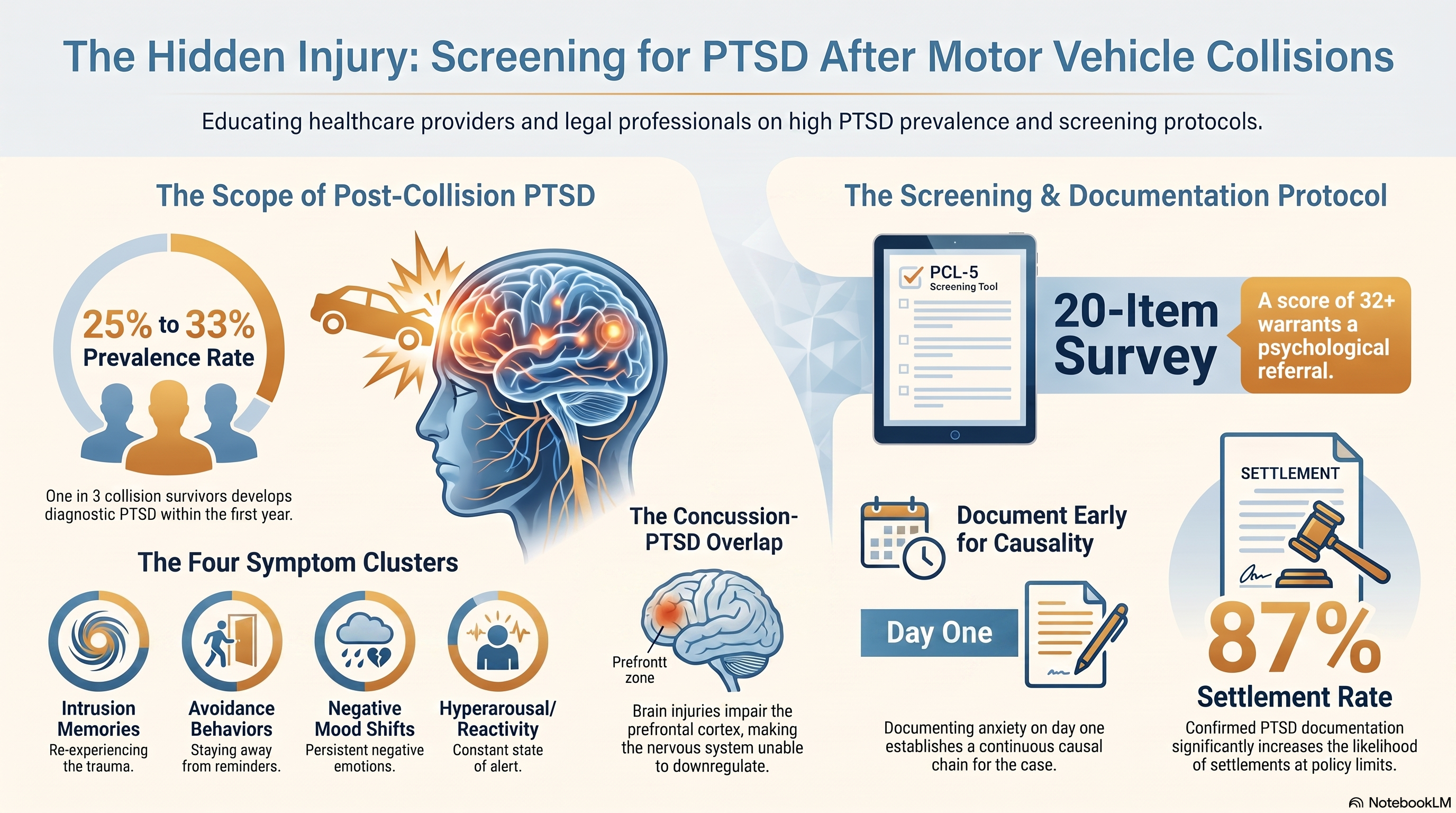
Between 25 and 33 percent of people involved in motor vehicle collisions develop post-traumatic stress disorder within the first year. Not anxiety that resolves in two weeks. Not hypervigilance that fades after the first few uneventful drives. Full diagnostic PTSD — intrusive memories, avoidance behaviors, negative alterations in cognition and mood, and hyperarousal — that meets DSM-5 criteria and persists for months or years without treatment.
That number is not from an obscure psychology journal. It is the consensus range from systematic reviews that have examined thousands of motor vehicle collision survivors across multiple countries and study designs. Motor vehicle collisions are, in fact, one of the single most common causes of PTSD in the civilian population. They outpace combat exposure in terms of absolute number of cases generated annually, simply because crashes are far more common than combat deployments.
The question is not whether PTSD follows motor vehicle collisions. It does — routinely and predictably, at rates that should make screening an automatic part of every post-collision clinical protocol. The question is why it remains undetected in most clinical settings, undocumented in most case files, and uncompensated in most settlements.
The answer is not that PTSD is difficult to find. There is a validated screening tool that takes three to five minutes to administer. It has a specific cutoff score. Positive results can be confirmed by a psychologist. The referral is within scope for any primary care provider. And documented, confirmed PTSD changes the trajectory of a case in ways that are measurable, significant, and directly tied to the completeness of the clinical record.
The answer is that most providers were never trained to look for it — and have never been told what they are missing.
What PTSD Actually Is After a Collision
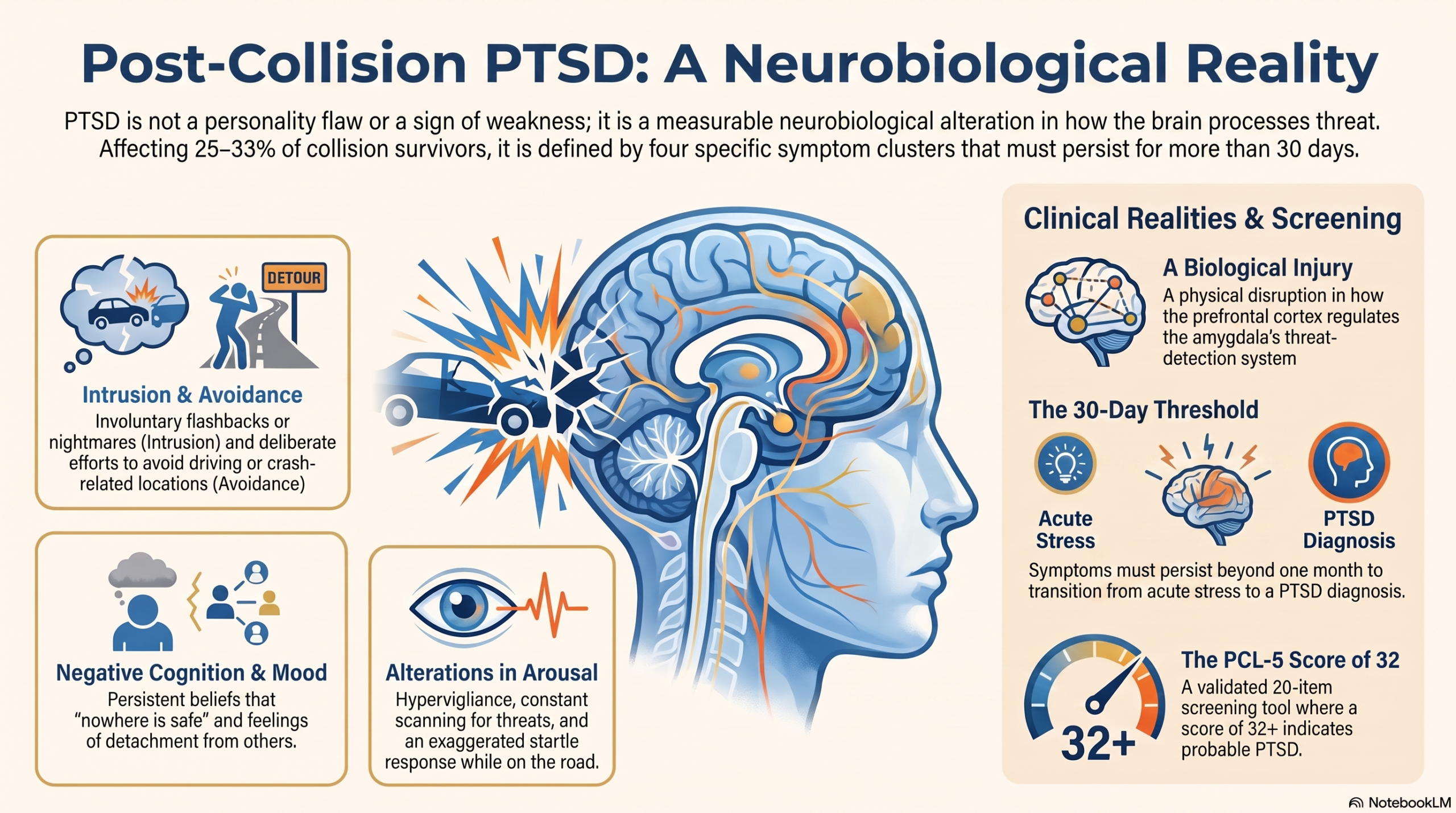
Post-traumatic stress disorder is not a personality flaw. It is not weakness. It is not an exaggerated response to something minor. It is a measurable neurobiological alteration in how the brain processes threat information — and it follows with remarkable predictability from the kind of sudden, life-threatening, involuntary experience that a motor vehicle collision represents.
The DSM-5 criteria for PTSD require exposure to a traumatic event involving actual or threatened death or serious injury, followed by symptoms in four clusters: intrusion, avoidance, negative alterations in cognition and mood, and alterations in arousal and reactivity. Motor vehicle collisions, especially those involving significant impact, loss of vehicle control, fear of dying, or witnessing serious injury, check the exposure criterion cleanly. What follows — the symptom clusters — is where providers and patients both tend to mislabel and miss.
Intrusion symptoms present as involuntary, distressing memories of the collision that intrude into waking consciousness without the patient choosing to recall the event. They present as nightmares with collision-related content. They present as flashbacks — dissociative episodes in which the patient re-experiences the crash as if it is happening in the present. They present as intense psychological distress or physiological reactivity — sweating, rapid heart rate, difficulty breathing — when exposed to stimuli that resemble the crash: the intersection where it happened, a vehicle similar to the one that hit them, a sharp braking sound, a yellow caution light.
Patients who experience these symptoms often do not describe them as flashbacks or intrusion. They say “I keep thinking about the accident” or “I had a bad dream” or “I can’t drive past that intersection” or “I tensed up when that car braked hard next to me.” These are clinical symptoms. They belong in the record.
Avoidance symptoms include deliberate efforts to avoid thoughts, memories, or feelings associated with the crash, and deliberate efforts to avoid external reminders — people, places, situations, activities, or objects. A patient who stops driving, who refuses to be a passenger, who changes their route to avoid the crash location, who declines social engagements because they involve being in a vehicle, is exhibiting diagnosable avoidance. The behavioral footprint of avoidance is directly measurable in terms of daily function.
Negative alterations in cognition and mood include persistent negative beliefs about oneself or the world (“I am helpless,” “Nowhere is safe”), persistent distorted blame of self or others, persistent negative emotional states — fear, horror, anger, guilt, shame — diminished interest in activities, feelings of detachment from others, and inability to experience positive emotions. This cluster often presents clinically as what looks like depression, which is not wrong — major depressive disorder and PTSD have significant comorbidity — but attributing the full presentation to depression when PTSD is the driving pathology leads to incomplete diagnosis and incomplete treatment.
Alterations in arousal and reactivity include irritable or aggressive behavior, reckless behavior, hypervigilance — the constant scanning of the environment for threat — exaggerated startle response, concentration problems, and sleep disturbance. These symptoms frequently overlap with concussion sequelae, creating a clinical picture where the PTSD is attributed to the head injury and the head injury is attributed to the neck pain and no one screens specifically for PTSD because everyone assumes someone else has handled it.
The duration criterion — symptoms must persist for more than one month — is important for understanding timing. Acute stress disorder is the diagnosis for the first month. PTSD is the diagnosis when symptoms persist beyond that window. The clinical implication is that a provider who does not reassess psychological status at the 30-day follow-up may never capture the transition from acute stress to diagnosable PTSD.
The PCL-5: A Validated Tool That Takes Minutes
The PTSD Checklist for DSM-5 — the PCL-5 — was developed and validated by the National Center for PTSD at the Veterans Affairs administration. It is a 20-item self-report measure that directly maps to the DSM-5 symptom criteria for PTSD. It has extensive psychometric validation across both veteran and civilian populations, including motor vehicle collision survivors specifically.
Each item asks the patient to rate how much they have been bothered by a specific symptom in the past month, on a scale from 0 (not at all) to 4 (extremely). Total scores range from 0 to 80. A score of 32 or higher indicates probable PTSD and warrants referral to a psychologist for confirmatory evaluation.
The PCL-5 takes three to five minutes to complete. It can be administered by a medical assistant during intake. It does not require a licensed mental health professional to administer — only to interpret a positive result clinically and confirm the diagnosis. It is free to use. It is widely available. It has been validated in the specific population — motor vehicle collision survivors — that fills most chiropractic and primary care post-collision practices.
The clinical protocol is straightforward: administer the PCL-5 at intake or at the first follow-up visit after the acute presentation has stabilized. Score it immediately. If the score is 32 or above, document the result in the clinical record, note the specific score, and refer to a licensed psychologist for confirmatory evaluation and treatment planning. If the score is below threshold, document it and reassess at 30 days if the patient remains symptomatic or if avoidance behaviors are present.
The documentation sentence is: “Patient completed PCL-5 screening on [date]. Total score: [X]. Score [meets / does not meet] the threshold of 32 for probable PTSD. [Patient was referred to [psychologist name] for confirmatory evaluation / Patient to be reassessed at 30-day follow-up given ongoing symptoms].”
Documentation language: “Patient completed PCL-5 screening on [date]. Total score: [X]. Score [meets / does not meet] the threshold of 32 for probable PTSD. [Patient was referred to [psychologist name] for confirmatory evaluation / Patient to be reassessed at 30-day follow-up given ongoing symptoms].”
That sentence took eleven seconds to read. It may represent the most important clinical notation in the chart — more impactful on case trajectory than any imaging report, more directly connected to comprehensive recovery than any manipulation protocol.
The Concussion-PTSD Overlap: Two Diagnoses, One Patient
The relationship between traumatic brain injury and post-traumatic stress disorder is not simply additive. It is multiplicative in its functional impact and synergistic in its pathophysiology.
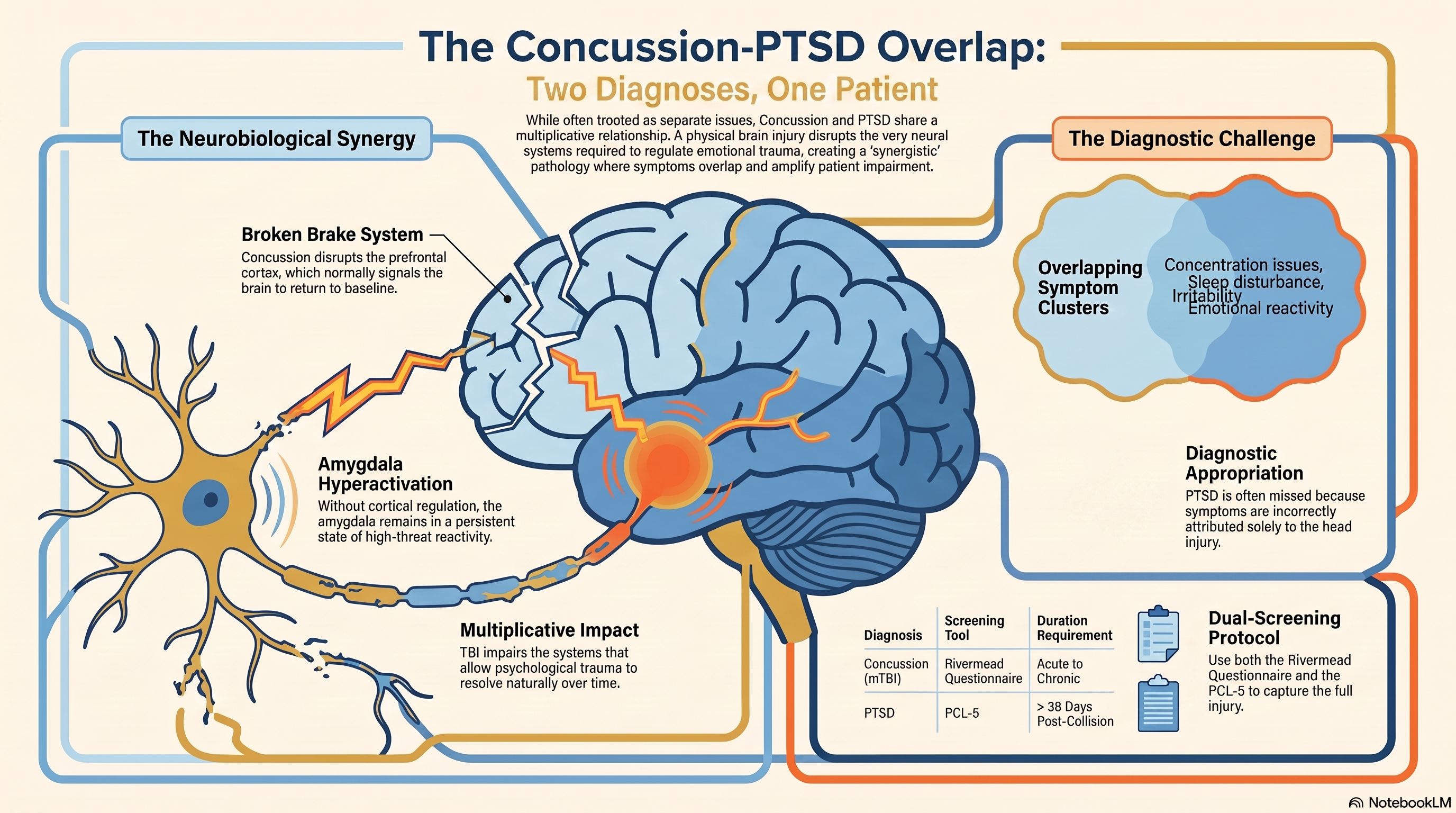
TBI — even mild TBI, even the kind that does not produce loss of consciousness, even the kind that does not show on CT — disrupts the prefrontal cortical systems that regulate emotional responses and the amygdala’s threat-detection system. The prefrontal cortex normally modulates amygdala reactivity, providing the “this is not actually dangerous” signal that allows the nervous system to return to baseline after a stressor. When the prefrontal cortex is disrupted by concussive injury, that modulation fails. The amygdala remains hyperactivated. Threat responses persist beyond the actual threat. The nervous system cannot downregulate.
This is the neurobiological mechanism by which concussion creates vulnerability to PTSD: the injury that impairs emotional regulation in the moment also impairs the system that allows psychological trauma to resolve over time. A patient with both a concussion and PTSD is not suffering from two separate problems that happened to co-occur. They are suffering from two conditions that are amplifying each other through a shared neurobiological mechanism.
The clinical implication is the instruction that the seminar formulated plainly: if there is a concussion, expect PTSD along the way. Not as a possibility. As an expected co-occurrence that should be screened for actively.
The overlapping symptoms — concentration difficulties, sleep disturbance, irritability, emotional reactivity, headaches that worsen with exertion — create a diagnostic challenge. Post-concussion syndrome can look like PTSD. PTSD can look like post-concussion syndrome. The patient who presents with both has a clinical picture that neither diagnosis alone fully explains.
The solution is not to choose between the diagnoses. It is to screen for both. The Rivermead Post-Concussion Questionnaire captures concussion symptom burden. The PCL-5 captures PTSD symptom burden. Administering both takes approximately ten minutes. The information generated by both changes the clinical picture from “post-collision patient with cognitive and emotional complaints” to “patient with documented concussion sequelae and probable PTSD requiring coordinated psychological and neurological referral.”
The second description is not only more accurate. It generates a fundamentally different level of case documentation — one that captures the full scope of the patient’s injury and its functional impact.
“If there is a concussion, expect PTSD along the way. Not as a possibility — as an expected co-occurrence that should be screened for actively.”
Driving Anxiety, Avoidance, and the Functional Footprint of Psychological Trauma
The functional impact of post-collision PTSD is often more visible in daily life than in a clinical examination, because the symptoms express themselves in what the patient can no longer do rather than in what a physical examination can detect.
Driving anxiety after a motor vehicle collision is among the most commonly reported functional consequences of collision-related PTSD, and it is also among the most commonly missed. Patients do not typically present saying “I have driving anxiety related to PTSD.” They say “I’m nervous on the freeway now.” They say “I don’t like being in the passenger seat.” They say “I’ve been having my husband drive me.” They say “I’ve been working from home because I don’t want to deal with traffic.”
Each of those statements, if it represents a change from pre-collision function, is a clinically significant symptom. Taken together, they describe the avoidance cluster of PTSD expressed through the most commonly collision-relevant behavior: being in a vehicle.
The specific presentations vary by patient and by crash circumstances. A patient who was rear-ended on the freeway may develop hypervigilance specifically at freeway speeds — scanning mirrors constantly, braking early, refusing to drive in the right lane. A patient whose crash occurred at an intersection may avoid that intersection specifically, or all signalized intersections, or may feel a surge of anxiety every time another vehicle approaches from the side. A patient who experienced a very close call — who felt they were about to die — may be unable to drive at all, even at slow speeds in familiar areas.
Agoraphobia — avoidance of situations where escape is difficult or help unavailable if panic occurs — can develop as an extension of collision-related PTSD. The patient who will not ride in an elevator because they cannot exit immediately if something goes wrong, the patient who declines concerts and restaurants because they need to be able to leave quickly, the patient who shops only in small stores during off-peak hours — these are post-collision patients whose PTSD has generalized beyond vehicle-related situations.
The functional footprint of this avoidance is measurable. It affects employment — if the job requires driving, or commuting, or being in vehicles, avoidance creates direct occupational impact. It affects social function — if social activities require driving, avoidance creates direct social impact. It affects family function — if the patient can no longer drive children to school or activities, the caregiving role is directly disrupted. These impacts are compensable. They belong in the clinical record. They belong in the case narrative. And they are only captured if someone asks.
The desensitization protocol for driving anxiety — gradual, supported exposure to vehicle-related stimuli in increasing increments — is an evidence-based psychological treatment for this specific presentation. It involves returning to the crash site, sitting in a stationary vehicle, driving in a parking lot, progressing to quiet streets, progressing to familiar roads, progressing to the crash location. A psychologist coordinates this treatment. The chiropractor or primary care provider’s role is to identify the problem, document it, and make the referral.
The Documentation Strategy: Starting on Day One
Post-collision PTSD follows a predictable temporal trajectory. Understanding that trajectory is what makes early documentation strategically essential rather than merely thorough.
In the hours to days following a collision, the dominant presentation is acute anxiety — heightened arousal, startle response, intrusive memories of the crash, difficulty sleeping, hypervigilance. This is normal neurobiological sequelae of a threatening event and does not yet meet criteria for PTSD. But it is the seed from which PTSD grows, and it is the beginning of a causal chain that the clinical record needs to capture in real time.
If acute anxiety is documented at intake — with a specific notation that the patient reports anxiety, intrusive memories of the crash, sleep disruption, and hypervigilance since the collision — then the clinical narrative that follows is continuous: acute anxiety documented at intake, progressing to avoidance behavior documented at two-week follow-up, progressing to depressive symptoms documented at six weeks, progressing to PCL-5 score of 38 documented at 30 days and confirmed by psychologist evaluation at 45 days.
If acute anxiety is not documented at intake and depressive symptoms appear at six weeks, a defense expert can argue that the depression is pre-existing, unrelated to the collision, or coincidental. Without the documented progression from collision-related anxiety to depression, the causal chain is broken and the clinical argument weakens.
Day-one documentation: Diagnose and document anxiety on day one if the patient reports it. Ask: “Since the accident, have you noticed more anxiety, nervousness, or trouble sleeping?” A yes answer produces a clinical notation. That notation becomes the first link in a causal chain that connects the collision to whatever psychological diagnosis follows.
The documentation instruction is explicit: diagnose and document anxiety on day one if the patient reports it. This does not require overreaching. It requires asking. “Since the accident, have you noticed more anxiety, nervousness, or trouble sleeping?” is a single-sentence question that every post-collision intake should include. A yes answer produces a clinical notation. That notation becomes the first link in a causal chain that connects the collision to whatever psychological diagnosis follows.
The five-item patient communication script is also documentation infrastructure: tell the patient that psychological responses to collisions are normal, expected, and treatable; tell them you are screening because it matters to their recovery; tell them that the screening result — if positive — will lead to a referral to a specialist; tell them that their psychological injuries are as real and as compensable as their physical injuries; and tell them to tell you if they are struggling to drive, struggling to sleep, or struggling to feel like themselves.
That conversation has two functions: it is therapeutic — it normalizes the patient’s experience and reduces the shame that often prevents disclosure — and it is documentary infrastructure for the clinical record.
The Legal and Insurance Calculus of Documented PTSD
PTSD has specific properties that make it unusually impactful in personal injury litigation.
First, it is objectively measurable. The PCL-5 provides a numerical score. A psychologist’s confirmatory evaluation produces a formal diagnosis with DSM-5 criteria documented. These are not subjective complaint reports. They are clinical measurements and professional diagnoses, produced by validated instruments and qualified evaluators. Defense attorneys and insurance adjusters cannot dismiss them the way a subjective pain report can be dismissed.
Second, PTSD is chronic. Studies of collision-related PTSD consistently find that a significant proportion of those affected remain symptomatic at one year, and a subset remains symptomatic much longer. The personal experience shared in the seminar was not atypical: PTSD from a motor vehicle accident persisting for fourteen years is documented in the clinical literature. Chronic PTSD has chronic functional impact. Chronic functional impact has chronic economic impact. Economic impact — in lost income, in reduced earning capacity, in cost of ongoing treatment — is directly calculated in damages.
Third, PTSD interacts with physical recovery in ways that are documented and legally significant. Untreated psychological trauma impairs physical rehabilitation outcomes. Patients with PTSD have reduced compliance with physical therapy, reduced participation in activities that promote recovery, reduced response to pain management interventions, and elevated rates of chronic pain sensitization. This means that a patient’s slower physical recovery — if PTSD is present and undocumented — creates a compounding effect: the physical injury is more severe in its functional impact because the psychological sequelae are impairing recovery, and neither the physical nor the psychological injury is being fully treated.
Fourth, PTSD referral and documentation can resolve cases rapidly. When PTSD is documented by screening, confirmed by a psychologist, and included in the case narrative with functional impact documented — avoidance behaviors, occupational impact, social impact, driving incapacity — cases move. Insurance carriers who are evaluating litigation risk assess confirmed PTSD documentation as a significant liability factor. The 87-percent settlement rate at or near policy limits within 90 days for properly documented cases is not theoretical. It reflects how insurance actuarial models assess the cost-benefit of defending against a case that includes a confirmed PTSD diagnosis with documented functional impact.
The provider who screens, documents, and refers is not doing legal work. They are doing clinical work — accurately and completely capturing what happened to a patient. The legal consequences follow from the clinical completeness.
“The provider who screens, documents, and refers is not doing legal work. They are doing clinical work — accurately and completely capturing what happened to a patient. The legal consequences follow from the clinical completeness.”
Why PTSD Goes Undetected After Collisions
The systematic under-detection of PTSD in post-collision care follows from several institutional and training failures that are predictable and correctable.
The physical-psychological bifurcation. Post-collision care is structurally organized around physical injury — cervical mechanics, imaging findings, pain management, functional restoration. The clinical training that produces chiropractors, physical therapists, and even many primary care providers emphasizes musculoskeletal pathology and largely omits psychological sequelae of trauma. Providers find what they were trained to find. They were trained to find a herniated disc, not a PCL-5 score.
The patient disclosure gap. Patients in acute physical pain are not reliably self-reporting psychological symptoms, for several reasons. They came in for their neck — that is the reason they made the appointment, and it is what they are focused on. They may not recognize their driving anxiety, their sleep disruption, or their irritability as injury symptoms — they may attribute them to stress, to life circumstances, or to personality. They may feel embarrassed about admitting that they are struggling psychologically, particularly if they have internalized beliefs about psychological toughness or about the legitimacy of psychological symptoms as injury. They will not volunteer what they have not been asked.
The diagnostic appropriation problem. Symptoms that belong to PTSD — sleep disturbance, concentration difficulties, irritability, emotional reactivity — are routinely attributed to the physical injury, to concussion, to pain, or to medication side effects. The diagnosis is appropriated by the physical framework before the psychological framework has a chance to apply. PTSD is attributed to the concussion, and the concussion is documented, and the PTSD is never screened for because everyone assumed the concussion explained the symptoms.
The referral ambiguity. Even providers who recognize psychological symptoms may be uncertain about whether it is within scope to address them, whether the patient will accept a mental health referral, or whether raising the issue will create friction in the clinical relationship. This ambiguity is resolved by understanding that screening is within scope, that referral is the clinical action — not treatment — and that most patients, when the topic is normalized, are relieved to have it addressed rather than offended.
The timeline mismatch. PTSD diagnosis requires one month of symptom duration. The most intensive period of post-collision clinical contact is typically the first four weeks, when the physical injury is being actively treated. By the time PTSD becomes diagnosable — at day 31 — the clinical contact frequency may have decreased, the focus has shifted to maintenance and documentation, and the window for systematic psychological screening may have been missed entirely.
Conclusion: The Diagnosis That Completes the Case
Post-traumatic stress disorder following a motor vehicle collision is not an incidental finding. It is not a rare complication. It is not something that falls outside clinical scope. It is a predictable, measurable, treatable, and legally significant sequela of one of the most common traumatic events in civilian life.
The collision happened in a second. The neurobiological consequences of that second — in spinal loading, in disc compression, in muscle injury, in brain acceleration — are what post-collision clinical care is designed to identify and document. But the nervous system’s response to threat does not end with the musculoskeletal injury. The threat response — the activation of the amygdala, the disruption of the prefrontal regulatory system, the consolidation of traumatic memory — is simultaneous with the physical injury. It is not a separate event. It is the same event, processed by a different system.
The PCL-5 takes five minutes. The referral to a psychologist takes a phone call. The documentation of anxiety at intake takes one sentence. The conversation that normalizes the patient’s experience and invites disclosure takes three minutes.
What those interventions capture — the full scope of what the collision did to a person, not just to their cervical spine — is the difference between a clinical record that accounts for one injury and a clinical record that accounts for all of them. Between a settlement that addresses physical trauma and a settlement that addresses the complete human cost of the event.
The patient sitting in the clinic has a neck injury and, in approximately one in four cases, they have PTSD. Both diagnoses exist in the same person, at the same time, from the same collision. The provider who documents both is providing complete care. The provider who documents only one is not.
The screening tool is available. The referral pathway is clear. The documentation is simple. The question — in every post-collision intake — is whether anyone thought to ask.
References
- Mayou RA, Ehlers A, Hobbs M. Psychological debriefing for road traffic accident victims. British Journal of Psychiatry. 2000;176:589–593.
- Blanchard EB, Hickling EJ, Taylor AE, Loos WR, Gerardi RJ. Psychological morbidity associated with motor vehicle accidents. Behaviour Research and Therapy. 1994;32(3):283–290.
- American Psychiatric Association. Diagnostic and Statistical Manual of Mental Disorders, 5th ed. (DSM-5). Washington, DC: APA; 2013.
- Weathers FW, Litz BT, Keane TM, et al. The PTSD Checklist for DSM-5 (PCL-5). National Center for PTSD. 2013. Available at: www.ptsd.va.gov.
- Bryant RA. Post-traumatic stress disorder vs traumatic brain injury. Dialogues in Clinical Neuroscience. 2011;13(3):251–262.