When the Body Speaks in Whispers
She came in for neck pain. Forty-eight years old, rear-ended on 101 near Petaluma six weeks earlier, twenty miles an hour, bumper damage but nothing dramatic. Her neck ached. That's what she wanted me to fix.
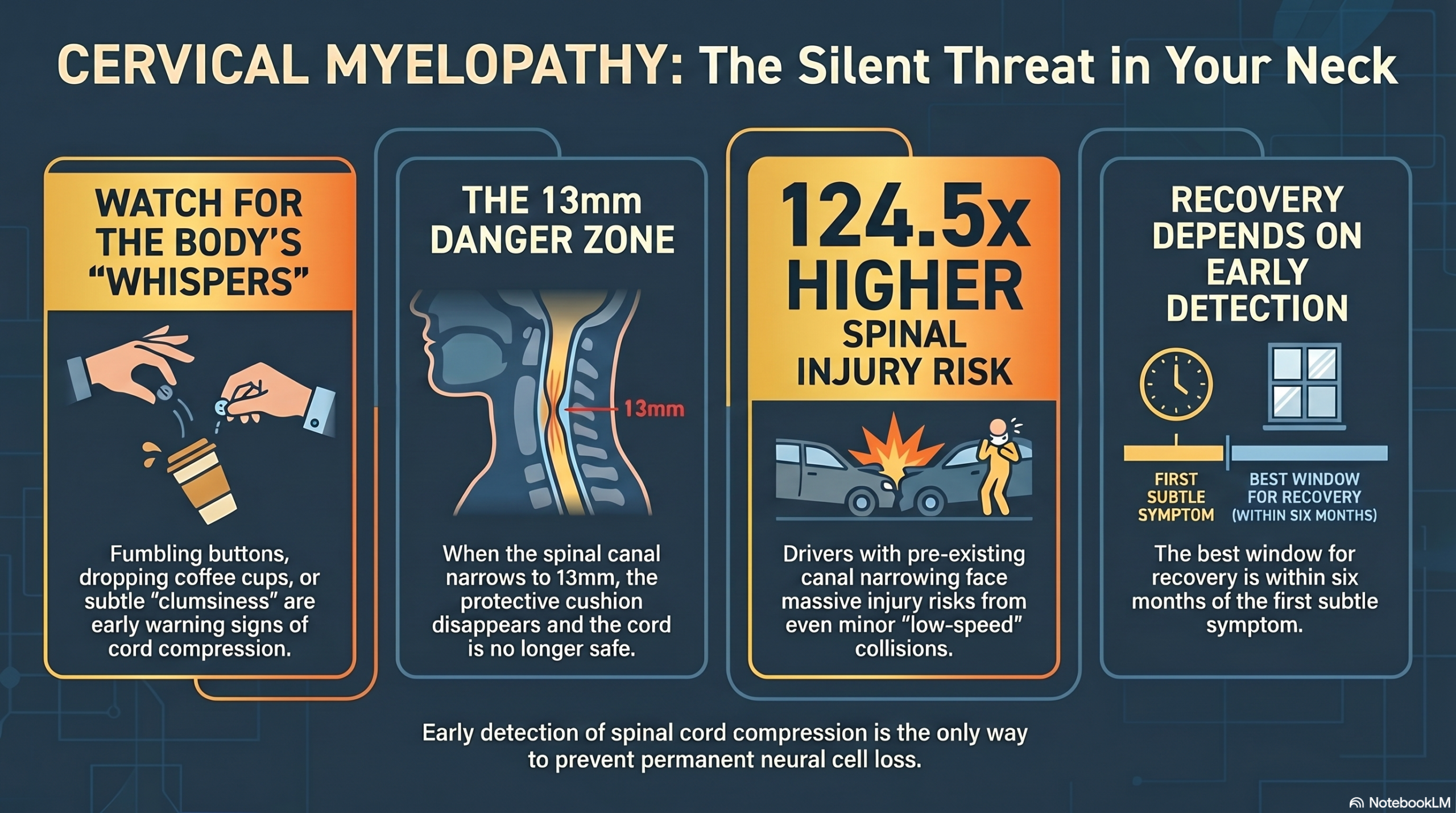
Ten minutes into the intake, almost as an afterthought, she mentioned she kept dropping her coffee cup. "I think I'm just tired," she said. Her husband had started teasing her about walking into doorways. Three times in the last month her right hand had gone numb for ten minutes and then returned to normal. She'd stopped wearing button-up blouses because the buttons had become, in her words, "weirdly hard."
I stopped writing. I told her I'd still help her with her neck — but first we had to talk about her spinal cord.
In more than two decades of practice, I've watched this pattern cost people years of their lives. Not because they didn't seek care. Because no one they saw asked the right questions. Myelopathy — compression of the spinal cord inside the bony canal of your neck — rarely announces itself. It whispers. It drops coffee cups. It fumbles buttons. It trips on a curb and calls it clumsiness. By the time it shouts, irreversible damage has often already been done.
I'm writing this for everyone who's been in a collision, who has an aging neck, who has watched a partner become a little less coordinated and assumed it was just stress. I want you to know what the research actually says, what to watch for, and why every chiropractor, primary care doctor, and attorney who touches post-collision patients should be screening for this. Silence, in the cervical spine, is not safety.
What Is Cervical Myelopathy, Exactly?
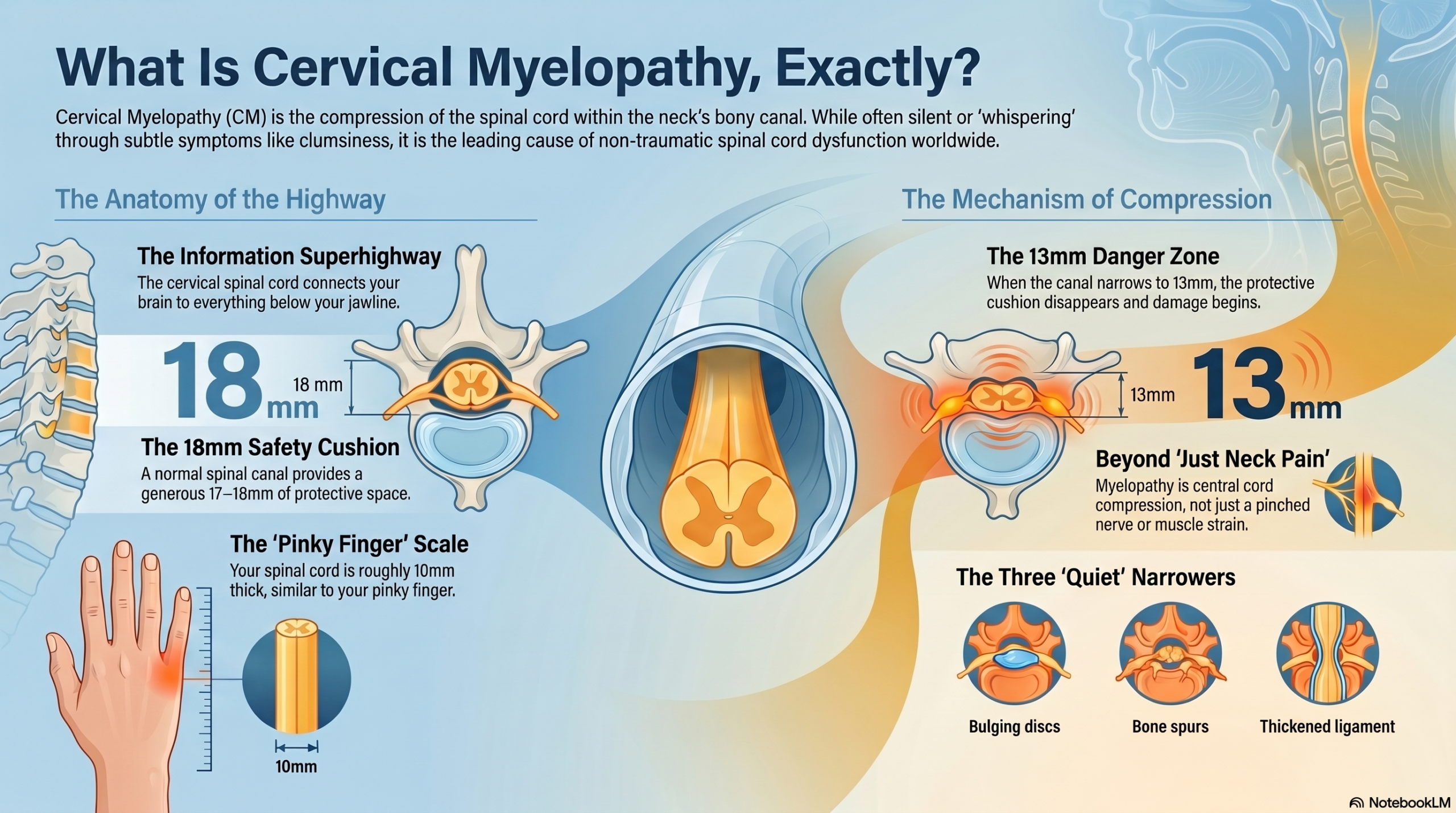
Let me tell you what's sitting inside your neck. Seven vertebrae, stacked like building blocks, each separated by a disc. Running down the middle of that stack is a bony tunnel called the spinal canal. And inside that canal, suspended in cerebrospinal fluid, is the cervical spinal cord — the information superhighway connecting your brain to everything below your jawline.
That cord is about as thick as your pinky finger. The canal surrounding it is supposed to be generous — a normal mid-cervical canal measures around 17 to 18 millimeters in its front-to-back dimension. The cord itself takes up maybe 10 millimeters. That cushion of space matters. It's what allows you to flex, extend, and rotate your neck without compressing neural tissue.
Now imagine the canal getting smaller. A bulging disc. A bone spur from years of wear. Thickened ligaments that lose their elasticity. A congenital narrowing you were born with but never knew about. Any of these can shrink that protective space. When the canal narrows to around 13 millimeters — when that cushion disappears — the cord is no longer safe. It's pressed against bone and ligament. And every time you move, you're irritating neural tissue that has nowhere to go.
That's cervical myelopathy. Not a radiculopathy (which is a pinched nerve leaving the spine to go to an arm). Not a muscle strain. Not a disc bulge causing "just" neck pain. Myelopathy is compression of the central cord itself — the part of your nervous system that coordinates your hands, your legs, your bladder, your balance. Degenerative cervical myelopathy is the most common form of non-traumatic spinal cord dysfunction in adults over fifty, and the single most common cause of spinal cord impairment worldwide.
What trauma does is expose what was already happening silently. A rear-end collision doesn't usually create myelopathy out of nothing in an otherwise healthy neck. But it absolutely can push a silently compromised cord into symptomatic territory — or accelerate a slow process that had been quietly unfolding for years. That's the part the emergency room doesn't always catch. That's the part I watch for.
The Research: Why Early Matters So Much
Evidence Box 1 — The Natural History Is Not Benign
One of the most persistent myths in medicine is that mild myelopathy is something you can safely "watch." The literature disagrees.
Research Evidence
PMID 19769489 — Baron & Young, Neurosurgery, 2007. Once symptoms begin, the disease course is typically stepwise deterioration punctuated by quiescent periods. Return to normal function without treatment is rare.
PMID 23963004 — Tetreault et al., 2013. In asymptomatic cervical stenosis, the risk of developing overt myelopathy is ~3% per year, and electromyographic abnormalities or clinical radiculopathy significantly increase that risk.
PMC5684834 — Karadimas et al., Global Spine Journal, 2017. Chronic mechanical compression drives progressive neural cell loss through apoptosis, neuroinflammation, and vascular compromise.
When someone tells you, "Let's just monitor it," they are making a bet against physiology. Sometimes that bet pays off. Often it doesn't. I'd rather make decisions with clear eyes.
Evidence Box 2 — The Symptoms Start Small and Get Missed
If I asked you to picture a spinal cord problem, you'd probably imagine paralysis. Wheelchair. Obvious dysfunction. The reality is far subtler — and that's exactly why it gets missed.
Research Evidence
PMID 40011743 — Scoping review, 2025. Earliest DCM presentations are mundane: bilateral hand numbness, loss of fine motor control (buttons, zippers, handwriting), subtle gait imbalance, and unexplained falls. Most patients see at least two providers before diagnosis.
PMC10982913 — Hand manifestations review, 2024. "Myelopathy hand" — slowed rapid grip-and-release — is highly specific but rarely elicited in routine exams.
PMID 41131090 — Prospective diagnostic accuracy study. Altered hand sensation: 76% sensitivity, 90% specificity. Hand incoordination: 52% sensitivity, 92% specificity.
Here's the part I need you to hear: the people I've missed in the past weren't hiding anything. They were describing exactly what myelopathy looks like at the beginning. I just wasn't asking the right questions. Now I ask every post-collision patient if they've dropped anything recently, if their handwriting has changed, if they've been surprising themselves with clumsiness. You'd be astonished how often they say yes.
Evidence Box 3 — Pre-existing Stenosis Multiplies Collision Risk
If you already have a narrow canal — from spondylosis, disc wear, or the neck you were born with — a rear-end collision is not a minor event for your spinal cord. It's a biomechanical earthquake.
Research Evidence
PMID 37341525 — Stemper et al., 2023. In a validated finite element model, a 6 mm stenotic canal subjected to a 2.6 m/s whiplash impact produced spinal cord stress/strain exceeding SCI thresholds. Normal-diameter canals did not.
PMID 23793521 — SCIWORA analysis. Relative risk of traumatic cervical SCI was 124.5× higher with pre-existing canal stenosis.
PMC5851023 — Whiplash + degeneration review. Whiplash on a degenerated neck is a clinically distinct entity that may declare itself over days to weeks.
This is why I can't accept the insurance adjuster's framing that a low-speed collision is medically insignificant. For a subset of drivers — and we cannot identify them without imaging — that same collision is a cord-stress event measurable in the finite element lab. The car may be fine. The human may not be.
Evidence Box 4 — Physical Exam Signs Are Helpful, But Imperfect
You've probably heard of the Hoffmann sign or the Babinski reflex. These are the classic "upper motor neuron" signs. They're real. They matter. But they're not infallible.
Research Evidence
PMID 37903098 — Systematic review/meta-analysis, 2023. Hoffmann sensitivity 8–59%; specificity 49–85%. Babinski sensitivity 7–53%; specificity 92–100%. No single sign is sensitive enough to rule out myelopathy.
PMID 18928217 — Hoffmann sign clinical correlations, Spine, 2008. A present Hoffmann sign should prompt MRI even in asymptomatic patients.
PMID 26949460 — Pyramidal signs sensitivity, 2016. Hyperreflexia, clonus, and inverted radial reflex together perform better than any single sign.
Translation: a good physical exam is a screening tool, not a final answer. When I find a Hoffmann or sustained clonus, I'm ordering an MRI. When the exam is clean but the patient describes hand clumsiness, delayed numbness, or unsteady gait after a collision — I'm still ordering an MRI. The exam tells me when to worry more. It rarely tells me when to stop worrying.
Evidence Box 5 — Time Matters for Recovery
If you take one thing from this article, take this: the longer myelopathy is untreated, the less the cord recovers.
Research Evidence
PMID 24048552 — Fehlings et al., AOSpine NA multicenter study, 2013. mJOA improves after decompression across all severities, but shorter symptom duration and milder preoperative deficit produce the largest gains.
PMID 29462066 — Severe DCM outcomes. Even in mJOA ≤ 8 patients, decompression helps — but two-thirds still have moderate-severe residual deficits at 2 years.
PMID 36149088 — Quality Outcomes Database, 2022. Longer symptom duration independently predicted failure to reach MCID on mJOA after surgery. Waiting hurts.
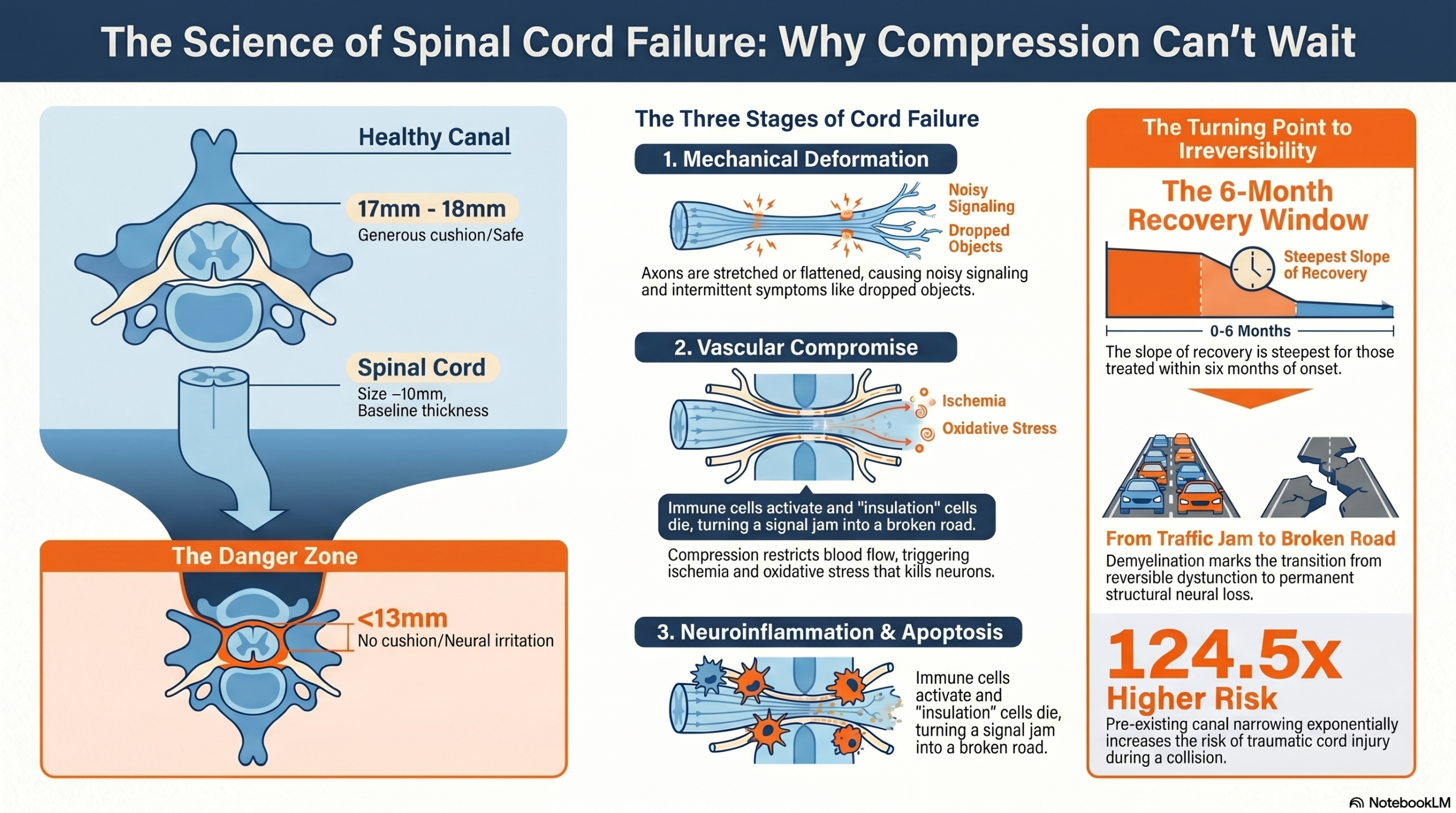
The treatment window for best recovery is often described as roughly six months from symptom onset. That is not a hard cutoff — people outside that window still benefit. But the slope of recovery is steepest for those caught early. The most common reason for a bad outcome is not a bad surgeon. It's a late diagnosis.
The Deeper Science: How a Compressed Cord Actually Fails
I want to take you under the hood for a minute, because understanding the mechanism changes how urgently you act.
Your spinal cord is not a passive cable. It's a living, metabolically demanding tissue bathed in cerebrospinal fluid and fed by a delicate vascular network. When it's compressed — even gently but chronically — three things happen in sequence.
First, mechanical deformation. The cord is squished. Axons, the long signal-carrying fibers, get stretched or flattened. In the short term they still conduct, but signaling slows and becomes noisy. This is why early myelopathy produces odd, inconsistent symptoms: intermittent numbness, occasional dropped objects, a foot that sometimes catches on the carpet. The wiring still works, but the bandwidth is shrinking.
Second, vascular compromise. The anterior and posterior spinal arteries, along with tiny penetrating vessels that feed the gray matter, are the most vulnerable structures in the cord. When the canal narrows, perfusion suffers. Karadimas and colleagues have shown that chronic ischemia triggers a cascade of oxidative stress, endothelial dysfunction, and disruption of the blood-spinal cord barrier. Neurons begin dying in a low-grade, chronic way you cannot feel — until you do.
Third, neuroinflammation and apoptosis. Microglia — the resident immune cells of the spinal cord — become activated. Pro-inflammatory cytokines accumulate. Oligodendrocytes, the cells that wrap axons in the myelin sheath that makes signaling fast, undergo programmed cell death. Once demyelination sets in, the conduction deficit begins to look less like a traffic jam and more like a broken road. That's the transition from reversible to partially reversible dysfunction. And it's silent. You cannot feel an oligodendrocyte dying.
This is why "watch and wait" for mild but real myelopathy is a gamble I personally am not willing to make with a patient's cord. Every month of ongoing compression is a month of demyelination, ischemia, and neural loss you cannot recover by adjusting a vertebra later.
Once you understand this, the clinical urgency is no longer an opinion. It's physiology.
What a Proper Screening Visit Actually Looks Like
When a post-collision patient walks into my Petaluma office, I don't just palpate their neck and adjust them. Here's what actually happens — and here's what I wish every first-contact provider did.
History — I ask the questions no one else asks. Have you dropped anything lately that surprised you? Has your handwriting changed? Any numbness or tingling in both hands, especially at rest or at night? Any unsteadiness in the dark or in the shower? Any new urinary urgency? When you walk down stairs, do your legs feel reliable? Have you noticed electric-shock sensations running down your spine or into your limbs when you bend your neck? That last one — Lhermitte's sign — is a classic early finding that almost no one volunteers.
Physical examination — I go beyond range of motion. I test deep tendon reflexes in upper and lower extremities and look for differences between levels. I check the Hoffmann sign bilaterally. I ask patients to rapidly grip and release ten times — "myelopathy hand" shows up here. I perform tandem gait and look for the subtle wobble that's easy to miss. I test proprioception at the great toes. I check vibration sense with a tuning fork. These are old-school neurological tools, and they matter.
Red flags — I trust them when they appear. Bilateral hand symptoms. Gait imbalance. Bladder urgency. Hyperreflexia. Lhermitte's phenomenon. A positive Hoffmann. Any one of these in a post-collision patient triggers an MRI — specifically T2-weighted sagittal images so I can see cord signal change, the fingerprint of chronic compression stress.
Important
When I suspect myelopathy, I do not adjust a neck. Manipulation in the presence of unrecognized cervical cord compression has been associated with symptom exacerbation and, rarely, acute neurological decline. The right move is to refer for imaging and co-manage with a spine specialist. I can still help these patients — through gentle mobilization, posture correction, rehabilitation, guidance — but high-velocity cervical manipulation is off the menu until the cord is cleared.
Documentation — because I work a lot of personal-injury cases. I write down every finding, positive and negative. I note the exact questions I asked and the patient's exact answers. When an attorney later asks why I ordered imaging, the record tells the story. When an insurance company argues that "nothing was wrong," my documentation says otherwise.
The whole visit takes about an hour. An hour is cheap insurance for a cord.
What This Means for You
If you've been in a collision — even a minor one — and you've noticed any of the following, take it seriously and ask your provider about the possibility of cervical myelopathy:
- Dropping things more than usual
- A change in your handwriting
- Trouble with buttons, zippers, or small fasteners
- Numbness or tingling in both hands
- Feeling unsteady walking, especially in the dark or on stairs
- New urinary urgency
- Electric-shock feelings down your spine or into your limbs when you bend your neck
- Any sense that your body is "not quite listening" the way it used to
Important
Do not wait for the symptoms to become dramatic. Dramatic is late.
If your provider has not asked about these symptoms, ask anyway. If your provider tells you it's "just whiplash" or "just aging" and does not examine for upper motor neuron signs, get a second opinion. If imaging has not been considered and you have two or more of the findings above, advocate for an MRI.
If you're in the North Bay and you're not sure where to start, come see me. I treat over a thousand post-collision patients in Sonoma County, and part of what I've learned since 2002 is that the people who recover best are the ones whose earliest, most subtle symptoms were taken seriously. The cord is a generous organ. It gives you warning. But it does not wait forever for someone to listen.
Silence is not safety. Whispers are not nothing. And if you think your body is trying to tell you something — you're probably right.
References
- Baron EM, Young WF. Natural history of cervical spondylotic myelopathy. Neurosurgery. PMID 19769489.
- Tetreault L, et al. Pathophysiology and natural history of CSM. Neurosurg Clin N Am. PMID 23963004.
- Karadimas SK, et al. Natural history of DCM: updated systematic review. PMC5684834.
- Clinical signs and symptoms for DCM: scoping review. PMID 40011743.
- Hand manifestations of cervical myelopathy. PMC10982913.
- Diagnostic accuracy of symptoms and signs of DCM. PMID 41131090.
- Stemper BD, et al. Cervical stenosis and rate of impact on SCI risk in whiplash. PMID 37341525.
- Cervical spinal canal stenosis and traumatic SCI without major fracture. PMID 23793521.
- Pathology and treatment of traumatic cervical spine syndrome: whiplash. PMC5851023.
- Clinical signs in DCM: systematic review and meta-analysis. PMID 37903098.
- Clinical correlations of cervical myelopathy and the Hoffmann sign. PMID 18928217.
- Sensitivity of pyramidal signs in CSM. PMID 26949460.
- Fehlings MG, et al. AOSpine NA surgical decompression study. PMID 24048552.
- Surgical decompression in very severe DCM. PMID 29462066.
- mJOA correlation with functional outcomes after DCM surgery. PMID 36149088.
- Identification of DCM in the chiropractic office. PMID 36415361.
- Manipulation in cervical spinal cord compression: a case series. PMID 16584950.