The Hidden Signs of Healing: Recognizing Wellness Beyond Pain Relief
Most patients measure chiropractic progress solely by pain reduction, missing the subtle functional improvements that signal true healing—better sleep, easier movement, improved energy, reduced muscle tension, enhanced balance, and greater resilience. These nuanced changes between acute pain and complete wellness are the real markers of neurological and biomechanical restoration.
Introduction: The Investment No One Planned to Make
In 25 years of chiropractic practice, I've noticed something interesting about patients who initially came in because of pain: the ones who get the most value from care are the ones who stop measuring success by pain and start measuring it by performance.
You might have scheduled that first appointment because your neck hurt after a car accident, or your back seized up at work, or you had a headache that wouldn't quit. Pain is a compelling motivator. It gets you in the door.
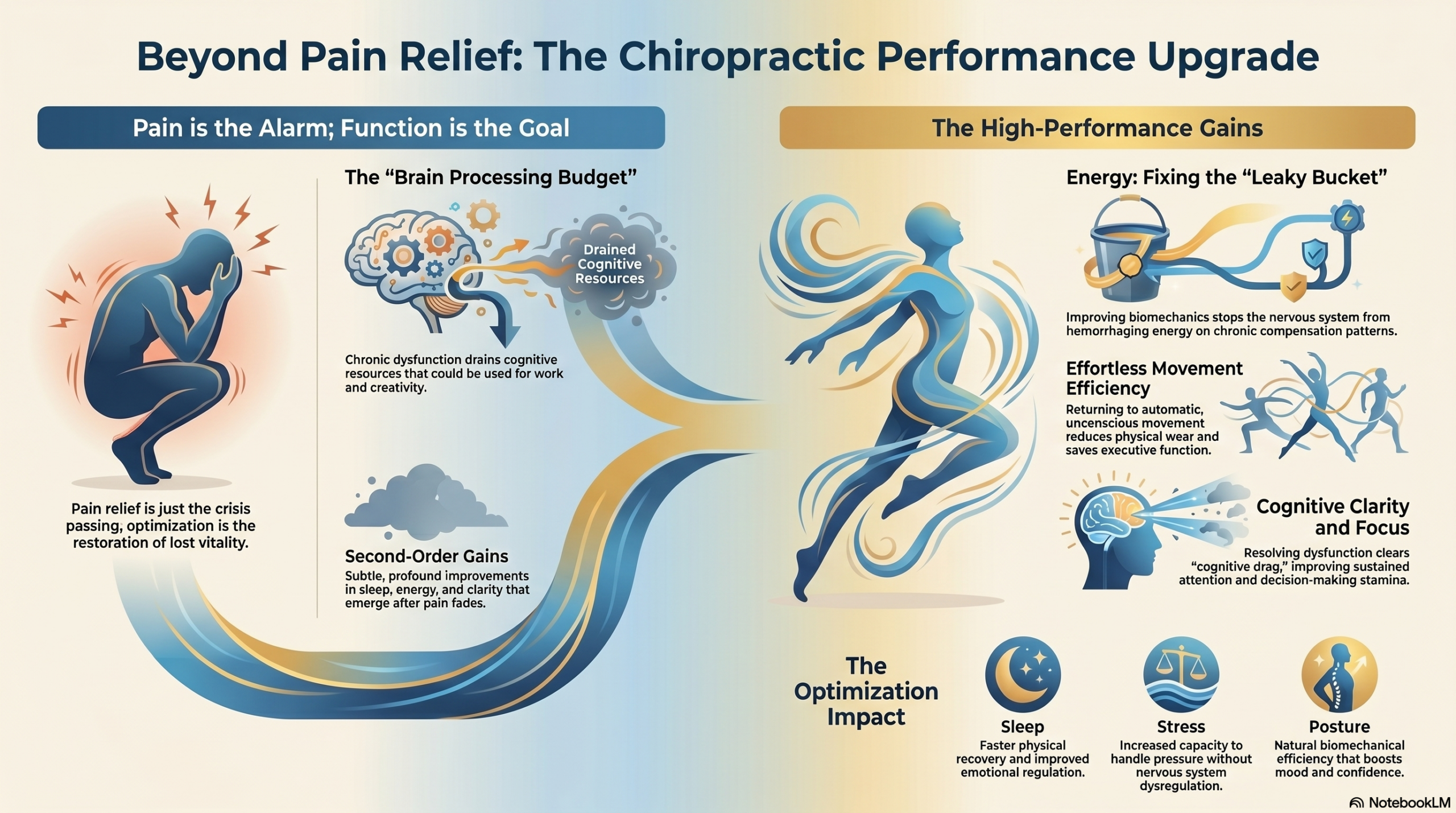
But here's what I've learned from watching thousands of patients move through care: the real value proposition isn't pain relief—it's the restoration and optimization of function that most people didn't even realize they'd lost.
Pain is usually the first thing to resolve. Within a few weeks, most patients feel significantly better. The alarm has quieted. And at that point, they face a choice: stop care now that the crisis has passed, or continue investing in the harder-to-articulate benefits that are just beginning to emerge.
The patients who continue are the ones who start noticing what I call the "second-order gains"—improvements in sleep quality, energy, mental clarity, stress resilience, movement efficiency, and overall sense of vitality.
These aren't side effects. These are the actual effects. They're what your body can do when it's no longer spending all its resources managing dysfunction.
This essay is about those second-order gains—the subtle, profound improvements in human performance and well-being that happen when your nervous system and biomechanics are operating at a higher level. These are the reasons patients who came in for a three-month injury treatment plan end up staying in maintenance care for years.
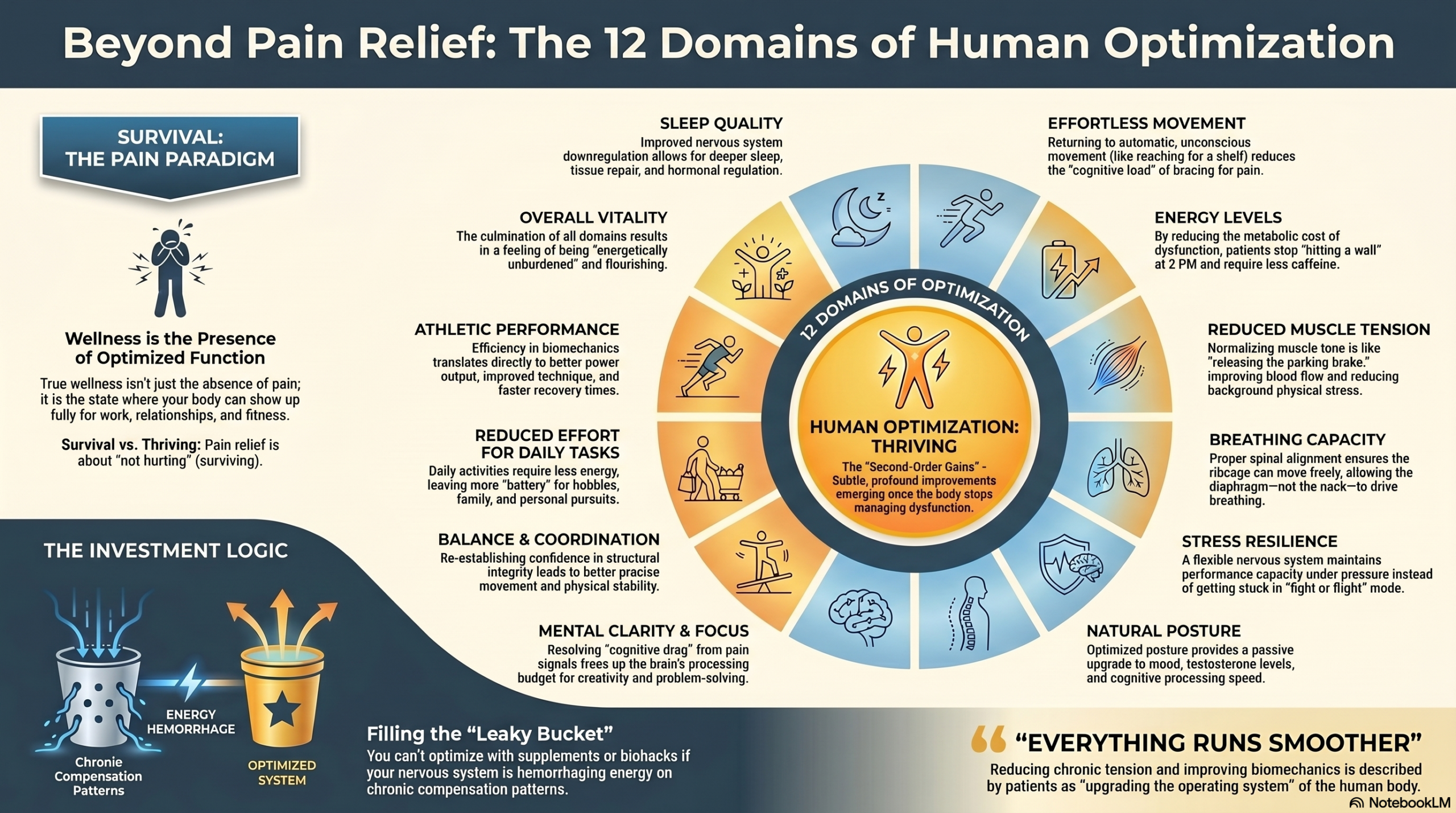
I'm going to walk you through twelve specific domains where you might notice optimization occurring. I'll explain the neuroscience and biomechanics behind why these changes matter. And I'll help you recognize them in your own experience, so you can make an informed decision about whether the investment in ongoing care is worth it for you.
Because here's the truth: wellness is not the absence of pain. It's the presence of optimized function.
And optimized function is what allows you to show up fully in your life—at work, in your relationships, in your fitness pursuits, in how you navigate stress, in how much energy you have for the things that matter.
Sleep Quality: The Foundation of Everything
Let me start with something that almost every patient notices but rarely expected: profound improvements in sleep.
You might not have mentioned sleep problems during your initial visit because you came in for neck pain, not insomnia. But three to four weeks into care, something shifts. You're falling asleep faster. Sleeping more deeply. Waking up fewer times during the night. And most importantly: waking up feeling actually restored instead of groggy and stiff.
This is your nervous system achieving better autonomic balance.
The Neuroscience of Sleep Optimization
Your autonomic nervous system has two branches: sympathetic (activation, performance, stress response) and parasympathetic (recovery, digestion, restoration). High performers—whether athletes, executives, or just people trying to do life well—need both. But they need them in the right proportion and at the right times.
When your body is compensating for biomechanical dysfunction, your sympathetic tone stays chronically elevated. You're in a low-grade state of activation even when you should be recovering. This is metabolically expensive and prevents deep, restorative sleep.
Research shows that spinal manipulation significantly improved sleep quality through measurable reductions in sympathetic nervous system activity. Patients showed improved heart rate variability—a key marker of stress resilience and recovery capacity.
What This Means for Performance
Elite athletes and biohackers obsess over sleep because it's the ultimate performance multiplier. Deep sleep is when your body repairs tissue, consolidates learning, regulates hormones, and clears metabolic waste from your brain.
When patients tell me they're sleeping better—even if they never told me they were sleeping poorly—I know their nervous system is downregulating appropriately. They're accessing recovery states more efficiently.
Better sleep means better cognitive performance, faster physical recovery, improved emotional regulation, and enhanced immune function. If you're investing time and money in supplements, tracking devices, and optimization protocols, but your nervous system can't access deep sleep because of spinal dysfunction, you're leaving massive gains on the table.
If chiropractic care improves your sleep, that alone could justify the investment—because sleep improvement cascades into every other area of performance and well-being.
Freedom of Movement: Effortless Efficiency
Here's a question I ask patients a few weeks into care: "How's getting in and out of the car?"
They usually pause. "Actually… I hadn't thought about it. It's fine."
That's the point.
The Cost of Compensation
When you're injured or dysfunctional, every movement requires conscious strategy. You're bracing, planning, compensating. This uses executive function—the cognitive resources you could be using for work, creativity, or decision-making.
As function improves, movement becomes automatic again. You reach for something on a high shelf without pre-planning. You turn to check your blind spot while driving without that catch. You bend down to pick something up without negotiating with yourself about whether it's worth it.
This return to unconscious, automatic movement is a profound neurological achievement.
A 2019 study in Gait & Posture found that even when pain levels were moderate, patients with neck dysfunction showed altered motor control—slower, more rigid movement with less variability. These patterns persisted even after pain improved with conventional treatment, but normalized when motor control was specifically addressed through manual therapy.
Why This Matters for Performance
In every domain—sports, fitness, manual labor, even just navigating daily life—movement efficiency is the difference between thriving and surviving.
When you move efficiently:
- You use less energy to accomplish the same tasks
- You reduce wear and tear on joints and tissues
- You have more capacity available for actual performance
- You reduce injury risk
For athletes, this is obvious. But even if you're not an athlete, movement efficiency affects everything: how much energy you have at the end of a workday, whether you can play with your kids, whether you can maintain an exercise routine without constant setbacks.
When patients tell me they're moving more freely—checking blind spots, reaching overhead, getting up from chairs without thinking about it—I know their nervous system has re-established confidence in their body's structural integrity.
Effortless movement isn't a luxury. It's a baseline requirement for optimized human performance.
Energy Levels: The Ultimate Currency
One of the questions I ask at every follow-up: "How's your energy throughout the day?"
Most people don't expect this from their chiropractor. But energy is the ultimate performance metric. You can have all the knowledge, skills, and opportunity in the world, but if you don't have the energy to execute, none of it matters.
The Metabolic Cost of Dysfunction
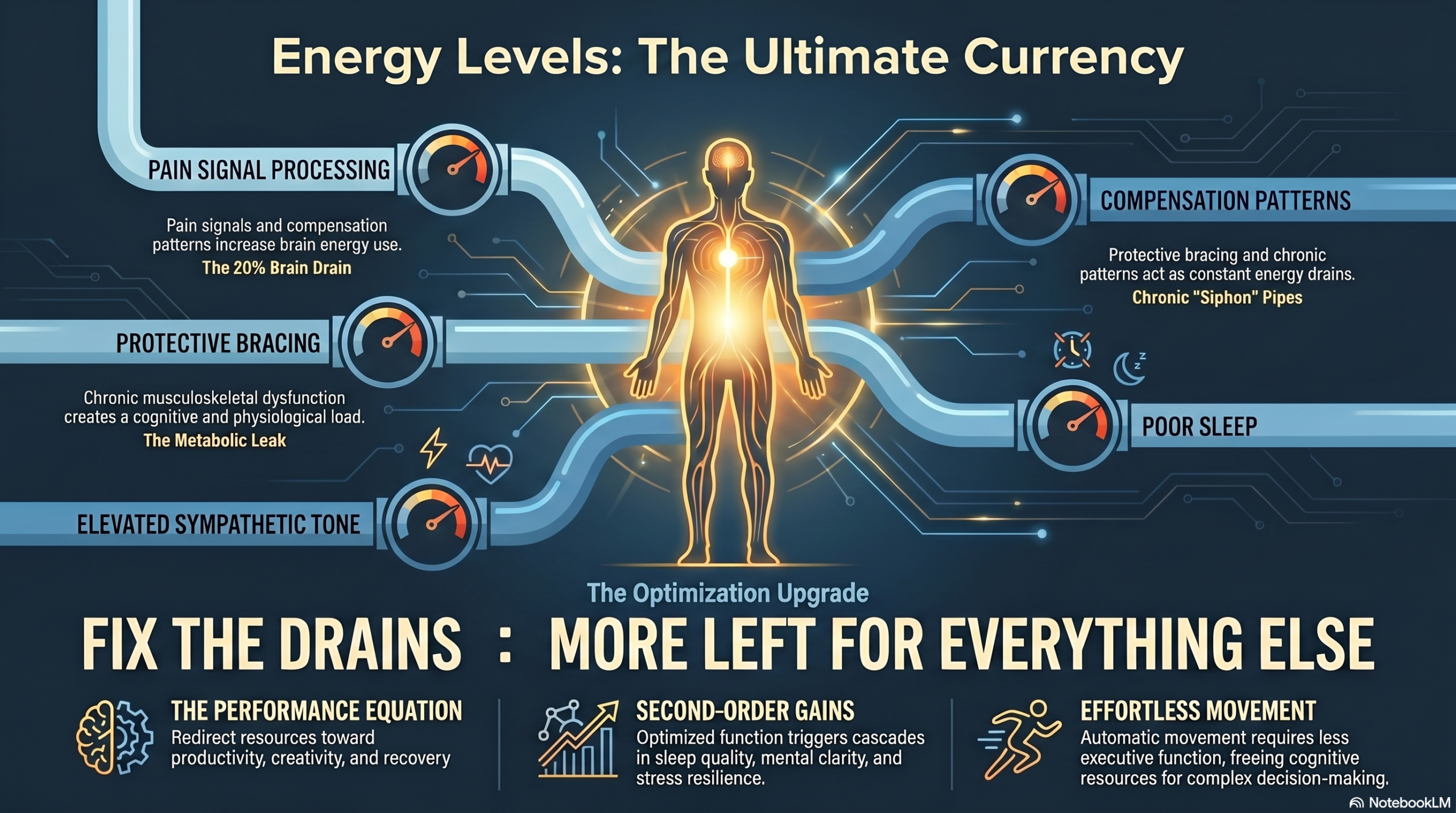
Your brain uses roughly 20% of your body's total energy expenditure. When your brain is constantly processing pain signals, compensating for altered movement patterns, and running threat-detection protocols, that percentage increases.
A 2016 meta-analysis found that patients with chronic musculoskeletal dysfunction reported significantly higher fatigue levels than matched controls, even when pain was moderate. The cognitive and physiological load of managing persistent dysfunction drains your battery.
But here's what I see clinically: as biomechanical function improves, energy improves—often dramatically.
Patients stop needing that second or third cup of coffee. They stop hitting a wall at 2 PM. They have energy in the evening for activities they care about instead of collapsing on the couch.
The Performance Implications
In biohacking circles, there's massive focus on mitochondrial function, nutrient timing, nootropics, and energy optimization. All valuable. But if your nervous system is hemorrhaging energy on chronic compensation patterns, you're trying to fill a leaky bucket.
When we improve spinal biomechanics and reduce nociceptive input:
- Your nervous system spends less energy on threat detection
- Your autonomic balance improves, reducing baseline metabolic cost
- Your movement becomes more efficient, requiring less energy
- Your sleep improves, enhancing recovery and energy production
Multiple patients have told me they accomplish more in a day—not because they're working longer hours, but because they have more available capacity.
Energy is the foundation of everything else. If you're not energized, you can't be present, creative, productive, or resilient.
Muscle Tension: Releasing the Brake
Most patients don't realize how much chronic muscle tension they're carrying until it starts to release.
Around week three or four of care, they'll mention: "My shoulders aren't up by my ears anymore." Or, "I didn't realize how tense I was until I stopped being tense."
This is your nervous system releasing protective bracing that's no longer needed.
The Physiology of Holding Patterns
When you're injured or stressed, your nervous system increases muscle tone to protect vulnerable areas. This is adaptive short-term. But when it becomes chronic, it's like driving with the parking brake on—you can still move, but everything requires more effort and creates more wear.
Chronic muscle guarding:
- Reduces blood flow and oxygen delivery to tissues
- Creates metabolic congestion (accumulation of waste products)
- Increases baseline energy expenditure
- Limits range of motion and movement quality
A 2018 study using electromyography found that patients with whiplash showed elevated resting muscle tone months after injury—their nervous systems were maintaining protective bracing unconsciously.
The Performance Upgrade
When muscle tension normalizes:
- Your breathing mechanics improve (shoulders and neck aren't doing the work your diaphragm should do)
- Your posture improves without conscious effort
- Your movement quality improves across all activities
- Your energy improves because you're not fighting constant background tension
For athletes, reduced tension means better power output, improved technique, and faster recovery. For everyone else, it means feeling less "locked up" and more fluid in your body.
Many patients describe this as feeling "lighter" or "less weighed down"—not physically lighter, but energetically unburdened.
Reducing chronic muscle tension is like upgrading your operating system. Everything runs smoother.
Breathing Mechanics: The Autonomic Control Panel
I've had hundreds of patients, midway through care, suddenly say: "I can breathe deeper now. I didn't even realize I couldn't before."
This is one of the most underappreciated performance upgrades chiropractic care can provide.
The Biomechanics and Neurology of Breath
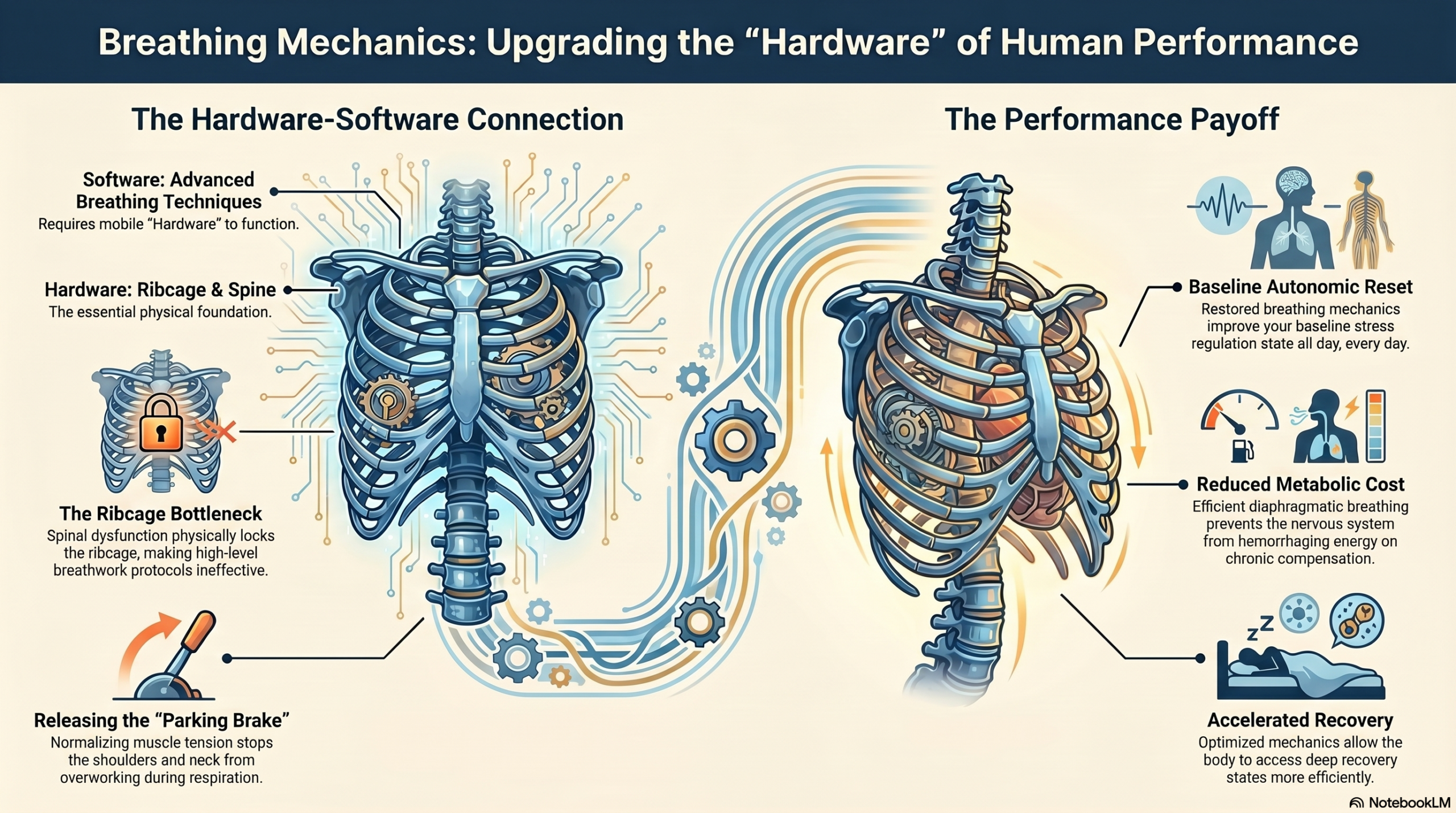
Your ribcage is a dynamic system of 24 ribs, each articulating with thoracic vertebrae. Every breath requires these joints to move. When thoracic spine function is compromised, rib mobility becomes restricted.
You can still breathe—you have to—but you're using accessory muscles (neck, shoulders, upper chest) instead of your diaphragm and intercostals. This is mechanically inefficient, metabolically expensive, and a chronic activator of sympathetic tone.
Here's the key insight: shallow, chest-based breathing perpetuates sympathetic dominance. It's how you breathe when you're stressed or threatened. Deep, diaphragmatic breathing activates parasympathetic tone—the recovery state.
When we restore thoracic and rib mobility, patients gain access to full, diaphragmatic breathing. This immediately improves oxygenation and cellular metabolism, autonomic nervous system regulation, stress resilience, and mental clarity.
Why Biohackers Should Care
Breath work is having a moment in performance optimization circles—Wim Hof, box breathing, coherent breathing, breathwork protocols. All powerful tools.
But if your ribcage won't move because of spinal dysfunction, you're trying to run advanced software on compromised hardware.
Restoring full breathing capacity doesn't just improve performance during intentional breathwork—it improves your baseline autonomic state all day, every day.
Better breathing mechanics = better stress regulation = better performance and recovery.
Balance and Coordination: Proprioceptive Precision
Here's something most people don't know: your spine is a sensory organ.
The joints, muscles, and ligaments are densely packed with mechanoreceptors that feed your brain constant information about where your body is in space and how it's moving. This proprioceptive input is critical for balance, coordination, and movement control.
When spinal function is compromised, proprioceptive input becomes distorted. Your brain gets bad data. Balance and coordination degrade—often subtly, but measurably.
The Research
Research using MRI found that chronic spinal dysfunction alters brain processing in the cerebellum and sensorimotor cortex—areas responsible for movement coordination and spatial awareness.
Another study found that patients with low back pain showed impaired postural control even when pain was mild. They weren't obviously unstable, but when tested on force plates, their neuromuscular control was measurably compromised.
The exciting part: these deficits improve with chiropractic care. A systematic review concluded that spinal manipulation improves proprioceptive accuracy and postural control by restoring normal mechanoreceptor input.
What This Means Practically
Most patients don't notice balance changes until I ask. Then they realize they're not grabbing handrails on stairs, they can stand on one leg to put on shoes without wobbling, they feel more stable on uneven terrain, their coordination in sports has improved, and they catch themselves better when they stumble.
For athletes, improved proprioception means better technique, more precise movement, and reduced injury risk. For older adults, it's fall prevention. For everyone, it's the foundation of confident, capable movement.
Better proprioception = better movement quality = better performance and longevity.
Stress Resilience: Nervous System Regulation
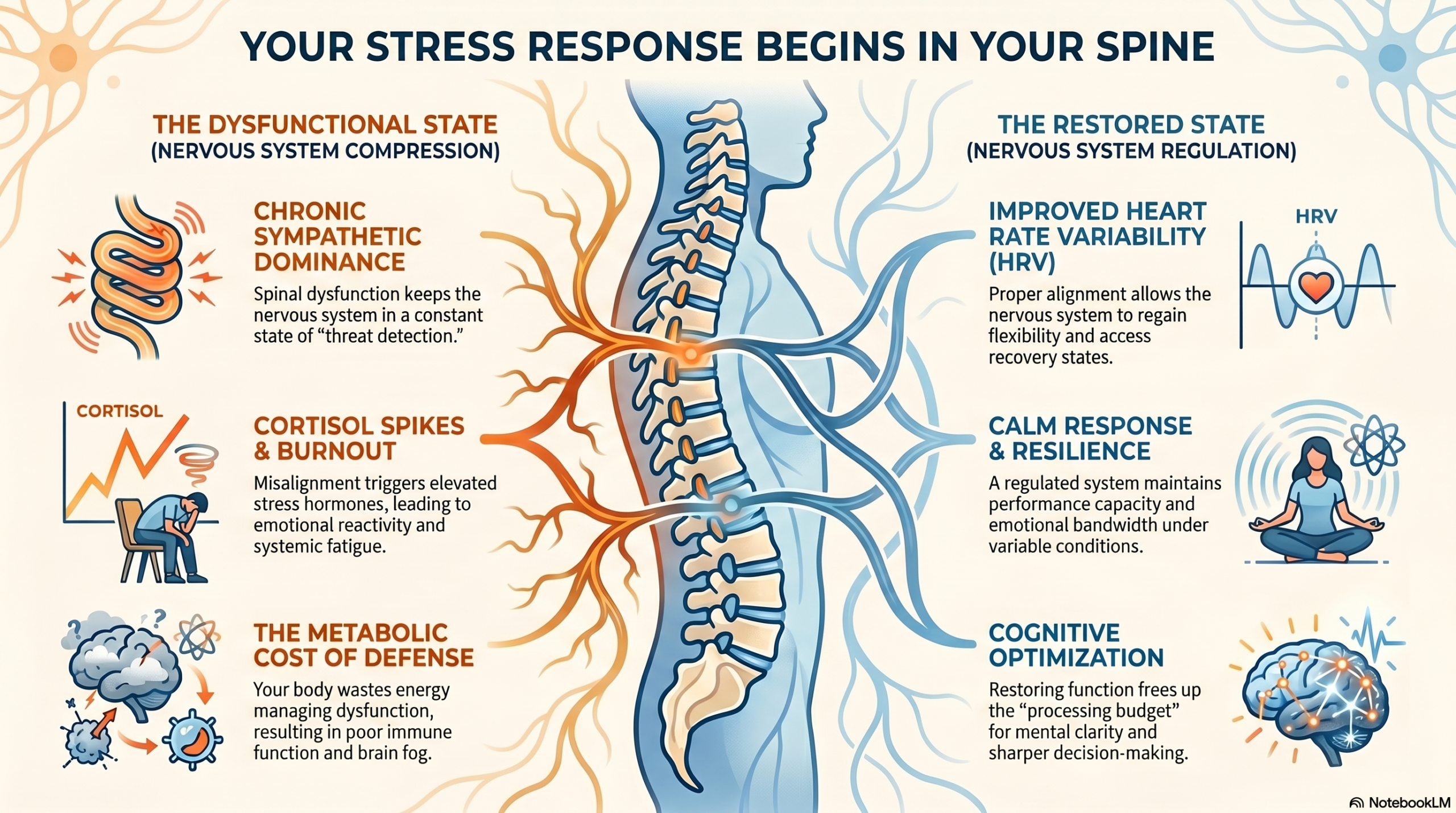
Around week four or five, patients often mention casually: "I don't know if this is related, but I feel like I'm handling stress better."
It's absolutely related.
The Neurology of Stress Response
Your sympathetic nervous system—the stress response system—originates in the thoracic and lumbar spine. When spinal function is compromised, especially in the thoracic region, your baseline stress reactivity becomes exaggerated.
Small stressors trigger disproportionately large responses. You're quicker to frustration, more easily overwhelmed, less able to regulate emotions.
Research measured cortisol levels and heart rate variability in patients receiving chiropractic care and found significant improvements: cortisol (stress hormone) decreased, and heart rate variability (stress resilience marker) increased.
The Performance Connection
In high-performance contexts—athletics, business, creative work—stress resilience is everything. It's not about eliminating stress (impossible and undesirable). It's about your capacity to handle stress without dysregulation.
When patients tell me they're responding to stressors with more calm and less reactivity, I know their nervous system is regaining flexibility. They're not stuck in chronic sympathetic dominance.
Better stress resilience means better decision-making under pressure, faster recovery from stressful events, more emotional bandwidth for relationships, reduced risk of burnout, and better immune function and metabolic health.
Stress resilience isn't just about feeling calmer. It's about maintaining performance capacity under variable conditions.
Postural Awareness: Effortless Alignment
Patients come in for their eighth or ninth visit, and I notice their posture has changed. They're sitting taller. Shoulders back. Head centered over spine.
I'll ask, "Have you been working on your posture?"
"No, actually. It just feels more natural now."
This is neurological re-education happening automatically.
How Posture Actually Works
Posture isn't willpower. It's unconscious neuromuscular control mediated by proprioceptive input from your spine, vestibular input from your inner ear, and visual input.
When these systems are dysfunctional, postural control suffers. You can force yourself into "good posture," but it requires constant conscious effort and feels like work.
When spinal function improves, your body naturally finds neutral alignment because it's mechanically efficient and requires less energy to maintain.
The Biohacking Angle
There's increasing recognition that posture affects not just musculoskeletal health, but cognitive performance, mood, breathing, and even confidence.
Research shows that postural changes can influence testosterone and cortisol levels, cognitive processing speed, mood and self-perception, breathing capacity, and digestive function.
When patients naturally adopt better posture without effort, they're getting all these benefits as a passive upgrade.
Optimized posture isn't about aesthetics. It's about biomechanical efficiency that allows better performance across all systems.
Everyday Effort: The Invisible Upgrade
Carrying groceries. Picking up your child. Doing yard work. Lifting weights. These activities should feel like normal expressions of capability, not ordeals requiring recovery.
One of the clearest signs of functional optimization is when everyday tasks stop feeling effortful.
The Efficiency Factor
Research measured the metabolic cost of walking in patients with chronic low back dysfunction and found they used significantly more oxygen and energy than healthy controls at the same speed. The difference? Altered biomechanics and increased muscle co-contraction.
When biomechanics normalize, tasks require less energy, you have more capacity available for actual performance, recovery time decreases, and you can sustain activity longer without degradation.
The Capacity Equation
Think of your daily energy and physical capacity as a budget. When you're dysfunctional, basic tasks consume a larger share of that budget. You're left with less for training, creative work, family time, or anything else you value.
When biomechanics improve and pain decreases, the "cost" of everyday tasks drops. You're left with more available capacity.
Patients describe this as not needing a recovery day after normal activities, being able to train harder without flare-ups, having energy left at the end of the day, and feeling less "beaten up" by normal life.
This is optimization: reducing the cost of baseline function so you have more capacity for everything else.
Mental Clarity and Focus: Cognitive Performance
After a few weeks of care, patients often mention: "I feel like I can focus better. I'm not as foggy."
Your brain has a limited processing budget. Chronic pain and dysfunction drain that budget.
The Neuroscience
When your brain is constantly processing pain signals and managing protective motor patterns, less capacity is available for higher cognitive functions—attention, working memory, problem-solving, creativity.
A 2019 study using functional MRI found that pain-related brain regions showed persistent activation even during cognitive tasks. Part of the brain was always "listening" to the dysfunction signal, creating cognitive drag.
When pain and dysfunction resolve, that processing capacity becomes available for other uses.
The Performance Gain
Patients describe improvements in sustained focus and attention, working memory and information processing, mental stamina throughout the day, clarity of thinking and decision-making, and reduced brain fog.
For knowledge workers, executives, students, or anyone whose work depends on cognitive performance, these gains can be transformative.
Mental clarity isn't separate from physical function. They're the same nervous system.
Exercise and Athletic Performance: Movement Quality
For patients who train seriously—athletes, fitness enthusiasts, weekend warriors—one of the most meaningful markers is performance improvement.
Are you lifting with better form? Running with smoother mechanics? Recovering faster between sessions? Pushing harder without flare-ups?
The Movement Quality Factor
Research examined runners with a history of low back pain and found that even those currently pain-free showed altered running biomechanics—reduced hip extension, increased trunk flexion, asymmetric loading. These compensations reduced performance efficiency and increased injury risk.
Pain resolution alone wasn't sufficient for return to optimal performance. They needed neuromuscular re-education to restore movement patterns.
What Improved Performance Looks Like
Patients report better squat depth and form, improved running gait and reduced soreness, more powerful and coordinated sports performance, faster recovery between training sessions, and PRs they haven't hit in years.
These improvements reflect restored biomechanics, improved neuromuscular coordination, better proprioceptive control, and enhanced tissue capacity.
Better movement quality means better performance and reduced injury risk—the foundation of athletic longevity.
Overall Sense of Well-Being: Interoceptive Optimization
Sometimes patients say: "I just feel… better. Not just less pain, but like my body is working better as a system."
This isn't vague. This is interoception—your brain's perception of your body's internal state—and it's one of the most sophisticated health indicators we have.
The Science of Well-Being
Interoception underlies emotional awareness, self-regulation, and overall sense of wellness. When interoceptive signals are distorted by chronic pain or dysfunction, your subjective well-being suffers even if objective measures look normal.
By reducing pain, improving autonomic balance, and restoring biomechanical function, we improve interoceptive accuracy. Patients describe feeling "more like themselves" or "more grounded in their body."
The Whole-System Perspective
Your body isn't isolated parts—it's an integrated system. Musculoskeletal, neurological, cardiovascular, immune, endocrine. When one system is chronically dysregulated, it affects all the others.
When we restore musculoskeletal and neurological function, we're reducing systemic stress, improving sleep and recovery, normalizing autonomic tone, reducing inflammation, and freeing up resources for repair and optimization.
This systemic improvement manifests as an overall sense of vitality that's hard to quantify but impossible to ignore.
Optimized well-being isn't just feeling good. It's having the physical and mental capacity to engage fully with your life.
Conclusion: The Real Value Proposition
If you take one thing from this essay, let it be this: the value of chiropractic care isn't pain relief. It's the optimization of function that becomes possible once pain is no longer consuming your system's resources.
Yes, pain is what got you in the door. And yes, pain relief is important. But pain is usually the first thing to resolve. What happens after that—in the weeks and months of continued care—is where the real value lives.
Better sleep. Effortless movement. Sustained energy. Reduced tension. Full breathing capacity. Better balance. Stress resilience. Natural posture. Reduced effort for daily tasks. Mental clarity. Athletic performance. Overall vitality.
These aren't side benefits. These are the actual benefits.
They're the difference between just "not hurting" and actually thriving. Between getting through the day and having capacity left over. Between managing dysfunction and optimizing performance. Between surviving and flourishing.
The Investment Decision
The question isn't whether chiropractic care can resolve your acute pain episode. It almost certainly can.
The question is: once pain is resolved, is there value in continuing to optimize the neuromuscular and biomechanical systems that underpin everything else you're trying to do with your body?
For patients who value high performance in work, athletics, or life, who are investing in other optimization strategies (training, nutrition, sleep, stress management), who want to maintain capacity and resilience as they age, and who recognize that physical and mental performance are inseparable—the answer is often yes. Not because they need treatment for a condition, but because they value operating at a higher level.
The Clinical Reality
In 25 years of practice, I've learned that the patients who get the most value from care are the ones who shift from asking "does it hurt less?" to asking "am I functioning better?"
When a patient is sleeping deeply, moving effortlessly, maintaining energy, releasing chronic tension, breathing fully, balancing precisely, handling stress effectively, sitting naturally upright, exerting less effort, thinking clearly, performing athletically, and experiencing overall vitality—that patient has accessed optimization that goes far beyond pain relief.
And that patient typically continues care not because they have to, but because the return on investment is clear.
Your Decision
Whether ongoing chiropractic care is worth the investment is a question only you can answer. It depends on what you value, what you're trying to accomplish, what else you're investing in, and what level of performance and well-being you're satisfied with.
My job isn't to convince you. My job is to help you recognize what's changing in your body beyond pain, so you can make an informed decision about whether those changes are valuable enough to continue investing in.
Pay attention to how you're sleeping, moving, energizing, releasing tension, breathing, balancing, handling stress, sitting, exerting effort, thinking, performing, and feeling overall.
These are the markers that tell the real story.
And if the story is one of increasing capacity, resilience, and vitality—then you're not paying for pain relief anymore. You're investing in human performance optimization.
That's a different value proposition entirely.
And for many people, it's worth every penny.