article.html
“I Think I’m Okay” — The Five Words That Should Worry You Most
In more than two decades of chiropractic practice — and over a thousand personal-injury cases treated right here in Sonoma County in the past four years alone — I’ve watched the same scene repeat itself hundreds of times. A patient walks out of a collision, checks themselves over, and says the words that worry me most: “I think I’m okay.”
They’re not lying. In that moment, they genuinely believe it. They can stand, they can talk, they can exchange insurance information. Nothing feels broken. The car might barely have a scratch. Bystanders nod approvingly. The police officer writes “minor” on the report. Everyone agrees, silently, that this was a non-event.
But I know what’s coming. Because I’ve treated the aftermath of this exact scene over a thousand times. And what comes next — usually within 24 to 72 hours — is a phone call, a walk-in, or a worried email: “Something’s wrong. I can’t turn my head. The headaches won’t stop. I can barely get out of bed.”
I know what you might be thinking right now: If the injury was real, wouldn’t you feel it immediately? That’s the most natural assumption in the world. And it’s wrong. Not because you’re imagining things, and not because you’re weak. It’s wrong because your body is running a survival program that was never designed for the aftermath — only for the moment of crisis. The illusion of immediate safety is biochemistry, not reality. And understanding the difference may be the most important thing you read after a collision.
What follows is a detailed, evidence-based exploration of why delayed symptoms are the norm — not the exception — after motor vehicle collisions, what’s actually happening inside your body during those deceptively quiet hours, and why the science overwhelmingly supports early evaluation even when you feel fine.
The Biochemistry of Deception: How Your Body Hides the Truth
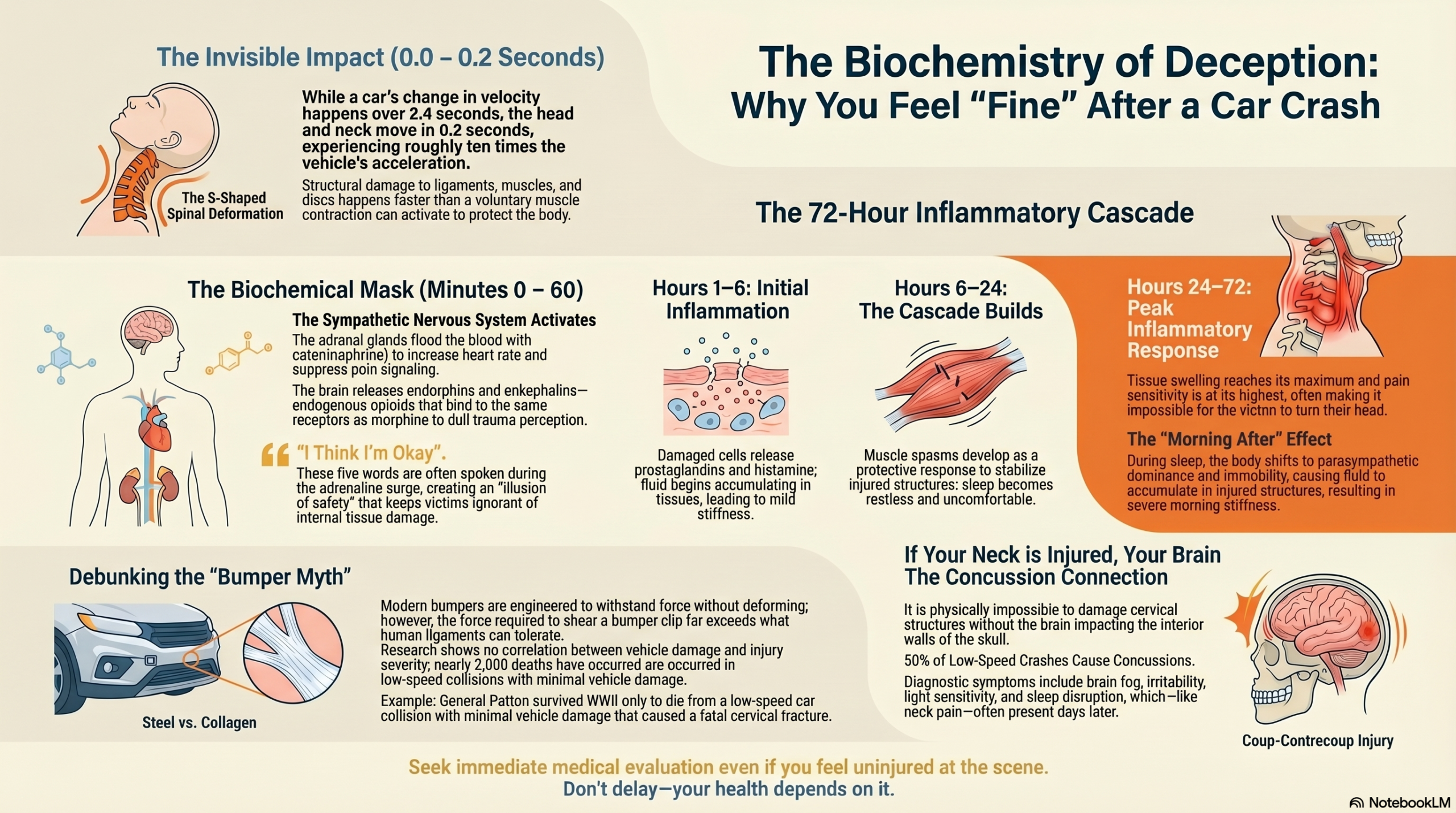
To understand why you feel fine at the scene of a crash, you have to understand what your nervous system is doing in the seconds after impact.
The moment your body registers a collision — and this happens in roughly two-tenths of a second — the sympathetic nervous system activates. This is the fight-or-flight response, and it is powerful, immediate, and indiscriminate. The adrenal glands flood the bloodstream with catecholamines: epinephrine (adrenaline) and norepinephrine. These hormones perform a suite of survival functions simultaneously: they increase heart rate, dilate the pupils, redirect blood flow to large muscle groups, and — critically — suppress pain signaling throughout the central and peripheral nervous system.
At the same time, the brain releases endogenous opioids — endorphins and enkephalins — that bind to the same receptors targeted by morphine. This is not a metaphor. Your body is literally administering its own painkiller in the moments after trauma. The analgesic effect is so potent that soldiers have been documented running on broken limbs, and car crash victims have walked away from collisions that fractured their vertebrae.
This system evolved for a reason. In a survival context, pain is a liability. If a predator is chasing you and you sprain your ankle, feeling that pain immediately would cause you to stop and become prey. The sympathetic response keeps you moving. It keeps you functional. It keeps you alive.
But it also keeps you profoundly ignorant of what’s already happened inside your body.
The adrenaline surge typically lasts 20 to 60 minutes. In some cases, the heightened sympathetic state can persist for hours, particularly if the individual remains psychologically activated — replaying the crash, dealing with police, managing the emotional aftermath. During this entire window, pain perception is suppressed. Tissue damage that has already occurred — ligament sprains, muscle strains, disc injuries, facet capsule disruption — is present but unfelt.
Key Takeaway
The gap between the collision event and the onset of symptoms is not evidence that the injury is absent. It is evidence of biology doing exactly what it was designed to do.
The Inflammatory Cascade: A Timeline Nobody Tells You About
Once the adrenaline wears off, a second biological process takes over — one that unfolds on a timeline that can be mapped with remarkable precision. Understanding this timeline is essential, because it explains why the hours and days after a collision follow such a predictable pattern of escalating pain.
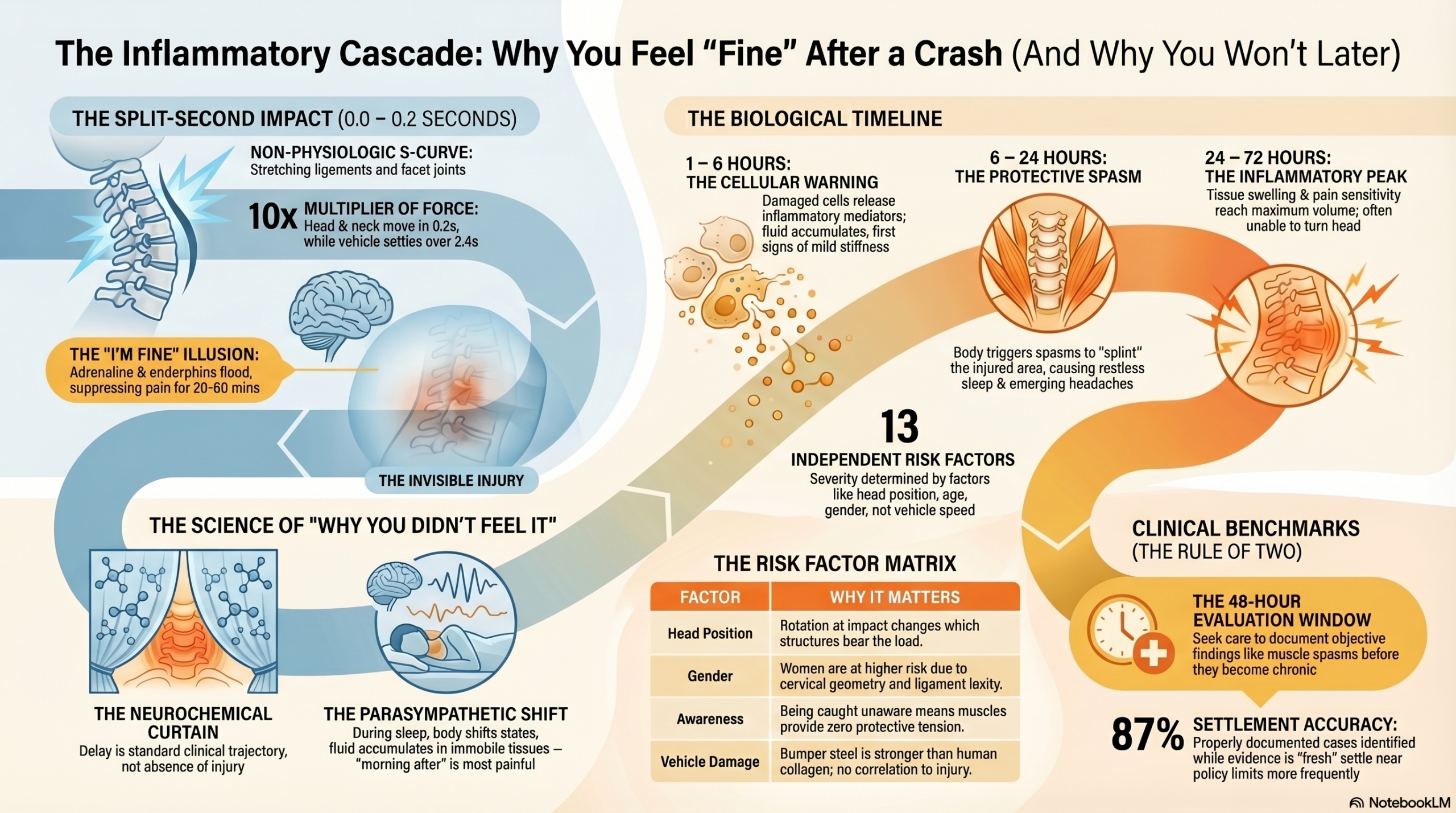
Seconds 0–0.2: The injury occurs. Tissue damage happens in two-tenths of a second. Ligaments are stretched or torn. Muscles are strained beyond their elastic capacity. Intervertebral discs may herniate or develop annular fissures. Facet joint capsules are disrupted. The structural damage is immediate and complete — even though the person at the scene feels nothing.
Minutes 0–30: The acute stress response. The sympathetic nervous system is in full activation. Adrenaline surges. Endorphins flood the system. The patient is alert, oriented, and genuinely believes they are uninjured. This is the window where the most dangerous words are spoken: “I’m fine.”
Hours 1–6: Initial inflammation begins. Damaged cells release inflammatory mediators — prostaglandins, histamine, and substance P. Capillary permeability increases at injury sites. Fluid begins accumulating. Nociceptors start activating, but incompletely. The patient may notice mild stiffness but attributes it to stress.
Hours 6–24: The cascade builds. Prostaglandin and bradykinin production accelerates. Edema increases substantially. Muscle spasm develops as the body’s protective response, attempting to splint and stabilize injured structures. Neck stiffness becomes more noticeable. Sleep that night is restless.
Hours 24–72: Peak inflammatory response. Tissue swelling reaches its maximum. Pain sensitivity is at its highest. The patient wakes up unable to turn their head. Range of motion is severely restricted. Headaches are persistent. The connection between the crash and the symptoms becomes undeniable.
This is not speculation. This is the standard post-traumatic inflammatory timeline recognized across emergency medicine, orthopedics, and sports medicine. It explains why every emergency department in the country includes some version of the same discharge instruction after a motor vehicle collision: “Your symptoms may worsen over the next 24 to 72 hours.”
If delayed onset were unusual or suspicious, emergency physicians would not routinely warn patients about it. They warn about it because it is the expected clinical trajectory.
There’s an additional mechanism that makes the morning after particularly brutal. During sleep, the body shifts into parasympathetic dominance. Inflammatory processes continue — and in some ways accelerate — while the patient is immobile. Injured cervical structures are stressed by sleeping postures. Fluid accumulates in tissues that are not being moved or drained through normal activity. The result is the classic morning-after experience: the patient went to bed feeling stiff and woke up barely able to move.
The injury didn’t appear overnight. It was there from the moment of impact. The inflammatory cascade simply needed time to reach the volume where pain becomes impossible to ignore.
What Happens to Your Cervical Spine in Two-Tenths of a Second
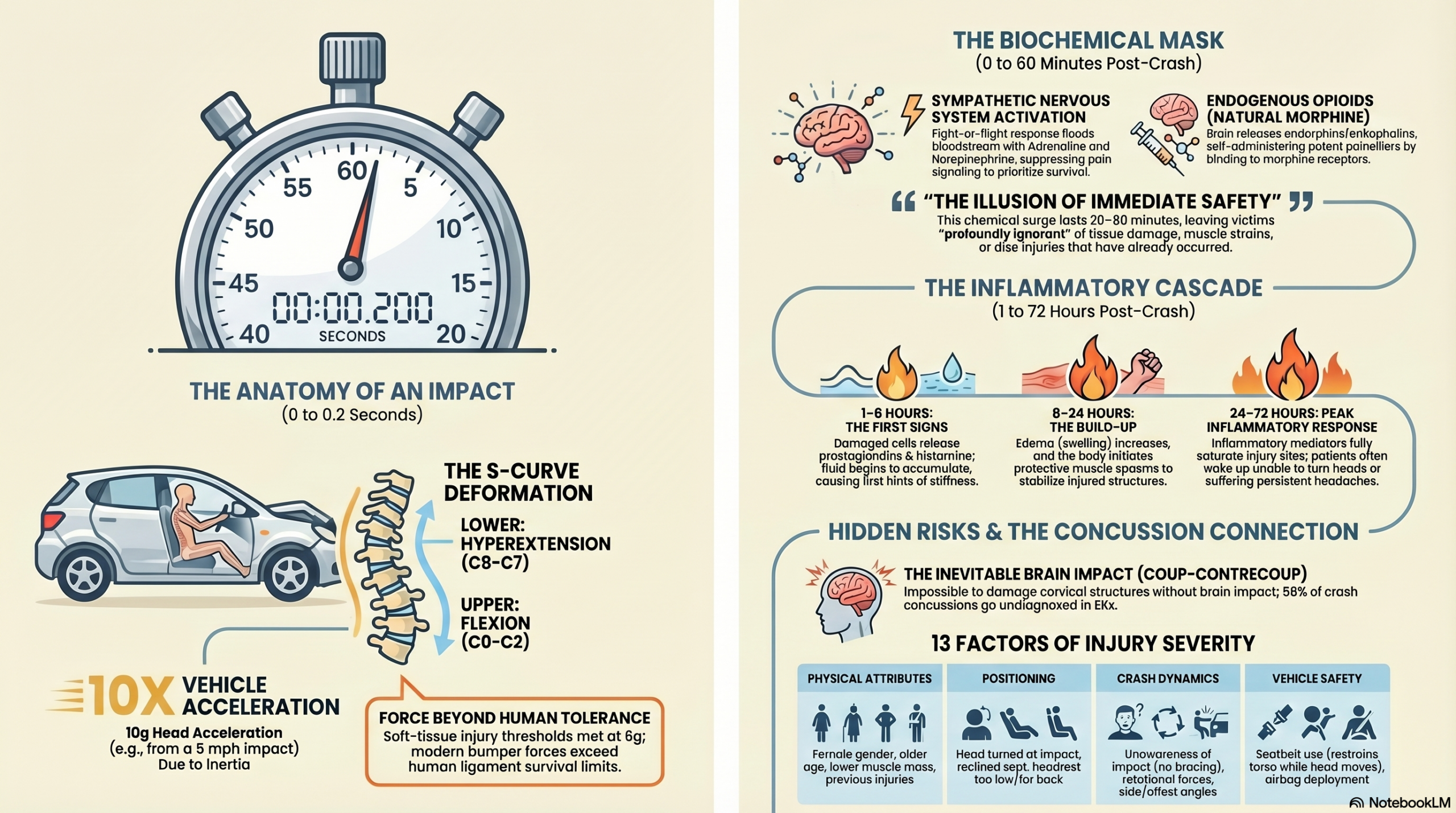
In a rear-end collision, the struck vehicle accelerates forward. The seatback pushes the occupant’s torso forward. But the head — unsupported by anything except the cervical spine and its surrounding musculature — lags behind due to inertia. The entire whiplash sequence occurs in approximately 200 milliseconds. That is two-tenths of a second. It is faster than a voluntary muscle contraction can activate to protect you.
Here is the critical physics almost always left out of insurance discussions: while the vehicle’s change in velocity occurs over roughly 2.4 seconds, the head and neck motion happens in approximately 0.2 seconds. Because force equals mass times the change in velocity divided by the change in time — F = m(ΔV/ΔT) — the head and neck experience roughly ten times the acceleration of the vehicle itself. A vehicle delta-V of 5 miles per hour can produce peak head accelerations exceeding 10 g.
10×
the acceleration your head and neck experience compared to the vehicle itself
Research by Grauer and colleagues, published in Spine in 1997, demonstrated that whiplash produces a non-physiologic S-shaped curvature of the cervical spine. The lower cervical segments (C5–C7) are driven into hyperextension while the upper segments (C0–C2) simultaneously flex forward. This creates shearing forces across the facet joints, stretches the posterior ligamentous complex, and compresses the anterior disc margins — all before the head has even begun its full excursion.
Research by Ito and colleagues (Spine, 2004) identified a soft-tissue injury threshold at approximately 5 g of peak horizontal acceleration at T1. Winkelstein and colleagues demonstrated that clinically meaningful facet capsule injury can occur at subfailure strains — meaning the ligament doesn’t have to rupture to be injured. It only has to be stretched beyond its yield point, producing pain and dysfunction that may never appear on standard imaging.
Important
A Florida study documented 330,000 low-speed collisions over six years. Of those, 280,000 people were injured and 1,910 people died — in low-speed crashes with minimal vehicle damage. General George S. Patton survived all of World War II only to die from a low-speed car collision in 1945: minimal vehicle damage, fatal cervical fracture.
No correlation exists between vehicle damage and occupant injury severity. Modern bumper clips require more force to shear than human ligaments can tolerate. When someone points to an undamaged bumper and says “no damage, no injury,” they are comparing the tolerance of engineered steel to the tolerance of collagen and nerve fiber.
The Concussion You Don’t Know You Have
Here is something that changed my clinical practice permanently: if you have a cervical spine injury from a collision, you almost certainly also have a concussion.
The teaching is direct and backed by physics: “It is not possible to introduce enough force to damage cervical spine structures without bouncing the brain inside the cranium.” If the forces were sufficient to strain your neck ligaments, those same forces transmitted through the cervical spine and skull were sufficient to cause a coup-contrecoup brain injury.
Did You Know
Studies estimate that 50% of low-speed collisions and 80–100% of high-speed collisions produce concussions. Yet in a study of ER-transported crash patients, 56% had concussion documentation without a formal diagnosis ever being made.
Concussions do not appear on CT scans or standard MRI. Diagnosis requires only one symptom plus a history of trauma (DSM-5, CDC): headache, dizziness, difficulty concentrating, brain fog, irritability, fatigue, sensitivity to light or noise, memory problems, sleep disruption, or mood changes.
The Cassidy study found that 75% of concussion patients still have symptoms at one year. The olfactory nerve — cranial nerve I — is the most commonly injured cranial nerve in motor vehicle collisions, with a direct connection to memory centers. The pituitary gland slams against the sella turcica during rapid deceleration, producing hormonal disruptions that may not manifest for weeks or months.
This is why delayed symptom onset is even more significant than most people realize. It’s not just your neck that needs time to declare its injuries. Your brain does too.
The Thirteen Factors That Determine Your Injury
Research has identified at least thirteen distinct risk factors that influence whether and how severely you are injured in a collision. Only one relates to speed:
- Previous injuries — even asymptomatic old injuries can be reactivated by trauma
- Head position at impact — were you turned, looking at your phone, checking a mirror?
- Seat position — distance from headrest, seatback angle, upright vs. reclined
- Gender — women are at statistically greater risk due to differences in neck muscle mass and cervical geometry
- Age — older tissues are less elastic, less hydrated, more vulnerable
- Body build and fitness level — muscular development provides some but not complete protection
- Awareness of impending impact — braced muscles vs. relaxed and unaware
- Seatbelt use — prevents ejection but creates its own loading patterns
- Headrest position — too low or too far back can worsen whiplash
- Vehicle safety features — airbags, crumple zones, seat engineering
- Angle of impact — rear-end, side-impact, angular, and offset collisions produce different patterns
- Rotational forces — especially damaging to brain tissue and cervical ligaments
- Speed — yes, it matters, but it is one variable among thirteen
Two passengers in the same vehicle, in the same crash, can have completely different injury outcomes. The absence of immediate pain tells you only that your sympathetic nervous system is working. It tells you nothing about your ligaments, discs, facet joints, or brain.
What the Emergency Room Already Knows
If delayed symptom onset were medically suspicious, emergency departments would not routinely warn patients about it. But they do. Every single time.
Standard ER discharge instructions include explicit warnings that symptoms may worsen over the next 24 to 72 hours. Patients are sent home with pain medication and muscle relaxers, along with instructions to follow up if symptoms develop or intensify.
Freeman and Santana’s causation criteria — affirmed in Etherton v. Owner’s Insurance (2016, 10th Circuit) — support a temporality window of up to 30 days post-collision. A patient who follows ER discharge instructions and presents for care at day 14 is doing exactly what they were told to do.
Two Paths Forward
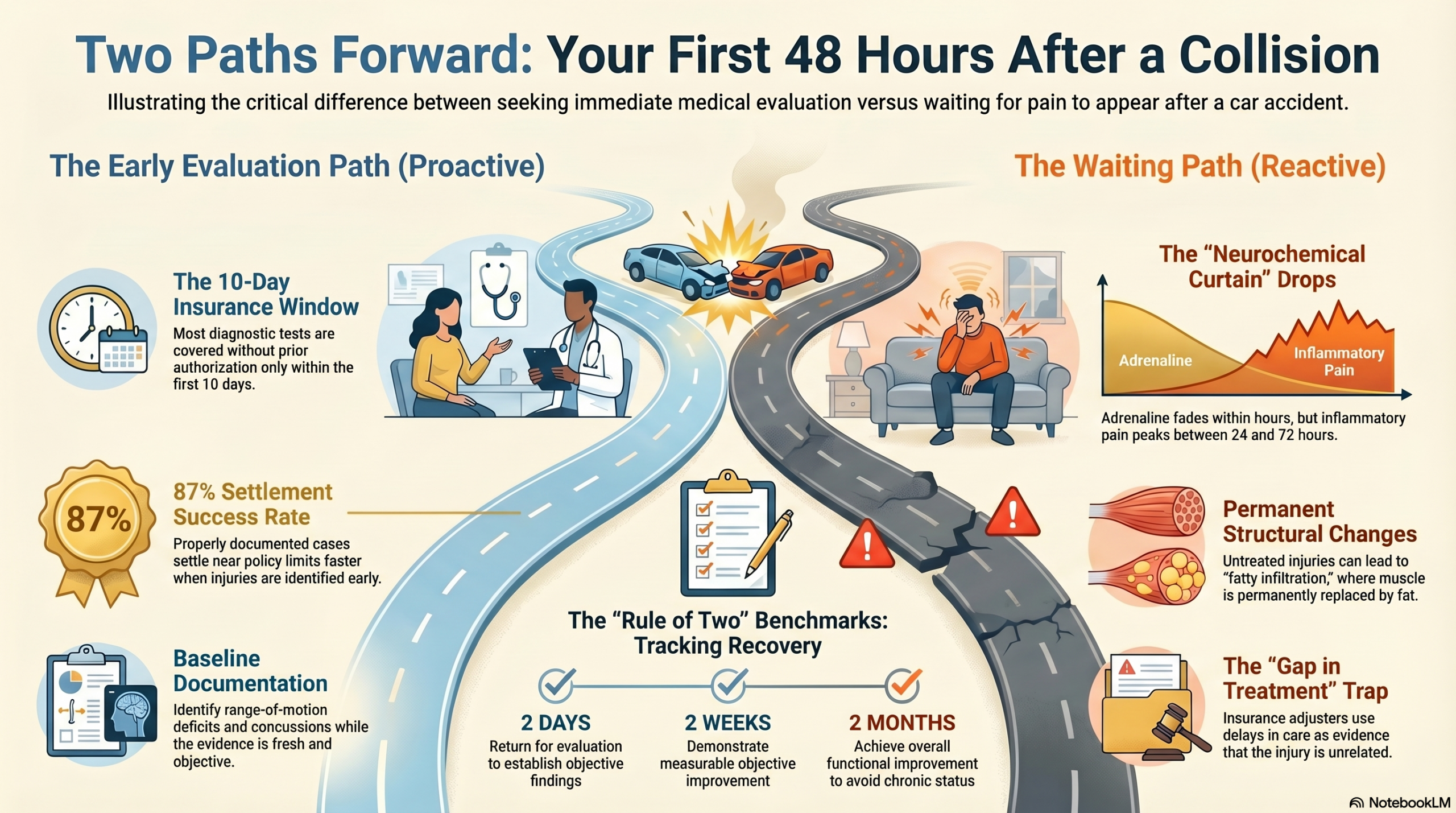
The early evaluation path: Within the first few visits, we establish baseline objective findings — range-of-motion deficits, palpatory tenderness, neurological screening, and functional limitations. We document the injury while it’s fresh. Insurance typically covers all diagnostic tests ordered in the first 10 days without prior authorization.
87%
of properly documented cases settle at or near policy limits within 90 days
The waiting path: The acute inflammatory window closes. Chronic myofascial tension replaces acute inflammation. Compensatory movement patterns become entrenched. Gaps in treatment become leverage for adjusters who argue the absence of early care proves the absence of early injury.
The difference between these two paths isn’t luck. It’s timing.
The Long Memory of the Spine
A 2001 study demonstrated increased risk of low-back pain seven years after a rear-end collision. The 2021 Watanabe study — a landmark 20-year prospective follow-up — showed that whiplash injuries significantly impacted residual symptoms two decades later.
Forward head translation places increasing load on posterior cervical extensors. Over time, these muscles undergo fatty infiltration. At 20 mm of forward translation, pain and disability begin. At 40 mm, fatty infiltration can reach 47% of muscle volume. Recovery from this level of structural change takes one to two years of corrective care.
Key Takeaway
The decision you make in the first 48 hours after a crash matters not just for the next week, but potentially for the next decade.
What You Should Do — Even If You Feel Okay
If you’ve been in a collision — any collision, at any speed, with any amount of vehicle damage — get evaluated within the first 48 hours. Not because something is necessarily wrong. But because the only way to know is through a proper examination, and because the window for accurate assessment, thorough documentation, and timely imaging is narrow.
Your body is not your car. Your tissues do not have the tolerance of engineered steel. Your nervous system runs survival programs that mask injury for hours or days after impact. The absence of pain at the scene is not a diagnosis — it is a biochemical event with an expiration date.
Your body deserves better than a guess made under adrenaline at the side of the road. The illusion of immediate safety is just that — an illusion. What matters is what happens next.
Note: This article is educational and not medical advice. If you have been in a collision and are experiencing symptoms, please seek evaluation from a qualified healthcare provider.