Based on the lecture "Happier Hour" by Cassie Holmes, PhD — Parker Seminars 2026, Las Vegas
I want to tell you about a night on a train.
Not my train. Not my night. But I recognized it immediately — the way you recognize your own reflection in someone else's exhaustion.
Cassie Holmes, a professor at UCLA's Anderson School of Management, stood in front of a ballroom full of chiropractors in Las Vegas and told us about the night she nearly quit everything. She'd been an assistant professor at Wharton, working toward tenure, raising a four-month-old. She traveled to New York for a talk she couldn't say no to. The day was a blur of back-to-back meetings, a high-pressure presentation, a compulsory dinner. Midway through the meal, she looked at her watch, panicked, ran out, hailed a cab, and screamed at an already-speeding New York City driver to go faster — because she could not miss the last train home to her baby and her husband asleep in Philadelphia.
She made the train. Barely.
And as she sank into her seat, forehead against the cold glass, watching the night lights blur past, one thought consumed her: I don't know if I can keep up.
I sat in that ballroom and thought: I know that feeling. Between patient care, documentation, lien negotiations, staff management, and trying to be present for the people I love — there are days when the train metaphor doesn't feel like a metaphor at all. It feels like my actual life, hurtling forward, and I'm just trying not to miss the last stop.
But here's what Holmes told us next. And it changed how I think about every hour of my day.
The Problem Isn't What You Think It Is
Holmes is a researcher. Her PhD is from Stanford's Graduate School of Business. She studies happiness and time — specifically, how the way we spend our hours shapes the quality of our lives. And she defines happiness the way the academic literature does: as subjective well-being, which includes both the joy we experience during our days and the satisfaction we feel about our lives overall.
I'll be honest — when I first saw the topic on the Parker schedule, part of me thought, Happiness? At a chiropractic seminar? We're here for technique updates, X-ray interpretation, documentation strategies. But Holmes anticipated that resistance. She said she hears it all the time: Given everything going on, happiness — are you kidding me?
Then she laid out the data. And the data is not kidding.
Research shows that when people feel happier, they become more creative and more adaptive in their problem-solving. Happy employees are more engaged, perform better, call in sick less often, and are less likely to quit. The studies demonstrate that investing in the happiness of your team positively impacts the bottom line — this isn't opinion, it's published, peer-reviewed evidence (Lyubomirsky, King, & Diener, 2005).
It doesn't stop at the workplace. Experiments show that when we're made to feel happier, we like other people more, and other people like us more. It makes us nicer — not just to our partners and kids and friends, but to complete strangers on the street.
And then there's health. Happier people demonstrate enhanced immune function, better responses to physiological stressors, and greater adherence to treatment regimens (Pressman & Cohen, 2005). There's a clear correlation between happiness and longevity. Happier people live longer.
As a chiropractor who treats personal injury patients every day, that last point hit me hard. I spend my professional life helping people recover from trauma. I document their pain, track their progress, advocate for their care. But how often do I think about the role of their emotional state in that recovery? How often do I think about my own?
Key Takeaway
Happiness is neither frivolous nor selfish. Prioritizing your happiness doesn't only make you feel better — it makes you do and be better.
Time Poverty: The Silent Epidemic
After establishing why happiness matters, Holmes introduced the concept that frames her entire body of work: time poverty.
Time poverty is the acute feeling of having too much to do and not enough time to do it.
She asked for a show of hands: How many of you agree with the statement, "I never seem to have enough time to get everything done"?
Every hand in the room went up.
Her team conducted a national poll showing that more than half of Americans feel time-poor. While the data showed that mothers and dual-income working parents tend to feel the most temporally impoverished, the finding that struck me was this: all types of people feel this way — including those without children and those who don't work for pay. It's not just an American phenomenon, either. People across the globe report suffering from a hectic pace of life with too little time.
And time poverty isn't just uncomfortable. It's destructive.
When we feel time-poor, we are less likely to exercise. We delay going to the doctor. We don't sleep enough. We eat fast food because it's fast, not because it's healthy. We become less kind — when we're in a hurry, we're less likely to slow down and help someone. We feel less confident. And we become less happy (Whillans, Dunn, Smeets, Stöcklin, & Hertenstein, 2017).
I see this in my patients constantly. They come in after a car accident, injured, in pain — and time poverty makes everything worse. They skip appointments because they can't get off work. They stop their home exercises because there aren't enough hours. They eat poorly, sleep poorly, stress constantly. Time poverty doesn't just erode happiness. It erodes healing.
The Surprising Shape of Happiness
Here's where Holmes's research took a turn I didn't expect.
On that miserable train ride home, she concluded there was one obvious solution: quit her job and move to a sunny island. If only she had a whole lot more time, surely she'd be happier.
But she's a scientist. So instead of telling her department chair she was leaving, she decided to test the question: Are people who have a whole lot more time actually happier?
She and her collaborators analyzed data from the American Time Use Survey — a large-scale dataset that allowed them to calculate how much discretionary time people had in a regular day and relate that to their reported life satisfaction.
The result was an inverted U-shape. Like an arc. Like a rainbow.
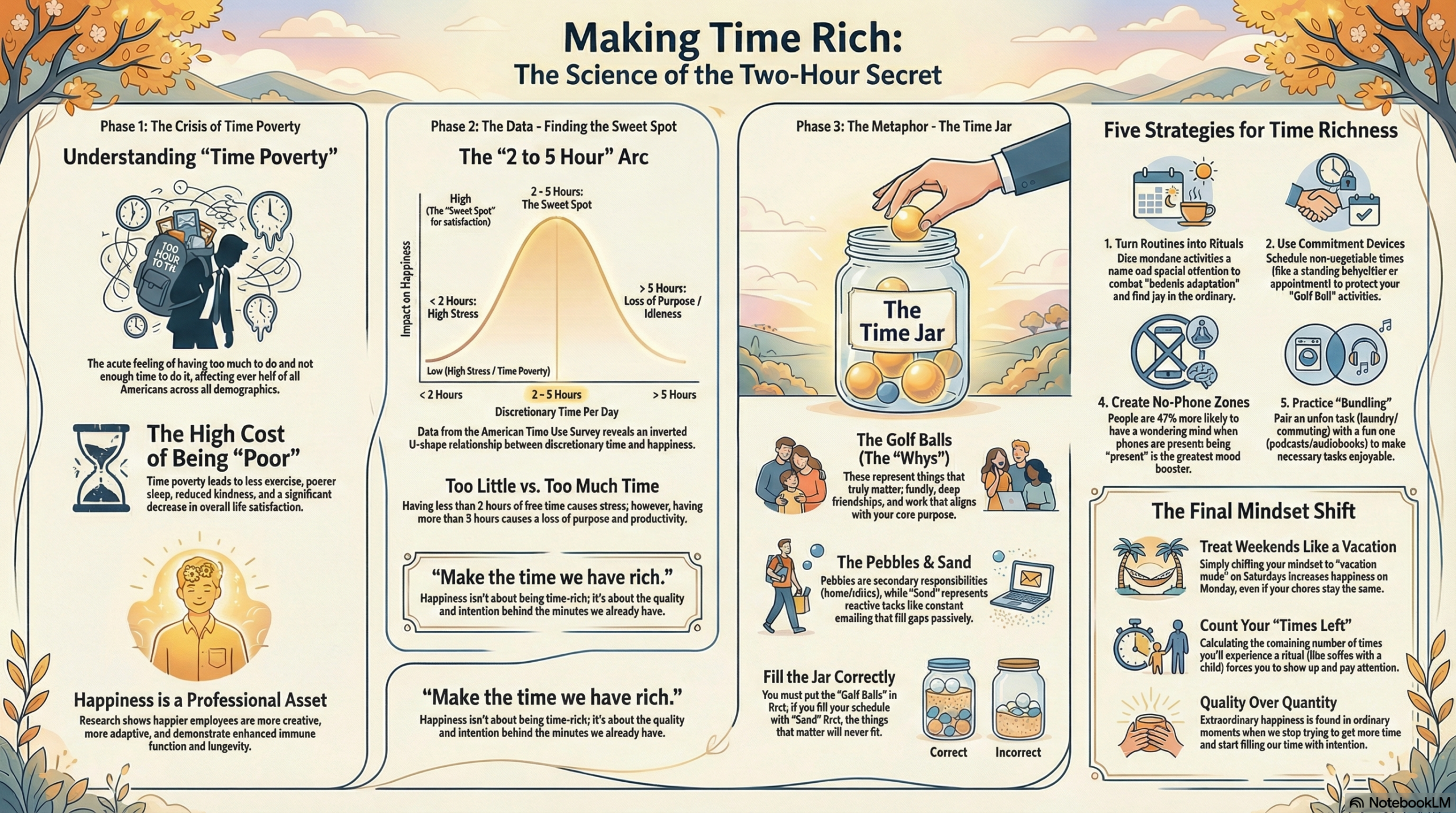
On the left side: people with less than approximately two hours of discretionary time per day were less happy. No surprise there. That's the stress of having too little time.
But on the right side — and this is the part that made the whole room lean forward — people with more than approximately five hours of discretionary time per day were also less happy (Holmes, Whillans, & Mogilner, 2021, Journal of Personality and Social Psychology).
There is such a thing as having too much time.
Why? Because we're driven to be at least a little productive. People are averse to being idle. When you spend all the hours of your day, day in and day out — not on vacation, but in the regular cadence of your life — with nothing to show for it, it undermines your sense of purpose. And without purpose, satisfaction crumbles.
~2 hrs
of discretionary time per day is the sweet spot for happiness
At first, Holmes said, two hours sounded like an immeasurable luxury. But when she did an honest accounting of her own time — even during that brutally hectic period — she found something remarkable. Fifteen minutes snuggling her baby before the day started. Twenty-five minutes talking to her best friend on the drive home. Thirty minutes sitting down with her husband for dinner and a glass of wine. Twenty minutes singing her baby to sleep.
Ninety minutes. Not far from two hours. And she wouldn't have wanted to spend any of those minutes differently.
"It's not about being time rich. It's about making the time we have rich."
— Cassie Holmes, PhD
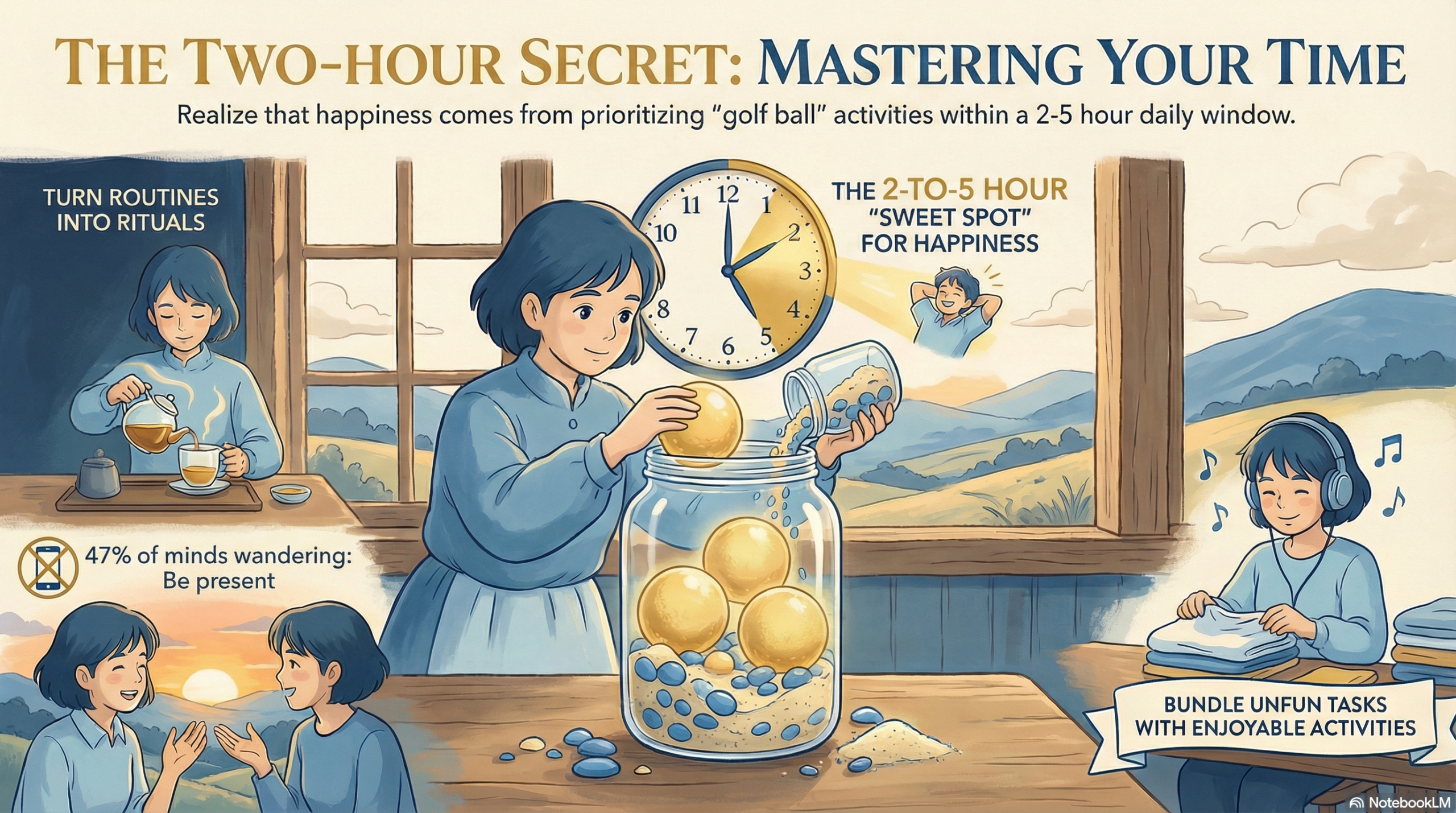
The Time Jar: Golf Balls First
Holmes shared a metaphor that I haven't been able to stop thinking about.
In the opening of her UCLA course — Applying the Science of Happiness to Life Design, which she's taught to MBA and Executive MBA students for seven years — she shows a short film. A professor walks into a classroom, places a large clear jar on the desk, and pours in golf balls until they reach the top. Is the jar full? The students nod. Then he pours in pebbles, which fill the gaps between the golf balls. Full now? Then sand, which fills every remaining space. Then — two bottles of beer, one poured into the jar, the other for himself as he perches on the desk.
He explains:
- The golf balls are the things that really matter to you. Your relationship with your family. Your deepest friendships. The part of your work that aligns with your purpose.
- The pebbles are the other important things. Other aspects of your job, your home.
- The sand is everything else. All the stuff that fills your time without you even thinking about it.
- The beer proves that no matter how full your schedule, you always have time for a drink with a friend.
Important
If you pour the sand in first, the golf balls will never fit. If you let your time get filled passively, it will absolutely get filled — but not necessarily with what matters to you.
You have to put your golf balls in first. Protect time in your calendar for the things that truly matter. Sand will fill the rest. That's fine. Because at the end of the week, you'll feel fulfilled — because you invested in what counts.
Know Your Golf Balls: Track Your Time
So what are your golf balls?
Holmes shared what time-tracking research reveals on average. The happiest activities tend to be socially connecting — intimate time, family, friends. The least happy are commuting, work, and housework. Not great news, given that those three activities fill most of our work weeks.
But these are averages. And averages can be misleading. There are plenty of people — I count myself among them — for whom certain work hours are a deep source of satisfaction.
So Holmes encourages something more personal: track your own time for a week. For every half hour, write down what you're doing — specifically, not just "work" or "socializing" — and rate how you feel on a 10-point scale.
She admitted it's tedious. But the data it produces is gold. Her students consistently discover that activities they think are fun — social media, binge-watching TV — actually rate poorly. The first half-hour of TV? Great. Hours two, three, four? They feel lousy. Meanwhile, activities they dread — especially exercise — rate surprisingly high, with positive carryover into subsequent activities.
This tracking also reveals where the sand is hiding. Holmes realized she could spend entire work weeks just responding to email — never touching the work that actually fulfilled her.
Did You Know
Don't ask yourself what do you enjoy doing? — that pulls from predictions, and we're bad at those. Instead, look back on your actual experience. What has made you happy? That is predictive of what will make you happy.
Five Strategies to Make Your Time Rich
From Holmes's research and her book Happier Hour, several actionable strategies emerged. Each one felt immediately applicable — not just to life in general, but to how I run my practice and how I advise my patients.
1. Turn routines into rituals
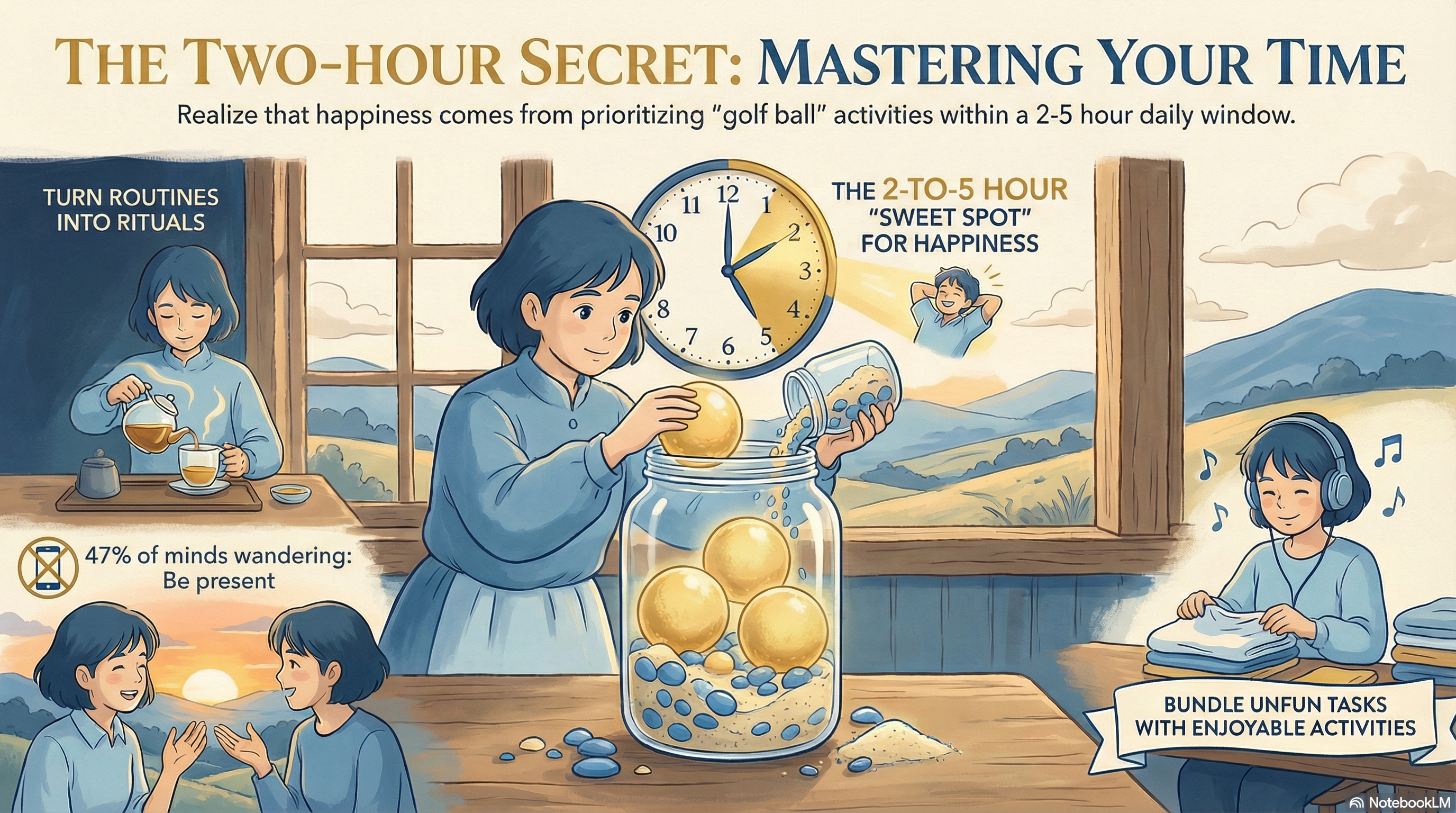
Holmes shared her weekly coffee date with her daughter Lita — born from a mindless carpool routine, transformed into a treasured ritual with its own playlist, its own name, its own specialness. Research shows that couples who have shared rituals feel closer and more connected. Families with traditions — even ones as simple as cheese fondue every Christmas — are more likely to gather and report enjoying those gatherings more. The shift is almost absurdly simple: give it a name, make it special, pay attention.
2. Use commitment devices
Holmes and her husband have a standing babysitter who arrives every Friday at six o'clock for their date night. Many Fridays, they're tired. They'd rather collapse on the couch. But because the babysitter is there — and they're paying regardless — they get out the door. After the first half hour of still talking logistics, they settle in and reconnect. Behavioral economists use commitment devices to help people exercise, eat healthier, quit smoking. You can use them to protect your joy, too.
3. Create no-phone zones
Researchers pinged people throughout their day asking what they were doing, what they were thinking about, and how they felt. The finding: 47% of the time, our minds are wandering somewhere else (Killingsworth & Gilbert, 2010, Science). And across every type of activity, people were happier when they were present — engaged and paying attention rather than mentally elsewhere.
A separate experiment among friends dining together found that those who put their phones away — out of sight — enjoyed the experience more and felt more connected. Even phones left on the table, unused, reduced happiness simply by reminding people of all the other things they could be doing.
4. Get outside
Holmes's morning run is her solitary thinking time — and it picks up on research showing exercise is highly effective at reducing anxiety, depression, and increasing self-esteem. A UK study using geolocation data (MacKerron & Mourato, 2013, Global Environmental Change) found a significant positive effect of simply being outside compared to inside — controlling for weather, controlling for environment type. Natural settings and sunshine helped, but even on a gray day, outside beat inside. A simple daily prescription: spend some time outdoors.
5. Protect deep work
Even though time-tracking research places "work" among the least happy activities, Holmes said that when she gets to close the door, log out of email, and dig into writing or data analysis — that's joy. That's her flow state. And when we're in flow, we're at our most creative, most productive, most satisfied (Csikszentmihalyi, 1990). The problem is that work weeks easily fill with reactive tasks — the sand. Protecting time for the work that aligns with your purpose isn't indulgent. It's essential.
Bundling: Making the Unfun More Fun
Not every hour can be a golf ball. Holmes acknowledged that. So she offered a beautifully practical strategy for the rest: bundling.
Take an activity you don't enjoy and pair it with something you do.
Commuting feels like wasted time? Bundle it with an audiobook. Suddenly you're reading a new book every week — and you might find yourself sitting in the parking lot at work because you want to hear how the chapter ends.
Housework is a drag? Load up a podcast that makes you laugh while you fold laundry. One reader wrote to Holmes to say the bundling strategy was the most helpful thing in the entire book — because now her husband loves ironing. He bundles it with watching sports on weekends.
Work includes tasks that drain you? Pull friendship into the workday. The Gallup poll includes a question that sounds like something a fourth-grader would ask: Do you have a best friend at work? Only two out of ten working Americans say yes. But those who do are more than twice as likely to be engaged in their work, and they report greater job satisfaction — which is a major predictor of life satisfaction.
Instead of sending an email to align with a colleague, suggest a walk and a cup of coffee. You get outside (mood booster), you move (mood booster), and you connect as humans, not just task managers.
Treat Saturday Like a Vacation
One of my favorite practical insights from the talk: Holmes's family treats Saturday like a vacation.
She described research showing that when working Americans were randomly assigned to "treat the weekend like a vacation" — to think and behave as though they were on vacation, to the extent possible — they were significantly happier on Monday morning than the control group who treated it as a regular weekend. They also enjoyed the weekend days themselves more.
The kicker: the two groups didn't spend their time all that differently. What changed was their mindset. The vacation group was more present. They shifted out of doing mode — checking boxes, moving through tasks — and into being mode. That shift alone made the time off more enjoyable and carried over into the work week.
It changes everything. When you wake up Saturday morning and it's like you're on vacation — even though you're at home — it just changes the whole vibe.
No extra money. No extra time. Just intention.
The Five Whys: Finding Your Purpose
Holmes introduced the Five Whys exercise as a way to uncover what really drives you in your work. You start with: What do you do? Then ask: Why is that important? And you don't stop. You keep asking why — five layers deep — until you hit the bedrock of your motivation.
Her own exercise landed here: What drives me is creating and disseminating knowledge about what makes people happy.
Then she told us about a conversation she'd had at another Parker event. She'd asked a chiropractor the same question: What drives you in the work that you do?
The answer: "What drives me is removing people's pain so that they can live their best lives."
I wrote that down. Because that's it. That's why I walk into my office every morning. That's why I fight for fair lien resolutions and document every visit with precision. Not for the paperwork. For the person.
Knowing your purpose acts as a filter. It tells you what to say yes to — and equally important, what to say no to. It reframes the tedious parts of your job. Email isn't fun. But when I'm responding to an attorney about a patient's treatment plan, that email is in service of removing someone's pain so they can live their best life. Purpose doesn't eliminate the sand. It changes how the sand feels in your hands.
Hedonic Adaptation: Why We Stop Noticing What Matters
The final section of Holmes's talk addressed something that quietly undermines all of us: hedonic adaptation — our psychological tendency to get used to things over time.
It's why the first time someone you love said "I love you," it felt like fireworks. And now, a few years on, it's been compressed to "love you" as you hang up the phone.
Hedonic adaptation is useful when it helps us recover from adversity — it makes us resilient, able to endure hard times. But it also erodes the happiness from the good things. The daily coffee. The bedtime routine. The walk with your partner. We stop noticing.
Holmes offered two countermeasures:
Turn routines into rituals. We covered this — give the activity a name, make it special, pay deliberate attention.
Count your times left. This one hit hard. Holmes calculated that she and her daughter Lita had accumulated about 400 weekly coffee dates since Lita was four. Then she calculated how many they had left — factoring in that Lita is ten, will likely start preferring friends in a couple of years, then go to college, then move away. The answer: approximately 230 coffee dates left. About 36% of their total.
36%
of their coffee dates together remain — and the child is only ten
Less than half. And the child is only ten.
That math doesn't make you sad, Holmes argued. It makes you show up. It makes you put the phone away. It makes you protect the time no matter how busy you are. It makes you pay attention — because you know this won't last forever.
And those 30 minutes? They color the entire week. Not just the joy during the activity, but the anticipation before it and the warm reflection after. When Holmes assesses her life satisfaction, those 30 minutes — and the relationship they sustain — carry enormous weight.
The Real Equation
Holmes closed with the insight that reorganized my thinking:
When it comes to happiness and time, it's not about the quantity of time we have available. It's not even about the quantity of time we spend on any given activity. It's about the quality of that time.
What activities do we invest in and protect? How invested are we while doing them?
With just a little intention — and by paying attention — we can find extraordinary happiness in our ordinary moments.
I walked out of that ballroom in Las Vegas and into the bright desert morning. I had a full schedule ahead. Vendor meetings, networking, evening plans. But something had shifted. I wasn't thinking about how to get more time. I was thinking about the time I already had — and whether I was filling it with golf balls or sand.
Twenty-five years into this career, over a thousand personal injury patients treated, and I can tell you: the science Holmes presented isn't just about personal happiness. It's about how we show up for the people who need us. Happier providers are more creative, more present, more resilient. Happier patients heal better, stick with their treatment plans, and have better outcomes.
"The pursuit of happiness isn't separate from the work. It is the work."
— Dr. Todd Lloyd, D.C.
References
- Csikszentmihalyi, M. (1990). Flow: The Psychology of Optimal Experience. Harper & Row.
- Holmes, C. E., Whillans, A. V., & Mogilner, C. (2021). Having too little or too much time is linked to lower subjective well-being. Journal of Personality and Social Psychology, 121(4), 933–947.
- Holmes, C. E. (2022). Happier Hour: How to Beat Distraction, Expand Your Time, and Focus on What Matters Most. Gallery Books.
- Killingsworth, M. A., & Gilbert, D. T. (2010). A wandering mind is an unhappy mind. Science, 330(6006), 932.
- Lyubomirsky, S., King, L., & Diener, E. (2005). The benefits of frequent positive affect: Does happiness lead to success? Psychological Bulletin, 131(6), 803–855.
- MacKerron, G., & Mourato, S. (2013). Happiness is greater in natural environments. Global Environmental Change, 23(5), 992–1000.
- Pressman, S. D., & Cohen, S. (2005). Does positive affect influence health? Psychological Bulletin, 131(6), 925–971.
- Whillans, A. V., Dunn, E. W., Smeets, P., Stöcklin, B., & Hertenstein, M. (2017). Buying time promotes happiness. Proceedings of the National Academy of Sciences, 114(32), 8523–8527.