I sat in a seminar room in Las Vegas last week, watching a chiropractor tape an ankle in under sixty seconds. The patient stood up, tested it, and said the pain dropped from a seven to a two. No drugs. No brace. Just a strip of rigid tape applied with precision. I turned to the doctor next to me and said what everyone in the room was thinking: "Why didn't I learn this twenty years ago?"
The Moment That Stopped the Room
I've been a chiropractor for 25 years. I've treated over a thousand personal injury cases in Sonoma County in the past four years alone. I adjust spines, I read MRIs, I write medical-legal reports that hold up in court. I thought my clinical toolbox was pretty complete.
Then Dr. Camille Reagan walked to the front of the room at Parker Seminars and said something that rewired how I think about patient care.
"Hands down, I would take a chiro who knew how to tape."
— Orthopedic Medical Director, AVP Beach Volleyball Tour
Not a chiro who could adjust. Not one who could read imaging. A chiro who could tape. Because in his experience — working alongside orthopedists, physical therapists, athletic trainers — the chiropractor who could assess a joint, adjust it, perform soft tissue work, and apply rigid strapping tape became the single most indispensable provider on the medical team.
That landed hard. And over the next several hours, I understood exactly why.
What Most People Get Wrong About Tape
You've probably seen athletes wearing colorful strips of tape on their shoulders and knees. That's kinesio tape — the stretchy, brightly colored stuff that's become a staple of sports broadcasts. And if you've tried it yourself, you probably thought it was… fine. Maybe helpful for a bruise. Maybe placebo.
I know you might think all athletic tape is basically the same. I did too. Here's what I didn't understand until Dr. Reagan broke it down.
There are actually three categories of tape, and they do fundamentally different things:
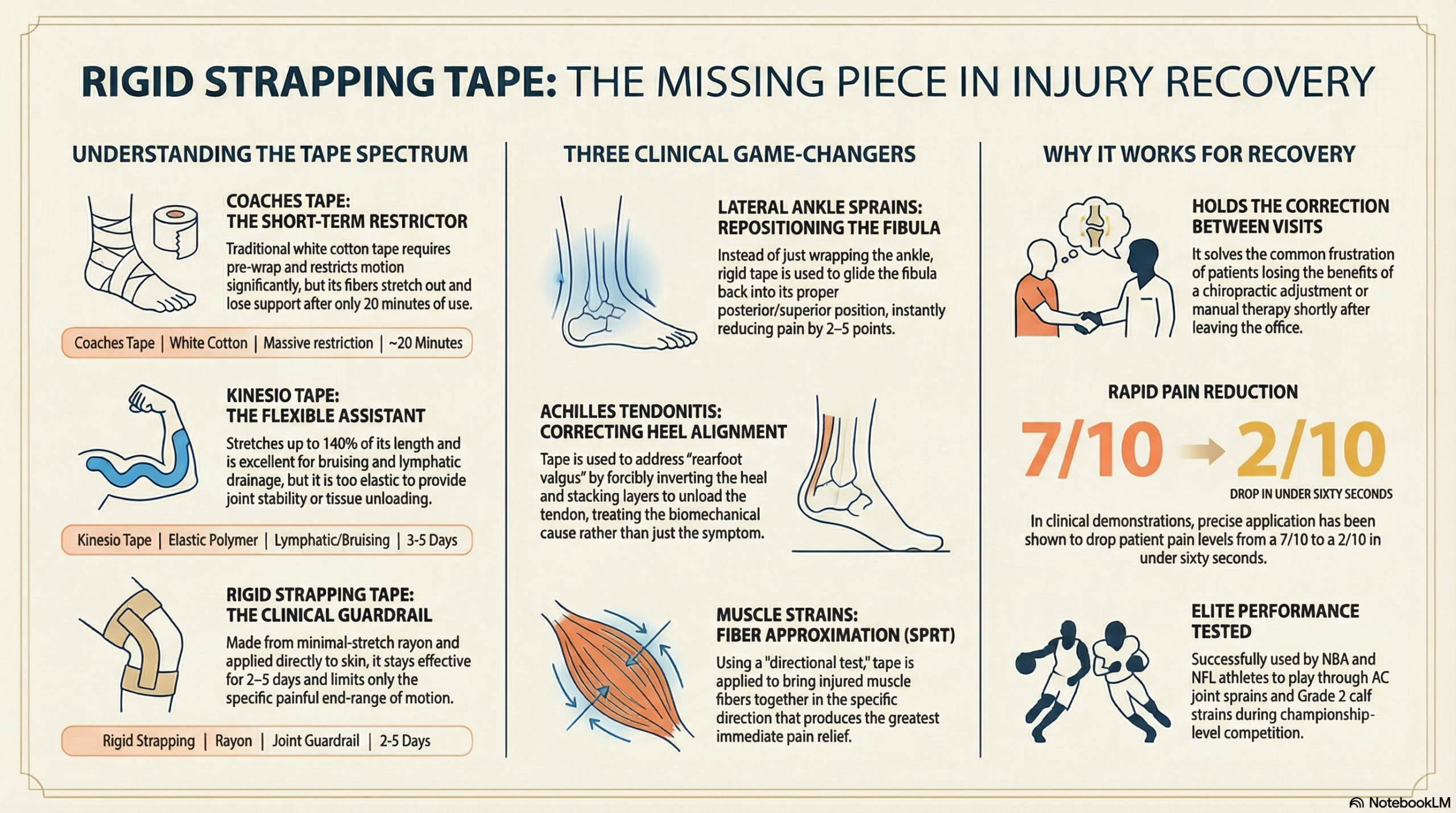
Coaches tape — the white cotton tape you've seen wrapped around athletes' wrists and ankles since high school. It requires pre-wrap, it wraps around the body, and its support lasts about twenty minutes before the fibers stretch out. It restricts range of motion so much that elite athletes hate wearing it. Dr. Reagan's verdict: not worth learning for clinical use.
Kinesio tape — stretches to 140% of its length, stays on for days, and works well for lymphatic drainage and bruising. But it's too stretchy to reposition joints or unload injured tissue. Dr. Reagan was blunt: "I never had real wow moments with kinesio tape."
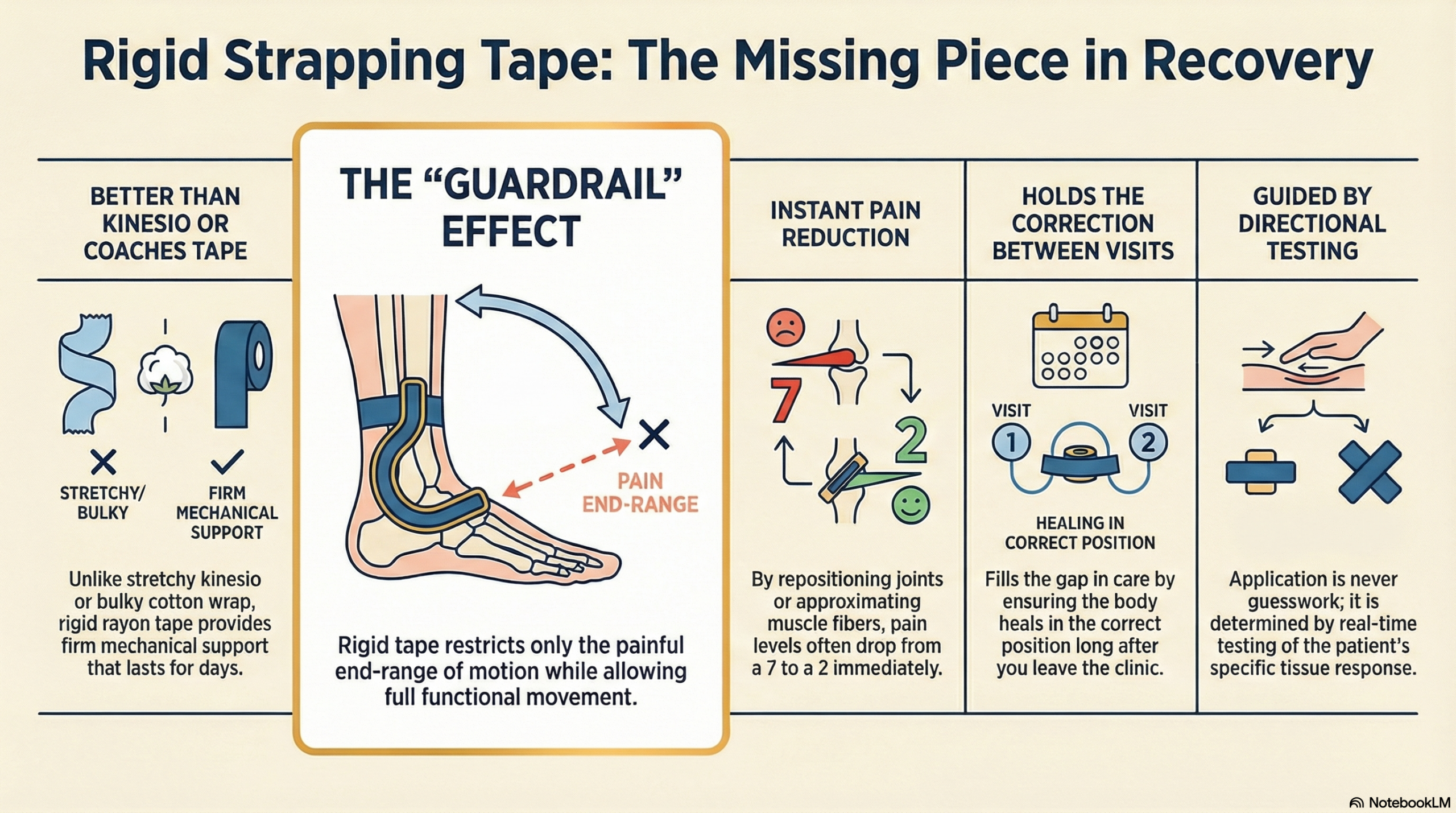
Rigid strapping tape — and this is where everything changed for me. Made from rayon with minimal stretch, applied directly to skin, it stays on for two to five days and restricts only the end range of motion. The patient keeps nearly full function but loses the painful last few degrees that aggravate the injury. Pain drops. Healing accelerates. The patient can keep moving.
Key Takeaway
The difference isn't subtle. It's the difference between wrapping a joint in a cast and giving it a guardrail.
Three Techniques That Changed How I Think About Injury Care
Dr. Reagan has worked with Olympic medical teams — Costa Rica at the 2007 Pan American Games, Colombia at the 2008 Beijing Olympics. She currently travels with professional NBA, NFL, and UFC athletes. The woman has taped world-class bodies under world-class pressure.
But what struck me most wasn't the celebrity cases. It was how transferable these techniques are to the patients I see every day — people recovering from car accidents, weekend warriors dealing with ankle sprains, office workers with nagging muscle strains.
Here are the three techniques that stayed with me long after the seminar ended.
1. Lateral Ankle Sprain: Repositioning the Fibula
This one comes from Brian Mulligan, a physical therapist from New Zealand who pioneered the concept of joint repositioning through mobilization with movement.
Here's what most providers miss about ankle sprains: when you roll your ankle inward, the force doesn't just stretch the ligaments. It pushes the fibula — the thin bone on the outside of your lower leg — forward and downward. That subtle shift changes how the ankle joint tracks. And until you correct it, the ankle doesn't heal right.
Dr. Reagan showed us a simple screening test. You passively move the patient's foot into the position that hurts and ask them to rate the pain. Then you manually glide the fibula back into position — posterior and superior — and retest the same motion. In demonstration after demonstration, patients reported their pain dropping by two to five points on a ten-point scale. Instantly. Just from repositioning that bone.
The tape locks that correction in place. One strip of rigid tape, applied in a spiral from the base of the fibula, pulling it back where it belongs. No wrapping around the ankle. No restriction of normal movement. The patient walks out of the office with a corrected joint position that holds for days.
For my personal injury patients — many of whom have ankle injuries alongside their neck and back complaints — this is a game-changer. A corrected, stabilized ankle means better gait, less compensation, and faster overall recovery.
2. Achilles Tendonitis: Correcting the Hidden Alignment Problem
This one surprised me because it reframes a common diagnosis entirely.
Most people think Achilles tendonitis is about the tendon itself — inflammation, overuse, tightness. And sometimes it is. But Dr. Reagan showed us that many Achilles cases actually stem from a rearfoot valgus deformity — the heel tilting outward, creating abnormal bowing and loading on the tendon.
The tape doesn't treat the tendon directly. It corrects the heel alignment. You identify the point of maximum tendon bowing, adhere the tape, forcibly invert the foot, and pull. Two to three layers, stacked directly on top of each other. The mechanical correction unloads the Achilles immediately.
What I appreciated most was Dr. Reagan's insistence on differential diagnosis before reaching for the tape. Is the problem rearfoot alignment? Calf tightness? Overpronation? Lateral instability? Each one demands a different approach. "This isn't a cookbook," she said repeatedly. "It's a clinical decision-making tool."
That philosophy resonates deeply with how I practice. The adjustment, the soft tissue work, the imaging review — it all comes down to identifying the actual biomechanical fault before you intervene. The tape is just the newest instrument in that process.
3. Muscle Strains: The Technique That Blew My Mind
Dr. Reagan called this one her favorite, and by the end of the demonstration, it was mine too.
The technique comes from a system called SPRT Taping, developed by Dr. Tim Brown, a chiropractor in California. The concept is elegantly simple: you use tape to approximate — to bring together — the injured muscle fibers. The result is immediate pain reduction and improved function.
But here's the part that made the room go quiet.
You create small adhesive tabs, place them in series over the painful area, and then perform a directional test. You pull the tabs one way while the patient contracts the muscle, then reverse direction and retest. The direction that produces the biggest pain drop wins. That's your taping direction.
It's not guesswork. It's not a recipe you memorize. You're literally testing the patient's tissue response in real time and letting their body tell you which direction to tape.
This works on any muscle belly — calf, hamstring, quad, low back. Grade 1 and grade 2 strains. The demonstrations were dramatic: patients going from painful, limited muscle contractions to near-normal function in minutes.
Did You Know
Virtually every car accident produces some degree of muscular injury alongside the joint and disc components. Having a tool that provides immediate, testable pain relief — and lasts for days between visits — fundamentally changes the treatment timeline.
Why This Matters for Your Recovery
I know what you might be thinking. It's just tape.
I would have thought the same thing a week ago. But here's what I keep coming back to.
Dr. Reagan shared the case of a professional NBA player — Jrue Holiday of the Boston Celtics — who sustained an AC joint sprain during the NBA Finals. He played every remaining game of the series with rigid strapping tape. The Celtics won the championship.
She described an NFL player with an MRI-confirmed grade 2 calf strain who missed only one game all season with taping and load management. He flew Dr. Reagan to San Francisco before the playoffs the following year — just for taping.
An Olympic diver who couldn't extend through the lower abdomen. Taped before competition. Top ten finish.
These aren't miracles. They're the result of understanding the biomechanical fault, correcting it with precise manual technique, and then holding that correction with rigid tape so the body can heal in the right position.
That's exactly the same principle behind everything I do in my office — the adjustment corrects joint position, soft tissue work restores muscle function, and now strapping tape maintains that correction between visits. It's the missing piece.
What I'm Bringing Back to the Clinic
I left Parker Seminars with a supply list, a patient prep protocol, and a fundamentally expanded treatment approach. Here's what changes:
Ankle sprains get taped at the first visit. The fibular repositioning technique pairs perfectly with the talus adjustment I already perform. Patients will feel the difference before they walk out the door.
Muscle strains get the directional test. Every car accident patient with a muscular complaint — which is nearly all of them — gets assessed for fiber approximation taping. If the test shows a pain reduction, we tape.
Achilles and foot patients get a biomechanical workup before any tape goes on. No cookbook approaches. Diagnosis first, intervention second.
My chiropractic assistants will learn the prep protocol. Skin inspection, hair clipping, alcohol prep, adhesive barrier application — this is delegable. The clinical decision-making and tape application stay with me.
The investment is minimal. A few rolls of Leukotape, a pair of Teflon-coated scissors, some adhesive barrier spray. Maybe $150 to start. The learning curve is manageable. The results, based on everything I saw and heard over two days in Las Vegas, are consistently remarkable.
The Bigger Lesson
I've been doing this for a quarter century. I've built a practice around being thorough — adjustments, soft tissue work, imaging review, detailed documentation. And I walked into a seminar thinking I'd pick up a tip or two.
Instead, I found a tool that fills a gap I didn't fully realize existed: maintaining the correction between visits.
That's the honest takeaway. Every chiropractor knows the frustration of adjusting a patient, seeing improvement on the table, and watching them return two days later with the same positional fault. Rigid strapping tape holds the correction. It gives the tissue time to heal in the right position. It turns a good adjustment into a lasting one.
If you're a patient recovering from an injury — whether it's a car accident, a sports injury, or a stubborn strain that won't resolve — ask about strapping. It's not flashy. It won't make the highlight reel. But the quiet, sustained correction it provides might be exactly what your recovery has been missing.
And if you're a chiropractor reading this, go learn it. Your patients will thank you.
Dr. Todd Lloyd is a chiropractor and Qualified Medical Evaluator in Petaluma, California, with a special emphasis on personal injury care. He has treated over 1,000 PI cases in Sonoma County over the past four years.