What to Do Immediately After a Car Crash: A Chiropractor’s Checklist
The evidence that wins cases — or loses them — is not gathered in the courtroom. It is gathered in the first minutes after impact, on the side of the road, in the emergency department, and in the days that follow before bruising fades, memories blur, and vehicles get repaired.
This is not a legal document. It is a clinical one. The same actions that strengthen a legal case also produce a more accurate medical record, a more complete diagnostic picture, and a higher-quality care pathway. Most crash victims receive no guidance on any of this. This checklist covers every phase from the moments after impact through the first provider visit, with the clinical reasoning behind each step.
At the Scene: Photograph Everything Immediately
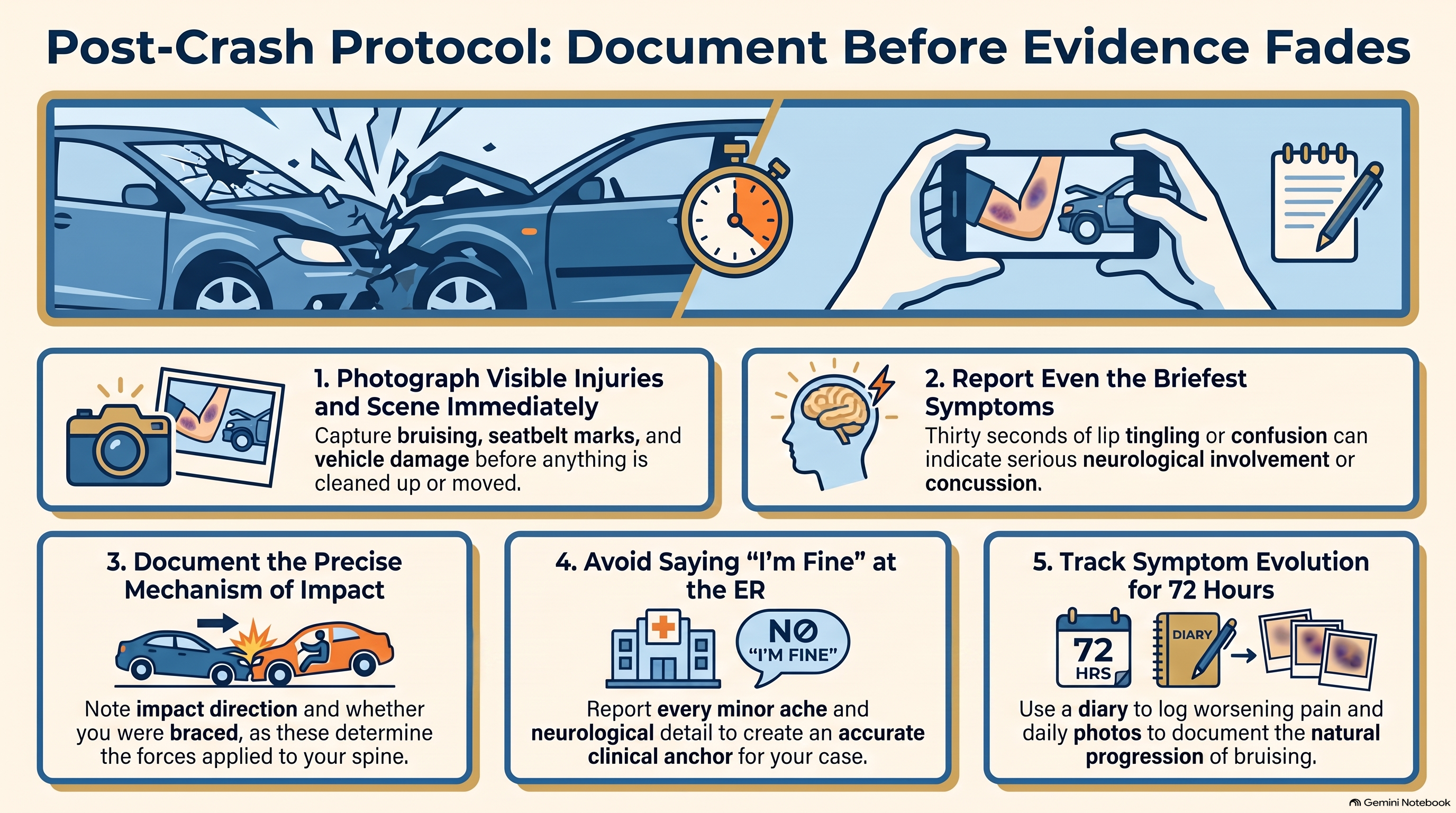
The single most important action a crash victim can take in the minutes after a collision is to photograph visible injuries — before emergency personnel arrive, before clothing is adjusted, and before anything is cleaned up. Bruising does not appear immediately. It develops over the first 24 to 72 hours as blood migrates through tissue. Without a photograph establishing the injury site immediately after impact, the timeline of that evidence becomes arguable.
Insurance claim assessment systems evaluate visual evidence of injury when calculating settlement values. Photographs that clearly show bruising, seatbelt marks, lacerations, or swelling — with the patient’s face or an identifying feature visible — document something that words cannot replicate.
Photograph at the Scene
- All bruising, redness, or swelling on the body
- Seatbelt marks across the chest and abdomen
- Any lacerations or abrasions
- Injury sites with face visible or identifying features for attribution
- Multiple angles: close-up and contextual distance
- All vehicle damage from all angles
- The other vehicle(s) involved
- The scene: skid marks, debris, intersection, speed limits, traffic controls
- Weather and lighting conditions
Continue photographing daily for the first week. Bruising evolves — it worsens before it improves, deepening and spreading as blood disperses through tissue. Daily photographs document the natural progression of injury evidence and establish a timeline that supports causation.
At the Scene: Report Every Symptom, Even Transient Ones
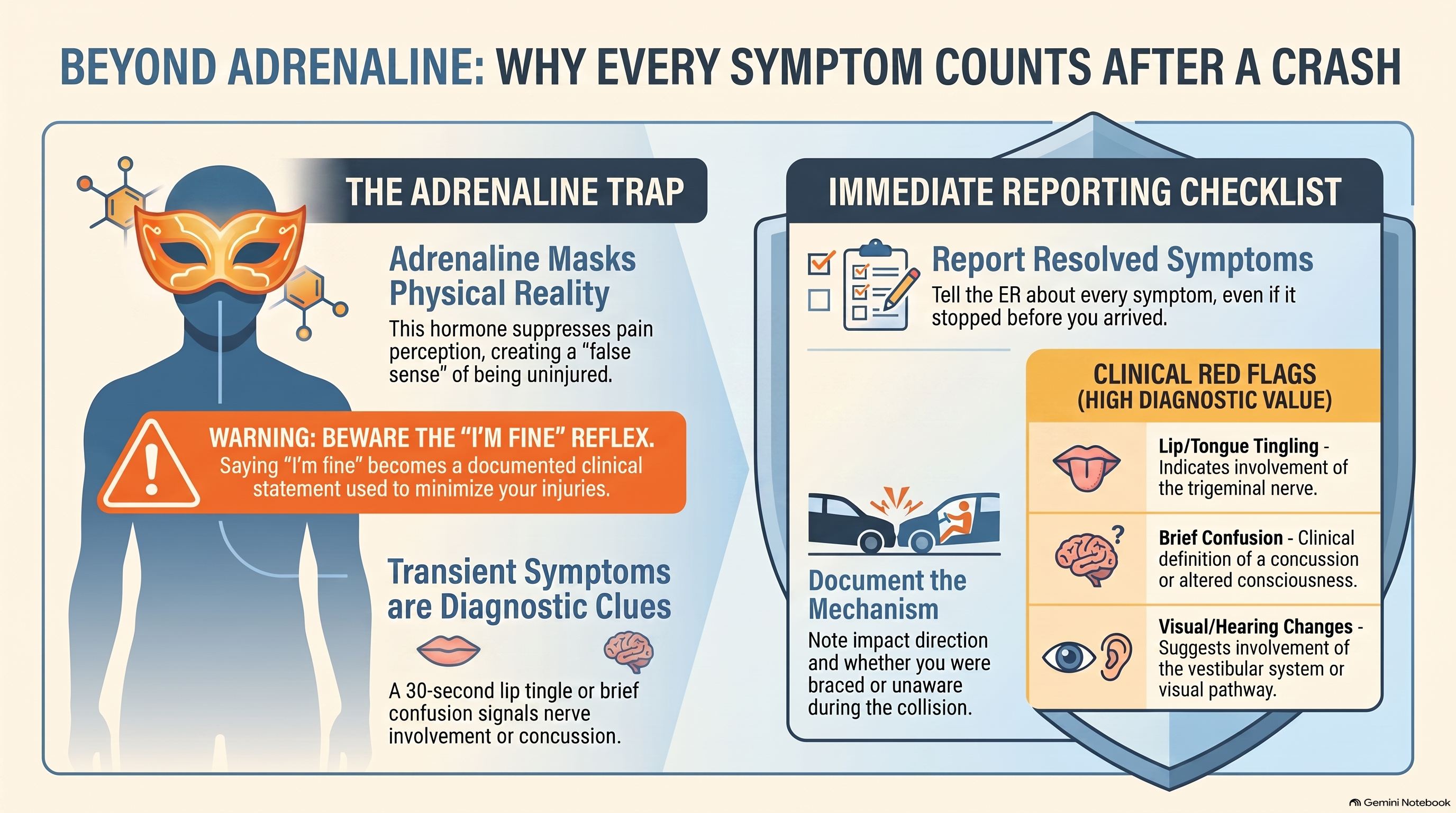
Adrenaline is a powerful pharmacological agent. In the minutes immediately after a collision, it suppresses pain perception, masks fatigue, and creates a physiological state that allows people to function far beyond what their injuries would otherwise permit. This is adaptive in emergencies. It is misleading in documentation.
The symptom you felt for thirty seconds at the scene — tingling in your lips, a moment of confusion, a flash of visual disturbance — and then did not notice again may be among the most diagnostically significant pieces of information in your entire case. Lip or tongue tingling indicates involvement of the fifth cranial nerve (trigeminal). A period of confusion, even brief, is the clinical definition of loss of consciousness or altered consciousness consistent with concussion. Visual disturbances suggest involvement of the visual pathway or vestibular system.
None of these can be documented later if they are not reported now.
Symptoms to specifically monitor and report:
- Loss of consciousness: if any time gap exists, attempt to calculate duration using verifiable sources (what time did the radio say, what time does the watch show)
- Confusion or disorientation
- Tingling in the lips, tongue, or extremities
- Vision changes of any kind
- Hearing changes or ringing
- Nausea
- Headache (onset and location)
- Difficulty breathing
- Pain in any location, however minor
Report these symptoms to first responders, document them yourself, and report them again at the emergency department — even if they have resolved by the time you arrive.
At the Scene: Document the Mechanism
The mechanism of injury — the direction of impact, the approximate speed, whether you saw it coming and braced, or were unaware and relaxed — determines the biomechanical forces applied to the cervical spine, the brain, and soft tissue structures. It directly informs which injuries are plausible and which diagnostic tests are warranted.
Mechanism to Document
- Direction the impact came from
- Approximate speed of the other vehicle
- Whether you were stationary or moving at impact
- Braced versus unaware at moment of impact
- Head and body position at impact
- Whether airbags deployed
- Seatbelt use and position
Use small physical models — toy cars work well — to demonstrate exactly what happened. Patients demonstrate mechanism easily and accurately with physical models, including those with concussion who struggle to verbalize the event. The demonstration can be photographed or video-recorded for contemporaneous documentation.
Preserve physical evidence: Head restraints (headrests) with damage show the force applied to the cervical region. In cases where the vehicle will be repaired or totaled, preserve damaged head restraints before the vehicle is processed. Modern vehicles have Electronic Data Recorders that record speed, braking, and seatbelt status in the seconds surrounding a collision. EDR data can be inadvertently overwritten by aggressive driving inputs after the crash. If EDR data may be relevant, do not drive the vehicle again before consulting an attorney about preservation.
At the Emergency Department: Report Everything
The emergency department assessment in the immediate aftermath of a motor vehicle collision creates the first formal medical record of the event. This record is the temporal anchor of the entire case. It documents what was known when, and it establishes the starting point against which all subsequent changes will be measured.
That record is only as complete as what you report.
Emergency physicians work quickly. Their goal is to rule out immediately life-threatening conditions — intracranial hemorrhage, spinal cord compression, pneumothorax, major vessel injury. The soft tissue injuries, the neurological subtleties, the diffuse aches that represent the full picture of a moderate motor vehicle collision injury are not the ER’s primary focus. They will be documented only if you name them.
Report at the ER:
- Every area of pain, even if minor compared to the worst pain
- Every neurological symptom, including those that resolved at the scene
- The mechanism: direction of impact, approximate speed, braced versus unaware
- Loss of consciousness or any period of confusion, however brief
- Whether you saw the collision coming
Do not minimize. Do not say “I’m fine” as a social reflex. The phrase “I’m fine” in the emergency department record becomes a documented clinical statement that will be cited in every subsequent assessment of your injury. If you are shaken, disoriented, uncertain of what you are feeling, say that instead: “I am not sure what I am feeling right now. I was just in a significant accident and I know some of this may take time to develop.”
Before leaving the emergency department, request copies of your discharge instructions. These documents frequently contain language acknowledging that symptoms may worsen over the next 24 to 48 hours, and they establish the provider’s expectation of symptom evolution — documentation that directly supports the clinical explanation for why your worst symptoms appeared the day after the crash, not at the scene.
Loss of consciousness • worst headache of your life • double vision or unequal pupils • weakness or numbness spreading through arms or legs • difficulty speaking or swallowing • confusion that does not clear • persistent vomiting • clear fluid from nose or ears • severe neck or back pain with neurological symptoms
The First 24 to 72 Hours: Symptom Evolution
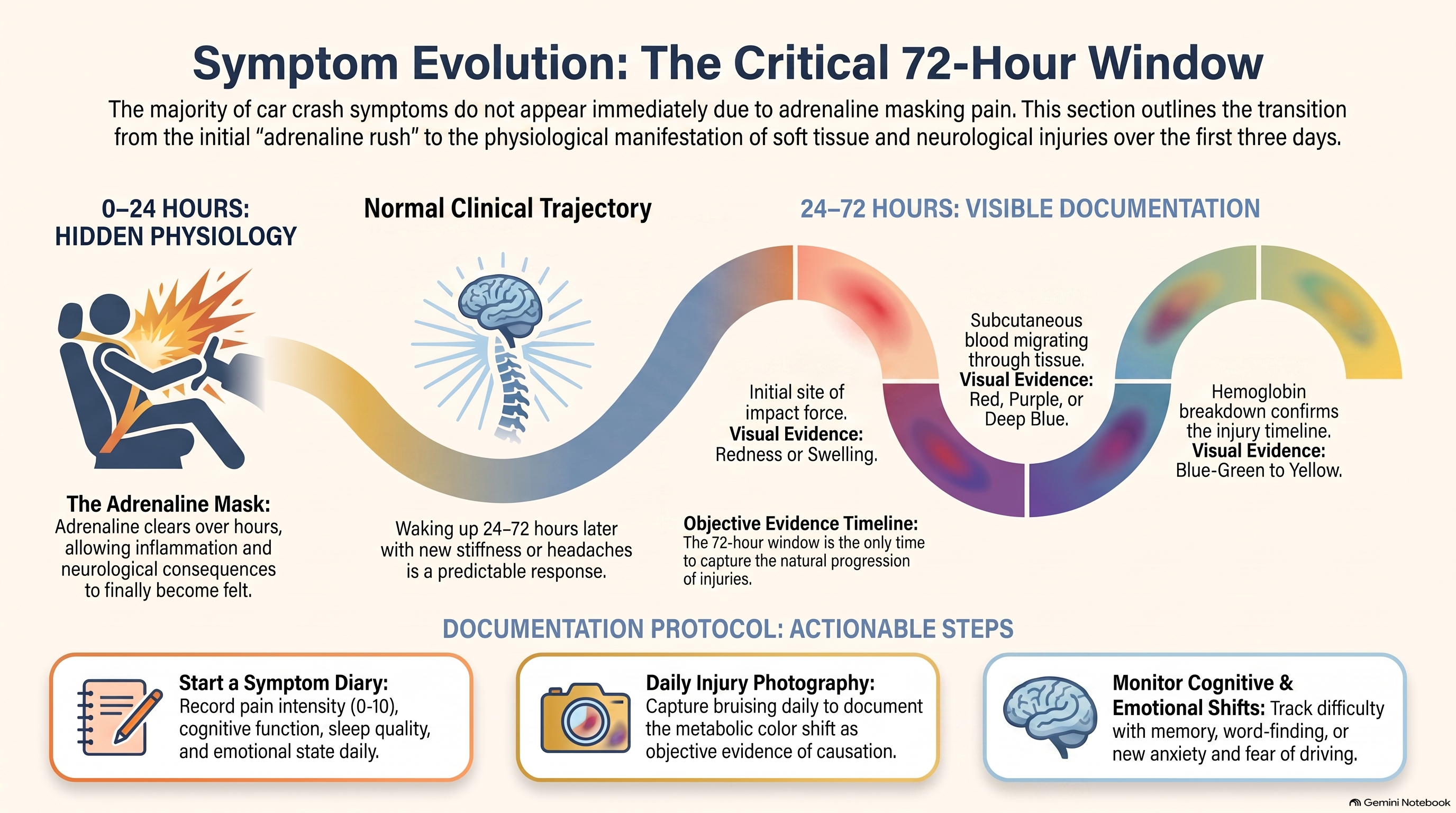
The physiological reality of motor vehicle collision injury is that the majority of symptoms do not appear at the scene. Pain develops over hours as adrenaline clears, as inflammation builds, as the neurological consequences of the impact begin to manifest. The patient who felt fine at the scene and wakes up the following morning with a stiff neck, throbbing head, and sensitivity to light is not experiencing something unexpected. They are experiencing the normal clinical trajectory of acute soft tissue and neurological injury following an acceleration-deceleration event.
This is clinically predictable. It is also the exact point at which most crash victims begin to question whether they are “really” injured, because the symptom evolution feels like it contradicts the initial sense of being okay.
Document the evolution. Start a symptom diary.
Symptom diary entries should include:
- Date and time
- All pain locations and intensity on a 0-to-10 scale
- New symptoms that have appeared since the previous entry
- Activities that worsen symptoms
- Activities or positions that provide relief
- Sleep quality and duration
- Cognitive function: difficulty with memory, concentration, word-finding
- Emotional state: anxiety, irritability, tearfulness, fear of driving
- Any headaches: location, character, duration, triggers
Continue photographing injuries daily through the first week. Bruising typically appears 24 to 72 hours after impact and follows a predictable color progression as the subcutaneous blood is metabolized: the initial red or purple deepens, then shifts through blue-green to yellow as hemoglobin breaks down. This color progression, documented photographically, is objective evidence of the injury timeline that cannot be fabricated after the fact.
The 30-Day Treatment Window
A 30-day delay between a collision and the initiation of formal care is clinically acceptable when it follows documented ER care and is consistent with discharge instructions. However, 30 days is the outer limit, not the target. The longer the gap between the collision and the initiation of comprehensive care, the more arguable the causal relationship between symptoms and the crash becomes.
Your First Comprehensive Provider Visit: What to Bring
The first appointment with a chiropractor, physiatrist, or primary care physician following a motor vehicle collision should be treated as a comprehensive intake. The more information you bring, the more thorough the evaluation and documentation will be.
Bring to the first provider visit:
- Photographs of injuries — all of them, from the scene through the present day, with dates
- Emergency department records — request copies before leaving the ER; they may take weeks to arrive through standard channels
- Police report number — the full report may take weeks, but the number establishes the incident
- Insurance information — yours and the other driver’s, if available
- Symptom diary — every entry from the day of the crash forward
- List of medications taken since the crash, including over-the-counter
- Prior medical records if available — these establish the pre-accident baseline and allow the provider to document what changed
Be prepared to describe the mechanism in detail. Your provider will likely use a diagram or physical models to document exactly how the collision occurred. This documentation creates a contemporaneous record of mechanism that will support every imaging interpretation, every diagnosis, and every treatment decision that follows.
Report every symptom — including those that have appeared or worsened since the crash, those that seem minor, and those you are uncertain whether to attribute to the accident. The provider’s job is to make clinical attributions. Your job is to give them complete information.
Conclusion
The first hours after a motor vehicle collision are a one-time opportunity. Bruises fade. Memories become unreliable. Vehicles get repaired. Evidence disappears. The EDR record gets overwritten. The initial symptom — the tingling in the lips, the thirty-second gap in memory, the flash of visual disturbance — becomes impossible to prove if it was not documented when it existed.
The patients who receive the most thorough care and who have the strongest documentation are not the ones who waited to see how they felt. They are the ones who treated the first hours as what they are: the only window in which certain evidence can exist at all.
This checklist is not about building a legal case. It is about building an accurate medical record. The accuracy of that record — the completeness of the symptom documentation, the thoroughness of the imaging, the explicitness of the causation statement — is the foundation of everything that follows: the treatment plan, the referrals, the impairment determination, and the resolution of the case.
Start at the scene. Start immediately.
References
- Croft, A. C. (2002). Whiplash and Mild Traumatic Brain Injuries: A Guide for Patients and Practitioners. Sonoran Desert Institute Press. (Cited for mechanism documentation and symptom evolution following acceleration-deceleration injury.)
- Sturzenegger, M., DiStefano, G., Radanov, B. P., & Schnider, A. (1994). Presenting symptoms and signs after whiplash injury: the influence of accident mechanisms. Neurology, 44(4), 688–693. (Cited for the effect of braced versus unaware impact on symptom severity.)
- Deans, G. T., Magalliard, J. N., Kerr, M., & Rutherford, W. H. (1987). Neck sprain — a major cause of disability following car accidents. Injury, 18(1), 10–12. (Cited for delayed symptom onset and documentation of post-collision injury progression.)
- National Highway Traffic Safety Administration. (2013). Event Data Recorders: Final Rule. U.S. Department of Transportation. (Cited for EDR data retention standards and preservation protocols.)
- Cassidy, J. D., Carroll, L. J., Côté, P., Lemstra, M., Berglund, A., & Nygren, Å. (2000). Effect of eliminating compensation for pain and suffering on the outcome of insurance claims for whiplash injury. New England Journal of Medicine, 342(16), 1179–1186. (Cited for documentation completeness and its effect on case trajectory.)
- Iverson, G. L., & Zasler, N. D. (2007). Post-concussive disorder. In N. D. Zasler, D. I. Katz, & R. D. Zafonte (Eds.), Brain Injury Medicine: Principles and Practice. Demos Medical. (Cited for concussion identification at scene and transient neurological symptom documentation.)