You got hit. Now what?
If you're reading this, there's a good chance you — or someone you care about — were recently in a car accident. Maybe a rear-end collision. Maybe something worse.
You went to the ER. They checked for fractures, maybe did a CT scan, told you nothing was broken, and sent you home with instructions to "rest and follow up with your doctor." And now you're sitting with a headache that won't quit, a neck that doesn't want to turn, and a fog over your thinking that nobody around you seems to understand.
The injury you can see on an X-ray is rarely the whole story. And the brain injury that doesn't show up on any scan? That's the one that changes your recovery timeline if you don't address it properly.
I want to walk you through something I've been studying — something that connects whole-body vibration therapy, sleep, and a waste-clearance system inside your brain that most people have never heard of. It's called the glymphatic system, and understanding it could change how you think about your recovery.
First, let's talk about what's actually in this clinic
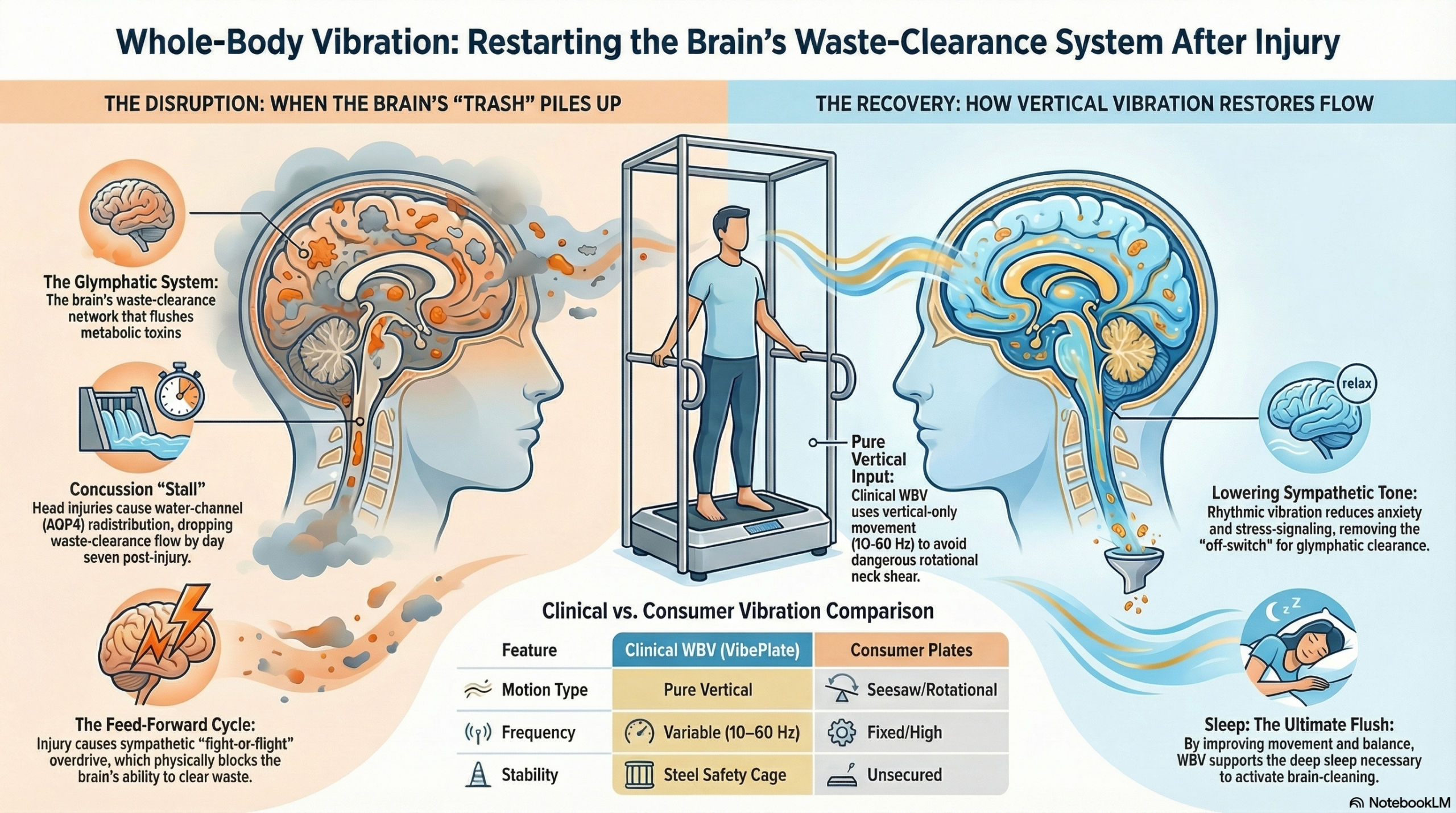
I have a piece of equipment called the VibePlate VibeStretch XL. When patients first see it, they're usually a little intimidated — it's a full-size steel cage with a steel vibration platform. It looks more like something you'd find in an elite training facility than a chiropractic office.
And that's kind of the point. This isn't one of those little wobble plates you see advertised online. Let me show you why that distinction matters.
Pure vertical vibration vs. the seesaw
Most consumer vibration plates use a pivoting, seesaw-style motion — one side tilts up while the other tilts down. That creates a rocking, rotational force through your body. For someone with a fresh neck injury or a concussion, that rotational shear is exactly what you don't want.
The VibePlate moves straight up and down. Pure vertical displacement. Both sides of your body get the same input at the same time. There's no lateral twist introduced at the spine or pelvis. That might sound like a small engineering detail, but when I'm working with someone whose vestibular system is already scrambled from a concussion — symmetry and predictability matter enormously.
Variable frequency: meeting you where you are
The controller lets me dial the vibration frequency anywhere from 10 to 60 Hz. That range gives us real clinical flexibility:
- 10–20 Hz — gentle, calming, good for the first session when we don't know how your nervous system will respond
- 25–40 Hz — the range where most of the published WBV research lives, the sweet spot for neuromuscular activation and balance work
- 40–60 Hz — more intense, reserved for later-stage rehab and conditioning
For a whiplash or concussion patient, I almost always start low and go slow. Your symptom response tells me whether to progress or pull back. That's the whole philosophy.
The cage changes everything
The stretch cage has attachment points for resistance bands, handles, and support bars. That means:
- You can hold on while your body acclimates to the vibration — no fear of falling
- I can set up banded rows, presses, and anti-rotation holds on the platform
- We can progress to eyes-closed balance work, split stance, and single-leg challenges — all inside a structure that keeps you safe
For someone who is anxious, dizzy, or deconditioned after a collision, that sense of security is not optional. It's therapeutic.
Specs at a glance
| Feature | Specification |
|---|---|
| Platform dimensions | 30" x 72" (with cage frame: 30" x 48" x 87") |
| Vibration form | Pure vertical |
| Frequency range | 10–60 Hz (variable) |
| Amplitude | 2 mm |
| Weight capacity | 2,400 lbs |
| Frame material | Steel cage with aluminum platform |
| Cage features | Band attachment points, handles, support bars |
What does the research actually say about whole-body vibration?
You might be thinking: "Okay, it's a fancy vibration plate. But does it actually do anything?"
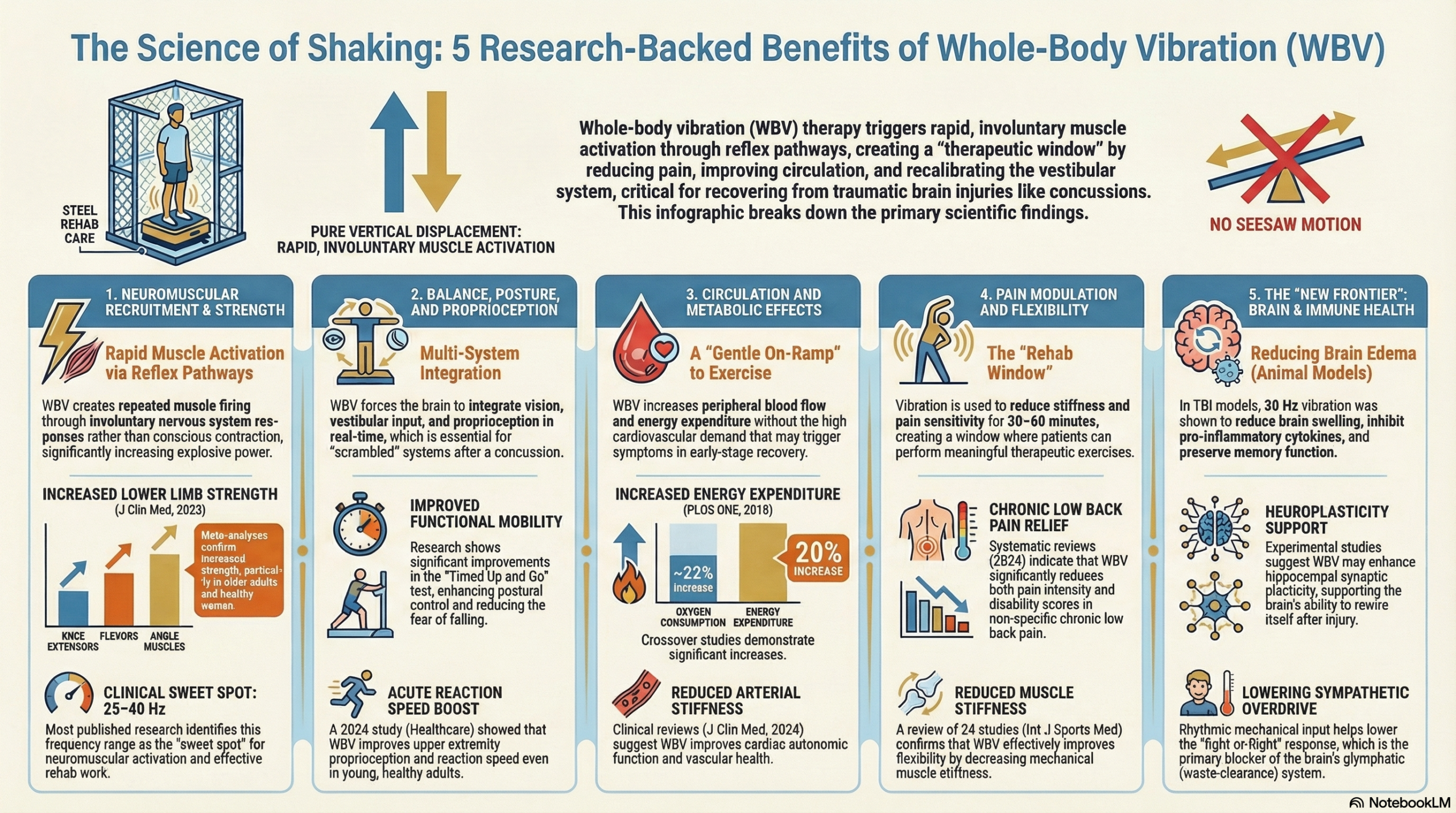
Fair question. Here's what I can tell you — the research base on WBV is broader than most people expect, and several benefits show up consistently across studies. Let me walk you through the five that matter most for injury recovery.
1. Strength, power, and neuromuscular recruitment
WBV creates rapid, repeated muscle activation through reflex pathways. Your muscles fire in response to the vibration — not because you're consciously contracting them, but because your nervous system is responding to the mechanical input.
- A systematic review and meta-analysis found WBV significantly increases neuromuscular activation and explosive power of the lower limb (PLOS ONE, 2022; PMID 36473014)
- A meta-analysis of RCTs in older adults confirmed WBV increases lower limb muscle strength for knee extensors, flexors, and ankle plantar flexors (J Clin Med, 2023; PMID 37445502)
- A meta-analysis of 21 RCTs in healthy women showed significantly greater muscle strength and power with WBV vs controls (PubMed, 2025; PMID 40445930)
2. Balance, postural control, and proprioception
This is the one I care about most for concussion patients. Balance is not just a "leg strength" thing — it's vision + vestibular input + proprioception + brain processing speed, all integrated in real time.
- A systematic review and meta-analysis found WBV improves postural control in elderly populations (BMC Geriatr, 2011; PMID 22054046)
- A meta-analysis of 10 RCTs showed WBV significantly improves functional mobility on the Timed Up and Go test (J Aging Phys Act, 2020; PMID 31629362)
- A study in young adults showed WBV acutely improved upper extremity proprioception and reaction speed (Healthcare, 2024; PMC 11734632)
3. Circulation and metabolic effects
WBV can function as a gentle on-ramp, increasing peripheral blood flow and energy expenditure without the cardiovascular demand of traditional aerobic exercise.
- A meta-analysis found an acute bout of WBV increases peripheral blood flow (J Athl Train, 2015; PMC 4560014)
- A crossover study showed WBV increased energy expenditure by ~20% and oxygen consumption by ~22% (PLOS ONE, 2018; PMC 5792008)
- A clinical review summarized evidence for WBV improving cardiac autonomic function and reducing arterial stiffness (J Clin Med, 2024; PMC 11396361)
4. Pain modulation and flexibility
Some patients experience short-term reductions in stiffness and pain sensitivity after WBV. I don't frame this as a cure — I frame it as a window. If vibration makes movement feel easier for 30–60 minutes, that's time to do meaningful rehab work.
- A systematic review found WBV significantly reduces pain and disability in non-specific chronic low back pain (Healthcare, 2024; PMC 10971737)
- A systematic review of chronic musculoskeletal pain studies found positive effects of WBV (Medicine, 2019; PMID 31004565)
- A literature review of 24 studies found WBV can improve flexibility and reduce muscle stiffness (Int J Sports Med, 2019; PMC 6533098)
5. Brain, immune, and inflammation signaling (emerging)
This is where the science gets really interesting — and where the connection to concussion starts to crystallize. I want to be clear: this is early-stage science. But the direction is compelling.
- In a mouse TBI model, WBV at 30 Hz reduced brain edema, attenuated microglial activation, inhibited pro-inflammatory cytokines, and preserved learning and memory (Front Cell Dev Biol, 2022; PMID 35465331)
- A comprehensive review explored cellular and molecular mechanisms by which WBV affects immune and brain function (Front Neurol, 2024; PMID 39144715)
- A review of experimental animal studies found WBV improves brain and musculoskeletal health, including enhanced hippocampal synaptic plasticity (Int J Mol Sci, 2022; PMC 9498983)
Now here's what most people don't know about concussion
You've probably been told that concussion is a brain injury — and it is. But in my experience, that framing is incomplete. What I see in the clinic, case after case, is that concussion is a systems problem:
- Disrupted vestibular processing — dizziness, motion sensitivity, the feeling that the room is tilting
- Disrupted vision processing — screens hurt, reading is harder, your eyes feel "wrong"
- Autonomic imbalance — your heart rate is erratic, you sweat at odd times, you cannot sleep
- Neck injury contributions — the same collision that rattled your brain also strained your cervical spine
Here's what I want you to understand: the brain has a system for cleaning itself after injury. And in concussion, that system gets damaged at exactly the moment when you need it most.
Your brain's night shift: the glymphatic system
Your body has a lymphatic system — a network that drains waste products from tissues throughout your body. But your brain doesn't have traditional lymphatic vessels deep in its tissue. For a long time, scientists didn't fully understand how the brain took out its metabolic trash.
Then they discovered the glymphatic system. And it changed everything we thought we knew about brain recovery and neurodegeneration.
How your brain flushes waste
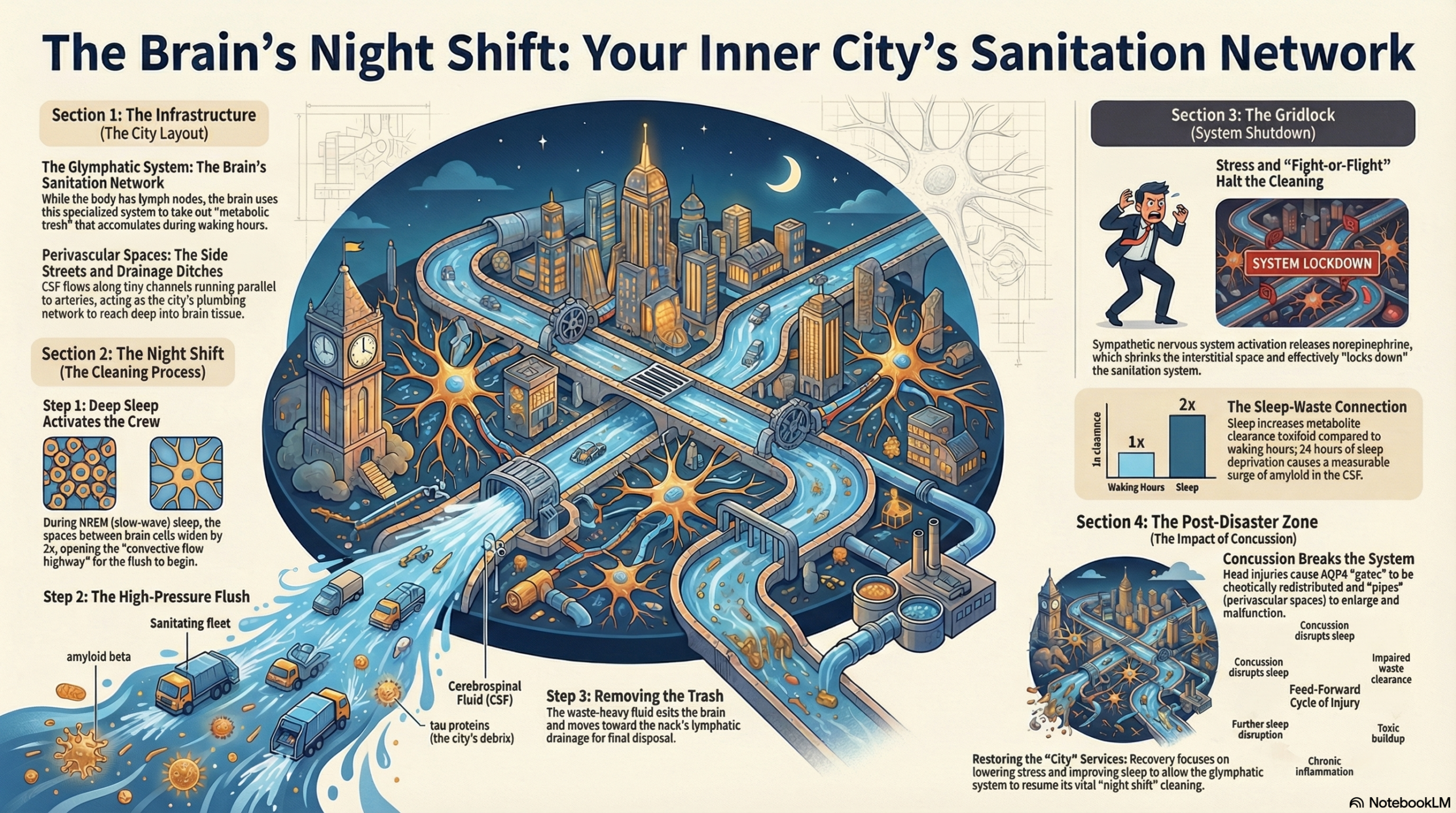
Cerebrospinal fluid (CSF) flows into the brain along perivascular spaces — tiny channels that run alongside arteries as they penetrate into brain tissue. Think of these like drainage ditches that run parallel to roads.
On the walls of these channels sit specialized water channels called aquaporin-4 (AQP4), anchored to the endfeet of astrocytes. These AQP4 channels act like gates, allowing CSF to flush through the brain's interstitial tissue.
As CSF moves through, it picks up metabolic waste products — including amyloid beta and tau proteins, the same substances that accumulate in Alzheimer's disease — and carries them out of the brain toward cervical lymphatic drainage in your neck.
- A 2025 randomized crossover trial confirmed the glymphatic system clears amyloid beta and tau from brain to plasma in humans (PMID 41593094)
- Genetic deletion of AQP4 in mice results in brain-wide interstitial fluid stagnation (Sci Transl Med, 2023; PMC 9995113)
- A comprehensive review established CSF flows along periarterial spaces, mixes with interstitial fluid, and exits via perivenous pathways (J Neurosci, 2021; PMC 8603752)
The on/off switch you need to know about
Deep, slow-wave sleep activates the glymphatic system. During deep sleep, the intercellular spaces widen by roughly two times their waking size. That expansion creates a convective flow highway. The flush begins.
But sympathetic nervous system activation — your fight-or-flight response — completely blocks glymphatic clearance. When your nervous system is running hot, the brain cannot take out its trash.
- A landmark 2025 study in Cell showed that norepinephrine-mediated slow vasomotion during NREM sleep is the primary driver of glymphatic clearance (PMID 39788123)
- Noradrenaline impedes glymphatic clearance by decreasing CSF production and shrinking interstitial space volume (Neurobiol Aging, 2021; PMC 8292227)
- Sleep increases metabolite clearance twofold compared to waking (Front Pain Res, 2021; PMC 7755843)
What concussion does to this system
The glymphatic system takes a direct hit after head injury:
- Glymphatic flow drops within the first day after injury and worsens by day seven
- Imaging studies show enlarged perivascular spaces that correlate with poor sleep quality
- Post-mortem studies show AQP4 water channels are chaotically redistributed
- Blood biomarkers 8–10 years after even mild concussion show elevated amyloid beta, tau, and NfL
- Poor sleepers have dramatically higher levels of NfL and inflammatory markers
- A systematic review confirmed impaired glymphatic clearance after head injury (Brain Sci, 2022; PMC 9408940)
- A 2025 mini-review synthesized evidence on AQP4 mislocalization and impaired clearance linking concussion to neurodegeneration (Front Neurosci, 2025; PMID 41179995)
- A review detailed how AQP4 dysfunction contributes to post-injury amyloid and tau accumulation (Mol Neurobiol, 2023; PMID 37185960)
The cycle that keeps concussion patients stuck
Concussion → disrupted sleep-wake circuitry → impaired glymphatic clearance + elevated sympathetic tone → metabolic waste accumulates + chronic neuroinflammation sets in → accelerated neurodegeneration → which further disrupts sleep → and the cycle repeats.
Dr. Werner called this a feed-forward cycle. The injury breaks the system that repairs the injury. And every night of poor sleep compounds the problem.
But it also means there's a clear intervention point. If we can improve your sleep, lower your sympathetic tone, and restore the conditions for deep, restorative rest, we can help your brain's glymphatic system do what it was designed to do.
The stakes are higher than you think
- A 30-year study of nearly 4,000 people found that sleeping 6 hours or less doubled the risk of dementia
- Just 24 hours of sleep deprivation produces a measurable surge of amyloid in cerebrospinal fluid
- Women who treated their sleep apnea had 70% less dementia over 5 years
- A study of nearly 200,000 US veterans found TBI was associated with a 41% increased risk of developing sleep disorders
Sleep is now considered the most modifiable risk factor for long-term neurodegeneration.
- A PET imaging study showed one night of sleep deprivation significantly increases beta-amyloid accumulation (PNAS, 2018; PMC 5924922)
- A longitudinal study found sleep disturbances forecast accelerated beta-amyloid plaque deposition (Curr Biol, 2020; PMC 7642104)
- A study of ~200,000 US veterans found TBI associated with 41% increased risk of sleep disorders over 14 years (Neurology, 2021; PMID 33658328)
So where does whole-body vibration fit into all of this?
I want to be honest with you — because that's how I'd want my own doctor to talk to me.
There is not yet strong clinical evidence that standing on a vibration platform directly "flushes" glymphatics in concussion patients. That study hasn't been done. And I'm not going to pretend it has.
But here's what I can tell you, based on 25 years of treating injuries and a careful reading of the emerging science:
WBV may help create the physiological conditions that allow your brain to heal itself.
The indirect pathway
The glymphatic system needs:
- Deep sleep — to activate the clearance pathway
- Low sympathetic tone — so norepinephrine isn't blocking the process
- Healthy astrocyte and AQP4 function — so the water channels work properly
WBV can contribute to those conditions through several mechanisms:
It improves movement tolerance. Patients who can move more comfortably tend to sleep better.
It may reduce sympathetic overdrive. Gentle, rhythmic mechanical input has been shown to influence autonomic nervous system activity.
It supports vestibular recalibration. When balance confidence returns, anxiety drops. When anxiety drops, sympathetic tone decreases. When sympathetic tone decreases, sleep quality improves.
It provides a low-impact exercise gateway. Exercise is one of the few interventions shown to enhance glymphatic clearance in animal models.
The goal is not to vibrate the brain clean. The goal is to build the physiological conditions — better movement, better balance, lower sympathetic tone, better sleep — that allow the brain to clean itself.
What a session actually looks like in my clinic
Step 1: We set the baseline
Before anything else, I want to know: How's your headache today? Any dizziness? Nausea? How did you sleep last night? I check your standing heart rate response.
Step 2: We start stable
You step onto the platform inside the cage. Both hands on the support bars. Feet shoulder width. I start the vibration low — maybe 15 Hz. We hold it for 30 to 60 seconds.
Step 3: We add gentle rehab
If your symptoms stay stable, we layer in movement: banded rows, anti-rotation presses, light split-stance work — all while standing on the vibrating platform.
Step 4: We respect the ceiling
If symptoms rise — headache gets louder, dizziness ticks up, you feel "off" — we stop. That's not failure. That's data.
I tell patients: "We're training your nervous system, not punishing it. The goal is to do a little more than yesterday without triggering a setback."
What I want you to take away from all of this
You are the central figure in your own recovery. Not the MRI. Not the insurance adjuster. Not even me.
Concussion recovery is not passive. Resting in a dark room indefinitely is outdated advice. Your brain needs graded input.
Your brain's waste-clearance system is compromised. The glymphatic system is impaired after head injury. It depends on deep sleep and low sympathetic tone to function.
Sleep is your most powerful recovery tool. Every night of restorative sleep gives your glymphatic system the opportunity to clear amyloid, tau, and inflammatory byproducts.
Whole-body vibration is a tool, not a miracle. But it's a good tool — one that can help rebuild your tolerance to movement, challenge your balance system safely, and create the downstream conditions for better sleep and lower stress.
The combination matters. Controlled vibration + supported positioning + resistance band rehab + sleep optimization + symptom-guided progression.
Your next step
If you're recovering from a concussion or whiplash injury and you want to know whether whole-body vibration therapy might be appropriate for your situation, the safest next step is a guided evaluation.
I'll assess where your nervous system is, how your balance and vestibular function are performing, and whether your symptoms are stable enough to begin graded WBV exposure. We'll build a plan together — one that respects your current limits and gives your brain the best possible conditions to heal.
You don't have to figure this out alone. That's what I'm here for.
A note about red flags: If your symptoms include loss of consciousness, repeated vomiting, worsening headache, new weakness, confusion, or seizures — seek urgent medical evaluation immediately. These require emergency assessment, not vibration therapy.