Think about the last time you were rear-ended at a stoplight.
Maybe the car behind you was barely rolling — five, six miles per hour. Your bumper looked fine. The other driver got out and shrugged. The police report said "no visible damage." Your insurance adjuster called a few days later and used the phrase "minor impact" like it was a medical diagnosis.
And meanwhile, you couldn't turn your head.
I've been a chiropractor since 2002. In the last four years alone, I've treated over a thousand personal injury patients in Sonoma County — the vast majority from motor vehicle collisions. And I can tell you, without hesitation, that the most dangerous thing about a low-speed crash isn't the crash itself. It's the assumption — made by adjusters, defense experts, and sometimes even other doctors — that a slow-moving car can't hurt you.
That assumption is wrong. I've seen it proven wrong hundreds of times. And I need you to understand why, because if you've been in a collision like this, what you believe about your own injury will shape every decision you make from here.
I Know What You're Probably Thinking
You're thinking: It was barely a fender-bender. How bad could it really be?
I get it. I hear this from patients constantly. They almost apologize for coming in. They feel like they're overreacting. The car looks fine, so they should be fine. Their friend told them to "give it a few days." The adjuster implied they're exaggerating.
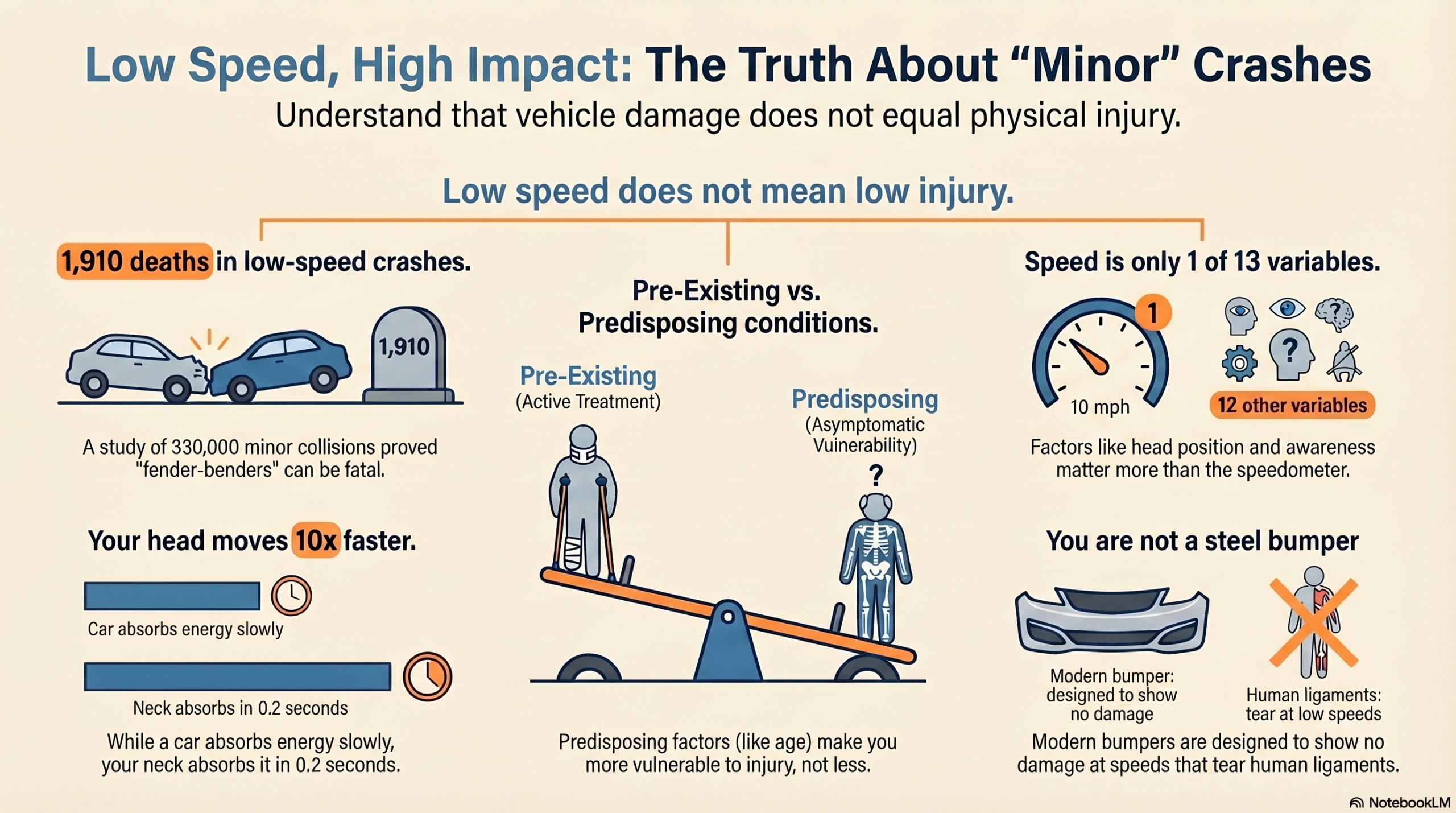
Here's what none of those people mentioned: a six-year study in Florida documented 330,000 low-speed collisions. These weren't highway pileups. These were the exact kind of crash you're picturing — cars still drivable, no visible injuries at the scene, estimated speeds under ten miles per hour.
Those 330,000 crashes produced 280,000 documented injuries. Not self-reported. Not from medical opinions months later. Documented by law enforcement at the scene.
1,910
people died in low-speed crashes in Florida over six years
Let me say that again. Nearly two thousand people died in crashes that, by every common definition, were "minor."
Important
If someone tells you a low-speed collision can't cause serious injury, they either haven't seen the data or they have a financial reason to hope you haven't.
The Physics They Don't Want You to Understand
Here's where it gets interesting — and where defense experts count on you not following along.
Force isn't just about speed. It's about speed and time. Specifically:
Force = Mass × (Change in Velocity ÷ Change in Time)
Both numbers matter. And here's the part that changes everything: when your car gets hit, the vehicle decelerates over about 2.4 seconds. The car's crumple zones, bumper, and frame absorb that energy across a relatively generous window of time.
Your head and neck don't get that luxury.
Your head accelerates in roughly 0.2 seconds. That means your head and cervical spine experience approximately ten times the acceleration that the car does.
10×
the acceleration on your head and neck compared to the vehicle
A ten-mile-per-hour crash that decelerates your car over 2.4 seconds might feel gentle to the vehicle. But your neck, absorbing that same energy over 0.2 seconds, experiences forces that rival a much faster collision with a longer deceleration. The math doesn't lie. A low-speed impact with a short acceleration window can generate the same force on your cervical spine as a high-speed crash with a longer one.
When a defense expert testifies that "the forces were too low to cause injury," they're leaving out the time variable. They're not simplifying the physics. They're breaking them.
Key Takeaway
Force does not equal mass times speed. Force equals mass times speed divided by time. Omitting the time component doesn't simplify the physics — it violates them.
Speed Is One Variable Out of Thirteen
This is the part that matters most, and it's the part that almost nobody talks about.
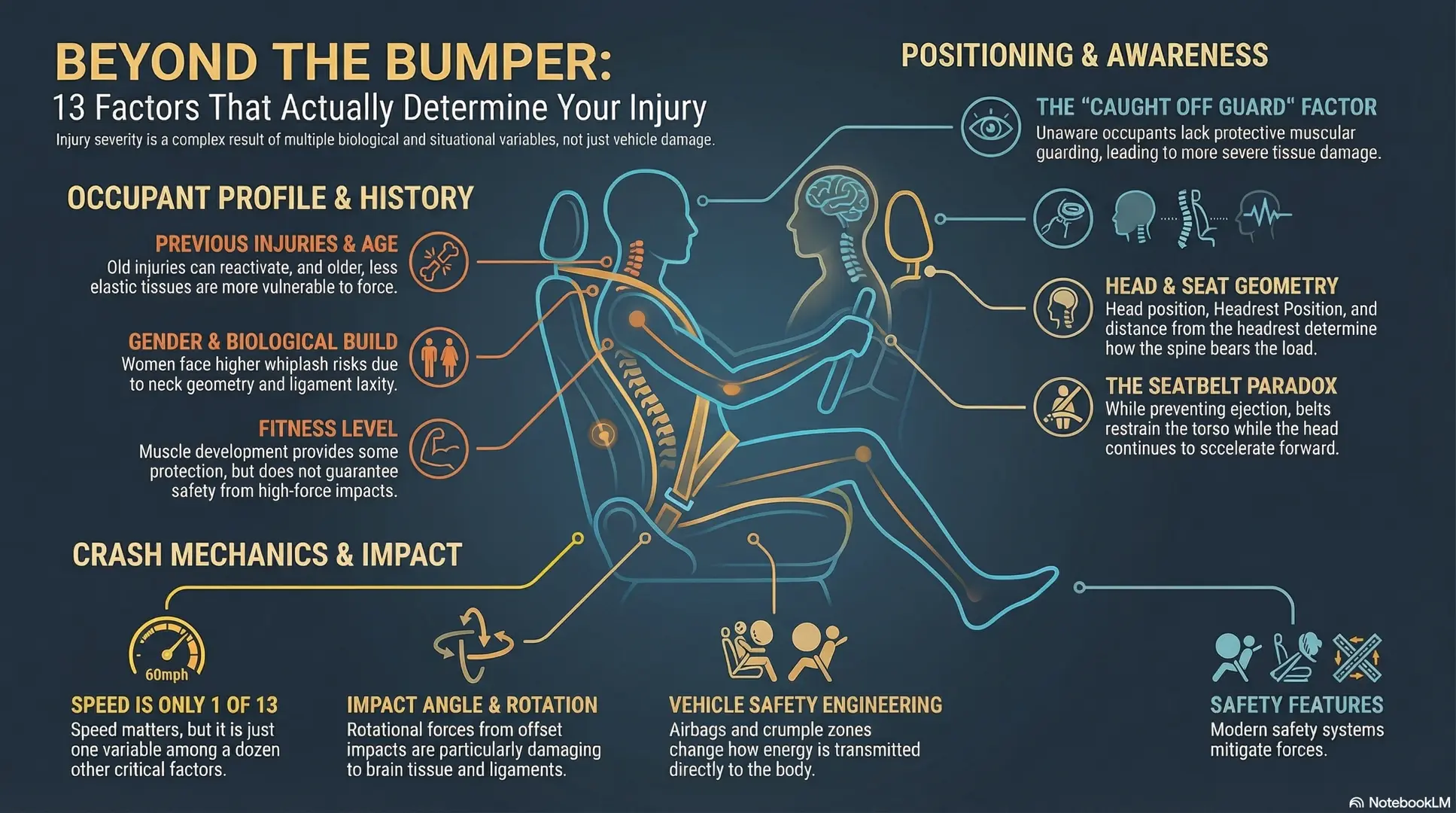
A Canadian researcher identified thirteen separate variables that determine whether someone gets injured in a collision. Thirteen. Speed is one of them. It's number thirteen on the list.
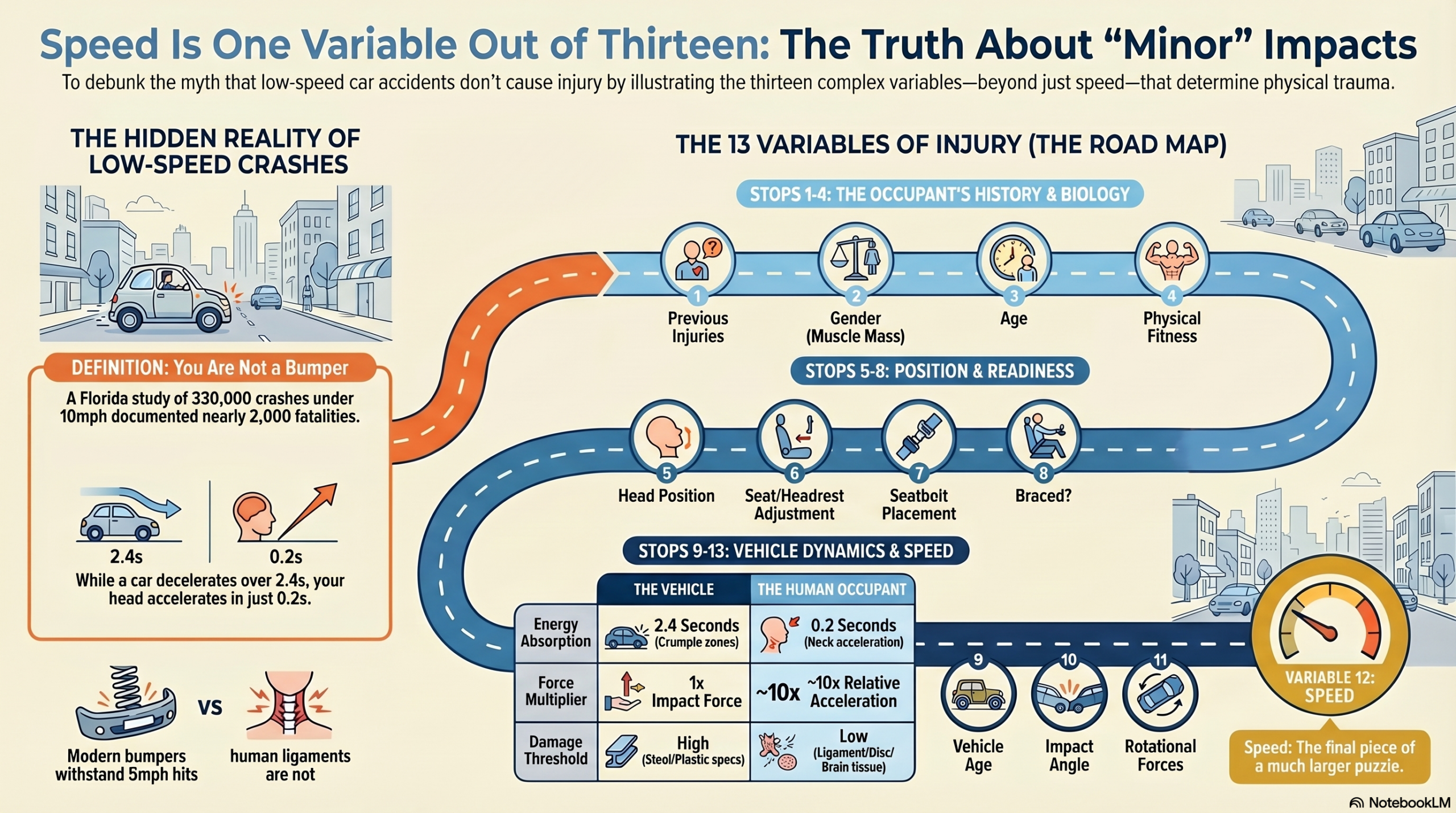
Here are the other twelve:
Previous injuries — even old ones you forgot about — create structural weakness in your tissues. That shoulder surgery from college? That whiplash from a fender-bender in 2015 that "resolved on its own"? Your body remembers, even if you don't.
Head position at impact. Were you turned to check your mirror? Looking down at your phone? That changes the force distribution through your entire cervical spine.
Seat position. How far back. How reclined. Whether the headrest was properly adjusted or sitting three inches too low.
Gender. Women generally have less cervical muscle mass. The research consistently shows higher injury rates in female occupants at the same impact speeds.
Age. Tissue resilience, bone density, and recovery capacity all decline with time. A fifty-year-old neck is not a twenty-five-year-old neck.
Body build and fitness. A deconditioned body absorbs force differently than a conditioned one.
Awareness. Did you see the car coming? If your muscles were braced, you absorbed the force differently than if you were relaxed and blindsided. A surprised occupant takes significantly more damage.
Seatbelt position. Where the belt sat across your body changes the entire pattern of force distribution.
Headrest adjustment. A properly positioned headrest catches the skull before hyperextension. Most headrests are set too low.
Vehicle age and safety features. A 2024 SUV and a 2009 sedan respond to the same impact very differently.
Angle of impact. Rear, side, frontal, oblique — each one loads your spine in a completely different way.
Rotational forces. If you're wearing a seatbelt — and you should be — rotation is virtually guaranteed. One shoulder is restrained while your body moves. That torsional load on your spine is additive. It compounds everything else.
And then, finally: speed.
Did You Know
With thirteen independent variables contributing to injury risk, two people in the same car can have completely different outcomes. The expectation that everyone in the vehicle should have the same injury is not medical reasoning — it's a talking point.
General Patton Died in a Low-Speed Crash
I bring this up with patients sometimes because it stops the conversation cold.
General George S. Patton — the man who survived the battlefields of two world wars, who led the Third Army across Europe — died from a low-speed car accident in 1945. He was in the backseat without a seatbelt. The car wasn't going fast. He was thrown forward, broke his neck, and died weeks later.
By modern insurance standards, that crash would have been classified as a minor impact. No significant vehicle damage. Low speed. The adjuster would have sent a denial letter.
And the patient would have been dead.
Your Body Is Not Made of Steel
This is something I explain to almost every new PI patient, because the logic of "no vehicle damage, no injury" sounds reasonable until you think about it for thirty seconds.
Modern bumpers are engineered to withstand five-mile-per-hour impacts without visible damage. That's the design spec. The steel clips, the energy-absorbing foam, the reinforced mounting brackets — all of it is built to shrug off low-speed hits.
But here's the thing: you are not a bumper.
The forces required to crack a steel bumper clip are orders of magnitude higher than the forces required to tear a human ligament. Your intervertebral discs — the fibrocartilage pads between your vertebrae — can sustain annular tears at force levels that wouldn't leave a scratch on your fender. Your brain has the consistency of gelatin. It doesn't need a high-speed impact to get injured. It needs acceleration. And acceleration, as we just discussed, is governed by time as much as speed.
"Saying the car wasn't damaged so the person must be fine is like saying the glass didn't break, so the water inside couldn't have spilled."
— Dr. Todd Lloyd, D.C., Q.M.E.
What Actually Happens to Your Tissues
I've treated enough of these cases to know exactly what the progression looks like. Let me walk you through the biology, because understanding this will help you make better decisions about your own care.
Ligament Failure
Ligaments fail when force exceeds their tolerance threshold. That threshold doesn't adjust based on the speed of the car. It's a fixed property of your tissue at that moment in time. A low-speed crash with a short acceleration window can exceed that threshold just as easily as a faster crash with a longer one. Once a ligament is torn, it doesn't care how fast the car was going.
Disc Injury
Discs are the silent injury. The research is clear: any intervertebral disc can be injured in any motor vehicle collision, regardless of speed. The mechanism — axial loading, rotational shear, combined flexion and compression — matters far more than the number on the speedometer. I've seen disc herniations from crashes at parking-lot speeds. The mechanism was there. The disc failed. The speed was irrelevant.
Brain Injury
Brain injury is the one that scares me most, because it can happen without any direct blow to the head. The acceleration-deceleration mechanism alone — your brain moving inside your skull — is sufficient to cause coup-contrecoup injury and diffuse axonal damage. Think about shaken baby syndrome. No one strikes the baby's head. The shaking alone causes the injury. The same physics apply to an adult in a rear-end collision. Your skull stops. Your brain keeps moving.
Rotational Forces
If you're wearing a seatbelt, rotational force is virtually guaranteed in any collision. The belt holds one shoulder while the rest of your body moves. That asymmetric restraint creates torsional loading through your entire spine. It puts shear force across your discs and facet joints. In the brain, rotational acceleration is one of the primary mechanisms of diffuse axonal injury — the kind that doesn't always show up on imaging but devastates function.
Key Takeaway
All of this — ligament tears, disc herniations, brain injury, rotational damage — happens at any speed where sufficient acceleration is present. Which, as the physics show, can be very low.
The 78-Year-Old Who Lost Everything
I want to tell you about a case that stuck with me.
A seventy-eight-year-old patient. Before the crash, this person played softball, golf, and pickleball. Active. Independent. Living a full life.
Then came a low-speed collision. The kind that barely dents a bumper.
Afterward? Couldn't play any of them. Not one. The functional loss was total and immediate.
The attorney on the case personally thanked the treating doctor for documenting that there were no pre-existing functional limitations before the crash. That documentation — proving this patient was fully active the day before impact — was the entire case.
Here's what the defense wanted to argue: the patient was old, therefore fragile, therefore the crash didn't really cause this. But you can't have it both ways. You can't say the speed was too low to injure someone and that the person was too fragile to withstand it. If the patient was vulnerable, then a low-speed crash is exactly the kind of event that would cause harm. Vulnerability and low speed, taken together, explain the injury. They don't excuse the defendant.
Did You Know
The eggshell plaintiff doctrine is a legal principle that says a defendant takes the victim as they find them. If a pre-existing vulnerability makes an injury worse, that's the defendant's responsibility — not a reason to deny the claim.
"Pre-Existing" vs. "Predisposing" — And Why It Matters
This is one of the most common tricks in defense medicine, and I want you to recognize it immediately.
A pre-existing condition is something you were being actively treated for at the time of the crash. You were seeing a doctor. You were on medication. You had an active complaint.
A predisposing condition is something that exists in your body — degenerative changes, old healed injuries, anatomical variations — but wasn't causing symptoms and wasn't being treated.
The defense loves to blur this line. They'll pull up your MRI, point to degenerative disc changes, and say: "See? This was already there. The crash didn't cause this."
But here's the question I ask: Were you being treated for it the day before the crash?
If the answer is no — if you were working, playing sports, living your life without limitation — then that degeneration was predisposing, not pre-existing. It made you more susceptible to injury at lower forces. Which actually strengthens the argument that the crash caused your symptoms, not weakens it.
Important
Don't let anyone confuse anatomy with injury. Having degenerative changes on imaging doesn't mean you were in pain. Becoming symptomatic after a collision does.
The Crash Test Deception
All standardized crash tests are performed at sixty kilometers per hour — about thirty-seven miles per hour. Vehicles are engineered to exceed those standards. Which means at speeds below thirty-seven miles per hour, most modern cars absorb the impact with little or no visible damage.
Defense experts love to point at this as proof that the occupant wasn't injured. The logic goes: the car was designed to handle this; the car shows no damage; therefore the forces were too low to hurt anyone.
But the reasoning is circular. The car was designed not to show damage at low speeds. Of course it doesn't show damage at low speeds. That doesn't mean the forces weren't transmitted to the occupant. It means the car did its job. Whether the occupant's tissue did the same job is an entirely separate question — one that can only be answered by clinical examination, not by looking at bumper photos.
Why I'm Telling You This
I've written this because I see what happens when patients don't know these things.
They minimize their own symptoms. They delay treatment because someone told them it was "just a fender-bender." They accept low settlement offers because a defense expert wrote a report saying the speed was too low to cause injury. They stop fighting for their own recovery because they've been made to feel like they're exaggerating.
I've watched it happen hundreds of times. And it's not right.
The science is not ambiguous. The Florida data alone — 1,910 deaths in low-speed crashes in one state over six years — should end the debate permanently. The physics of force transmission, the biology of tissue tolerance, the clinical reality of functional loss in patients who were fully active before their collisions: all of it points to the same conclusion.
"Low speed does not mean low injury. Speed is a single variable among thirteen. Your body is not made of steel."
— Dr. Todd Lloyd, D.C., Q.M.E.
What You Should Do Now
If you've been in a low-speed collision and you're experiencing symptoms — neck pain, headaches, restricted range of motion, dizziness, radiating pain — don't wait. Don't "give it a few days." Don't let anyone tell you that because the car looks fine, you must be fine.
Get examined. Radiology is mandatory in trauma cases. Fracture is always a possibility, and waiting months to image a potential fracture isn't caution — it's malpractice. A proper evaluation starts with imaging, a thorough history, and a functional assessment.
Document everything. What you could do before the crash. What you can't do now. The activities you've lost. The sleep you're not getting. This documentation is what separates a winning case from a denied claim.
Don't accept the "minor impact" label. You now know more about the physics of low-speed collisions than most adjusters do. A low delta V with a short delta T produces forces that have killed nearly two thousand people in one state alone. "Minor impact" is an insurance term, not a medical diagnosis.
And if you're in Sonoma County, I can help. I've been doing this for more than two decades. I've treated over a thousand of these cases. I know what the defense is going to argue before they argue it, and I know how to document your injury so the science speaks for itself.
Key Takeaway
You're not exaggerating. The crash was real. The injury is real. And you deserve care that takes it seriously.