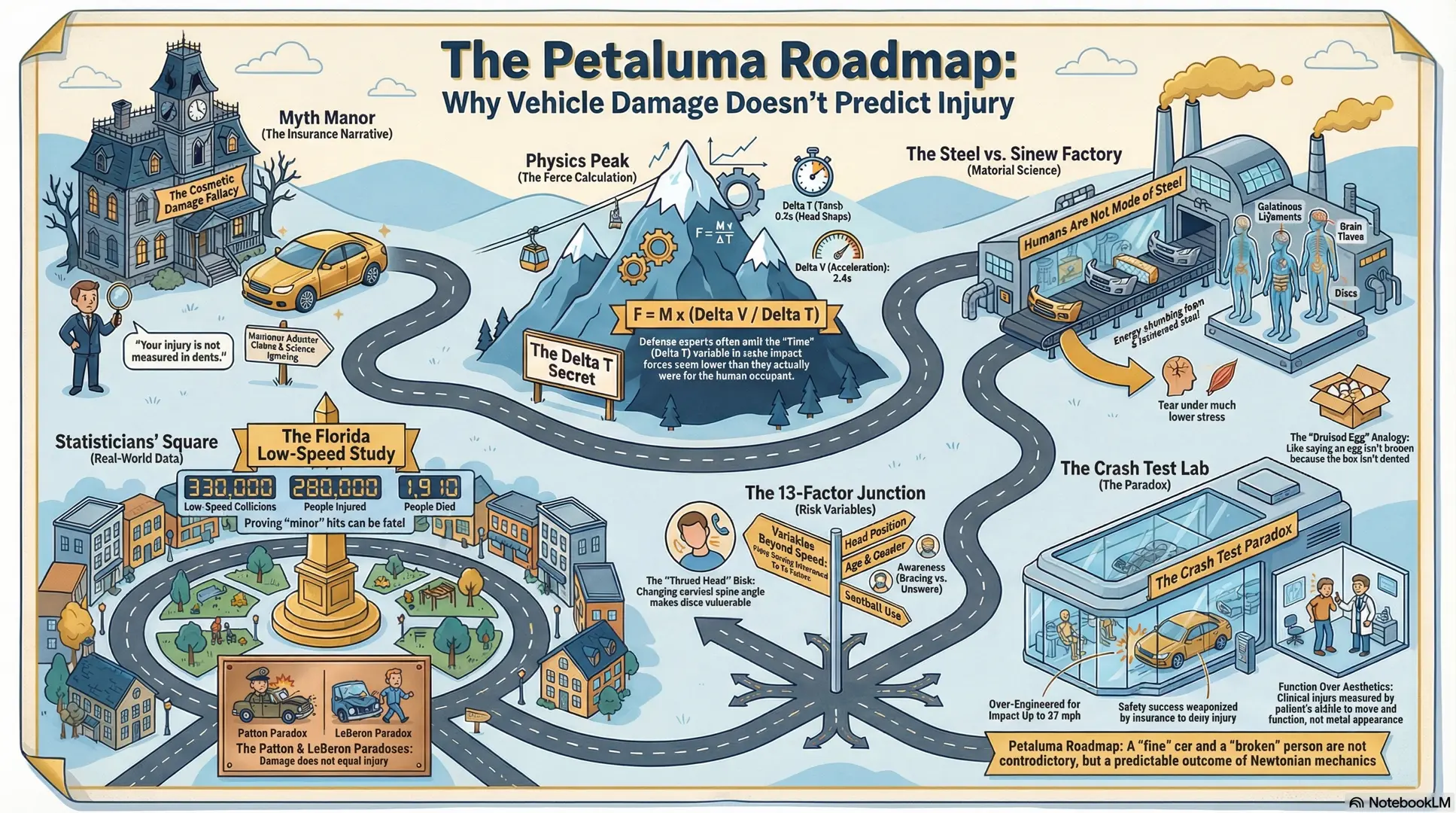
The Moment Everything Changed
Think back to the last time you saw a fender bender. Two cars, barely a scratch. Maybe a scuffed bumper, a cracked license plate frame. You probably thought what most people think: No big deal. Everyone's fine.
I used to think that too—before I spent more than two decades treating the people inside those cars.
In over a thousand personal injury cases treated in Sonoma County over the past four years alone, I've watched the same pattern unfold with devastating consistency. A patient walks into my office weeks after a "minor" collision. Their car looked fine. The insurance adjuster already told them there's no way they could be seriously hurt. And yet here they are—unable to turn their head, unable to sleep, unable to pick up their child without pain radiating down their arm.
Here's what I've learned, and what I need you to understand: the damage to your car has almost nothing to do with the damage to your body. This isn't opinion. It's physics. It's material science. It's epidemiology. And the exposed reality is far more disturbing than you might expect—because the people who should know better are deliberately ignoring it.
The Dangerous Myth That Protects Insurance Companies
There's a narrative that dominates insurance defense strategy, and it goes like this: If the car wasn't badly damaged, the person inside couldn't have been badly injured. It sounds reasonable. It feels intuitive. And it is categorically, provably wrong.
This myth persists not because it has scientific support—it doesn't—but because it saves insurance companies billions of dollars every year. When an adjuster looks at photos of a car with minimal cosmetic damage and concludes that the occupant's injury claim must be exaggerated or fraudulent, they're making a judgment that violates fundamental principles of physics, ignores decades of peer-reviewed research, and treats the human body as though it were made of the same materials as a car bumper.
Your pain is real, your injury is real, and the science is unequivocally on your side.
You might be reading this because you were in a crash. Maybe you're dealing with neck pain, headaches, or back pain that started after a collision your insurance company called "minor." Maybe an adjuster has already told you that because your car wasn't totaled, your injuries couldn't be serious. Maybe you're starting to doubt your own experience.
I need you to hear this clearly: your pain is real, your injury is real, and the science is unequivocally on your side.
Research Evidence
- Ferrari R (1998) — Concluded there is a lack of relationship between occupant injury, vehicle speed, and vehicle damage, finding that symptoms can occur at velocity changes as low as 4 km/h (2.5 mph), while vehicle damage may not occur until 14–15 km/h.
- Robbins MC (2012) — Analyzed 105 U.S. minor rear crashes and documented 427 AIS injuries among 113 struck-vehicle occupants, predominantly cervical (29.7%), lumbar/sacral (23.2%), and thoracic (14.3%).
- Evans RW (1992) — Found only a minimal association between poor prognosis and collision severity, noting that persistent neck pain and headaches after 2 years are reported by more than 30% and 10% of patients, respectively, regardless of crash severity.
The Physics They Don't Want You to Understand
Let's start with Newton. Force equals mass times acceleration. F = M × A. Every insurance defense expert knows this equation. The problem is that most of them only use half of it.
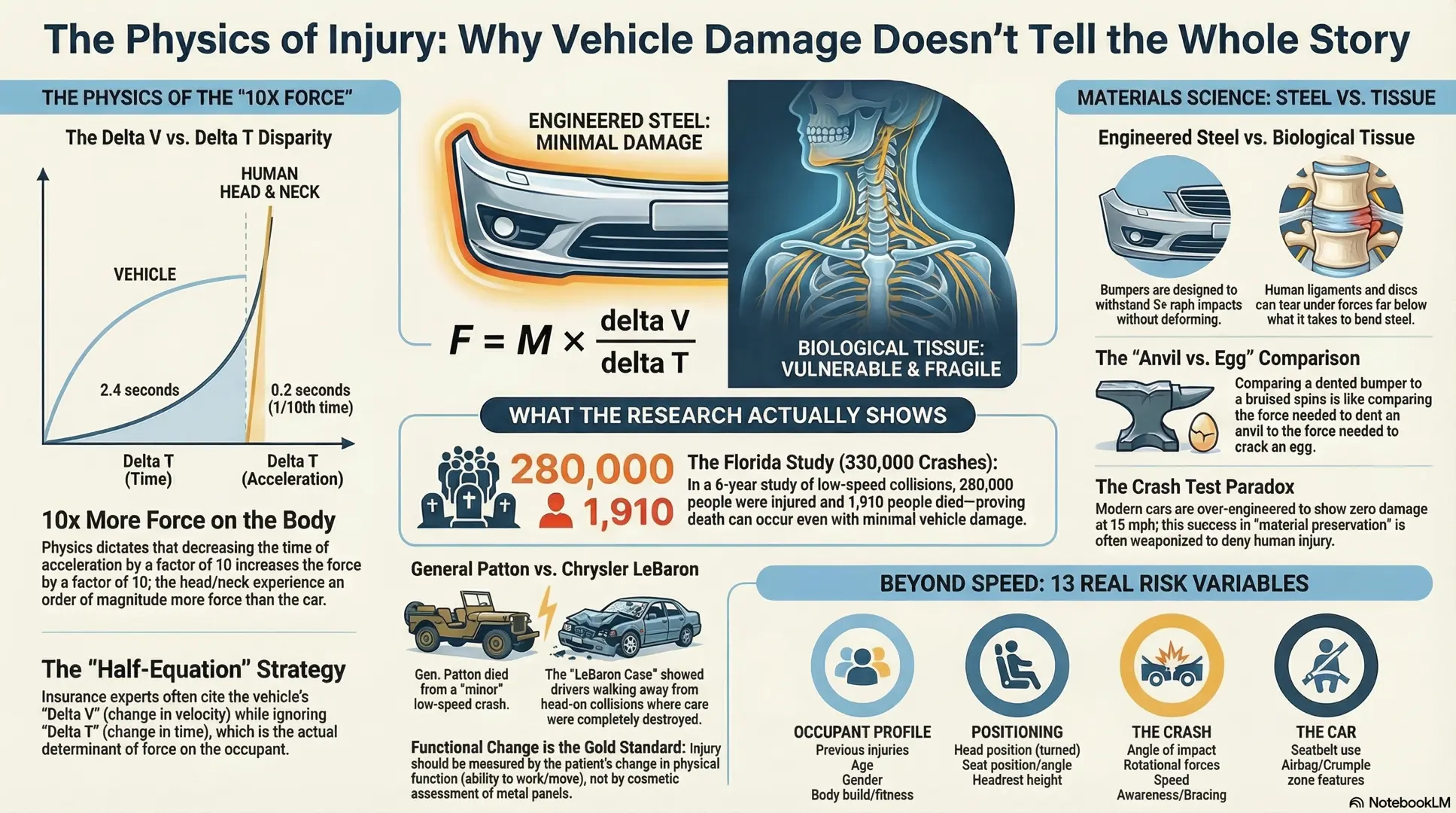
When a vehicle is struck from behind, the entire car accelerates forward over a period of approximately 2.4 seconds. That's the vehicle's change in velocity—what biomechanical engineers call delta V. Insurance defense experts love delta V. They measure it, model it, and present it in court as though it tells the complete story of what happened to the person inside the car.
But here's what they leave out: the human head and neck don't accelerate over 2.4 seconds. They accelerate over approximately 0.2 seconds—two-tenths of a second. That's one-tenth of the vehicle's acceleration time.
The real equation: F = M × (ΔV / ΔT)
When you decrease ΔT by a factor of 10, you increase force by a factor of 10. The head and neck experience roughly ten times the acceleration force of the vehicle itself.
Read that again. The head and neck experience roughly ten times the acceleration force of the vehicle itself.
This is not controversial physics. This is freshman mechanics. And yet, in courtrooms and claims offices across the country, defense experts routinely present delta V figures—the vehicle's change in velocity—while deliberately ignoring delta T, the change in time that determines the actual force delivered to the human occupant.
When a defense biomechanist testifies that a 5 mph impact couldn't have caused injury because the delta V was "only" 5 mph, they are committing a fundamental physics error. They're calculating the force on the car and applying it to the person. But the person isn't the car.
The person's head snapped forward and back in a fraction of the time it took the vehicle to accelerate. The forces involved are an order of magnitude higher than what the vehicle experienced.
This isn't an honest mistake. When trained engineers present half an equation to minimize injury claims, that's not ignorance—it's strategy.
Research Evidence
- Svensson MY et al. (2012) — Confirmed that the whiplash motion takes place in approximately 200 ms (0.2 seconds) and that the majority of reported whiplash injuries occur at delta-V values below 4.4 m/s (16 km/h).
- Kohles SS et al. (2022) — Developed and validated a probabilistic model linking vehicle delta-V to peak head acceleration across 1,000 simulated crashes and 86 published human subject tests.
- McConnell WE et al. (1995) — Found that tangential head accelerations typically exceeded 10 g during the first 150 milliseconds after impact in tests with delta-V of 3.6–6.8 mph, while vehicle damage was minimal.
- Linder A et al. (2020) — Established a statistically significant power relationship between delta-V and peak head acceleration, confirming that gender and occupant head position significantly affect the experienced head acceleration.
Humans Are Not Made of Steel
Here's a sentence that shouldn't need to be written: Humans are not made of steel.
Modern vehicle bumpers are engineering marvels. They're designed to absorb impacts of 5 mph or more without any visible deformation. They use energy-absorbing foam, reinforced steel brackets, and flexible plastic fascias that spring back into shape after contact. This is intentional. This is what billions of dollars in automotive engineering has produced.
But consider what that means. The steel clips and mounting brackets inside your bumper assembly are designed to withstand forces that would obliterate human tissue. When a bumper absorbs a 5 mph impact without a scratch, it hasn't proven that the impact was harmless. It has proven that the bumper is stronger than the forces involved. The occupant's body is not.
Your body is made of:
- Ligaments — collagen fibers that can tear under forces far below what bends steel
- Muscles — soft tissue vulnerable to strain, spasm, and microtrauma
- Intervertebral discs — cartilage and gel structures that herniate under compressive and shearing loads
- Brain tissue — with the consistency of gelatin, suspended in fluid inside a rigid skull
- Nerves — delicate axons that can be stretched, compressed, or damaged by forces invisible on any imaging study
None of these structures can withstand the forces that a modern bumper absorbs without visible damage. Not one. When a defense expert points to a photograph of an undamaged bumper and says "there wasn't enough force to cause injury," they are making a claim that requires human tissue to be as strong as steel. It's an absurd premise, and it falls apart the moment you examine it.
The bumper did its job. It protected the car. But the forces it absorbed were transmitted through the vehicle frame, through the seat, and into the person sitting in it.
Research Evidence
- Ito S, Ivancic PC, Panjabi MM (2004) — Using a biofidelic whole cervical spine model, this Yale study identified that the soft tissue injury threshold occurs at a peak T1 horizontal acceleration of just 5 g, with the lower cervical spine (C5-C6) sustaining the first significant injury.
- Ivancic PC et al. (2007) — Demonstrated that cervical spine ligaments rupture at peak forces of 220–244 N, with peak elongations to failure as low as 1.6 times physiological elongation.
- Winkelstein BA et al. (2007) — Established that cervical facet capsular ligament yield (the point at which tissue deformation becomes permanent and pain-producing) occurs at significantly lower forces than gross failure.
- Yoganandan N et al. (2001) — Comprehensive review establishing that cervical spine injury tolerance diminishes approximately 2.5-fold with age, underscoring that material properties of human tissue are fundamentally different from engineered structures.
What the Research Actually Shows
If the "minimal damage means minimal injury" argument had scientific support, we could have a reasonable debate. But the research doesn't just fail to support it—the research demolishes it.
Consider the Florida study: over a six-year period, researchers documented 330,000 low-speed collisions in the state of Florida. Of those, 280,000 people were injured—not according to chiropractors or plaintiff attorneys, but according to police officers documenting the scene. And here's the number that should end this debate forever: 1,910 people died in those low-speed crashes.
Nearly two thousand people died. In low-speed collisions. With minimal vehicle damage.
Every time a defense expert testifies that a low-speed impact couldn't cause serious injury, they are contradicting a dataset of 330,000 real-world collisions that produced nearly two thousand deaths.
General George S. Patton—one of the most formidable military leaders in American history—survived World War II only to die from a low-speed car accident in 1945. He was riding in the back seat without a seatbelt when his vehicle was involved in a low-speed collision. He was thrown forward, broke his neck, and died weeks later from complications.
Minimal vehicle damage. Fatal human injury. One of the most documented cases in military medical history.
Then there's the famous Chrysler LeBaron case—often described as the moment crashworthiness stopped being an abstraction and became something you could see with your own eyes. Two Chrysler LeBarons collided head-on on a dark country road. The front ends telescoped in. Hoods buckled. Engine compartments collapsed. To anyone looking at the wreckage, it read like a simple equation: that much metal distortion must mean catastrophic human damage.
But when responders arrived, the scene told a different story. Both drivers were out of their cars, standing and talking. Shaken, yes. Bruised, likely. But alive, oriented, and able to move—because the cars had done what modern safety engineering is designed to do: sacrifice the vehicle to preserve the occupant.
That is why the Insurance Institute for Highway Safety reportedly kept those vehicles on display for years. They were a physical, unavoidable demonstration that the intuitive "damage equals injury" assumption fails in both directions: sometimes the car looks fine and the person is not, and sometimes the car is destroyed precisely because it protected the person inside.
Research Evidence
- Curatolo M, Bogduk N et al. (2011) — Comprehensive review documenting that lesions of facet joints, dorsal root ganglia, discs, ligaments, muscles, and vertebral arteries have been validated through biomechanical and autopsy studies, yet most remain undetectable by standard imaging.
- Siegmund GP et al. (2001) — Provided direct mechanical evidence of cervical facet capsule injury during whiplash loading in cadaveric specimens, demonstrating that subcatastrophic tissue damage occurs during realistic whiplash kinematics.
- Grauer JN, Panjabi MM et al. (1997) — Demonstrated that whiplash produces a non-physiologic S-shaped cervical curvature with hyperextension at lower levels occurring before full neck extension, identifying a mechanism for injury invisible from external observation.
The Thirteen Factors That Actually Determine Your Injury
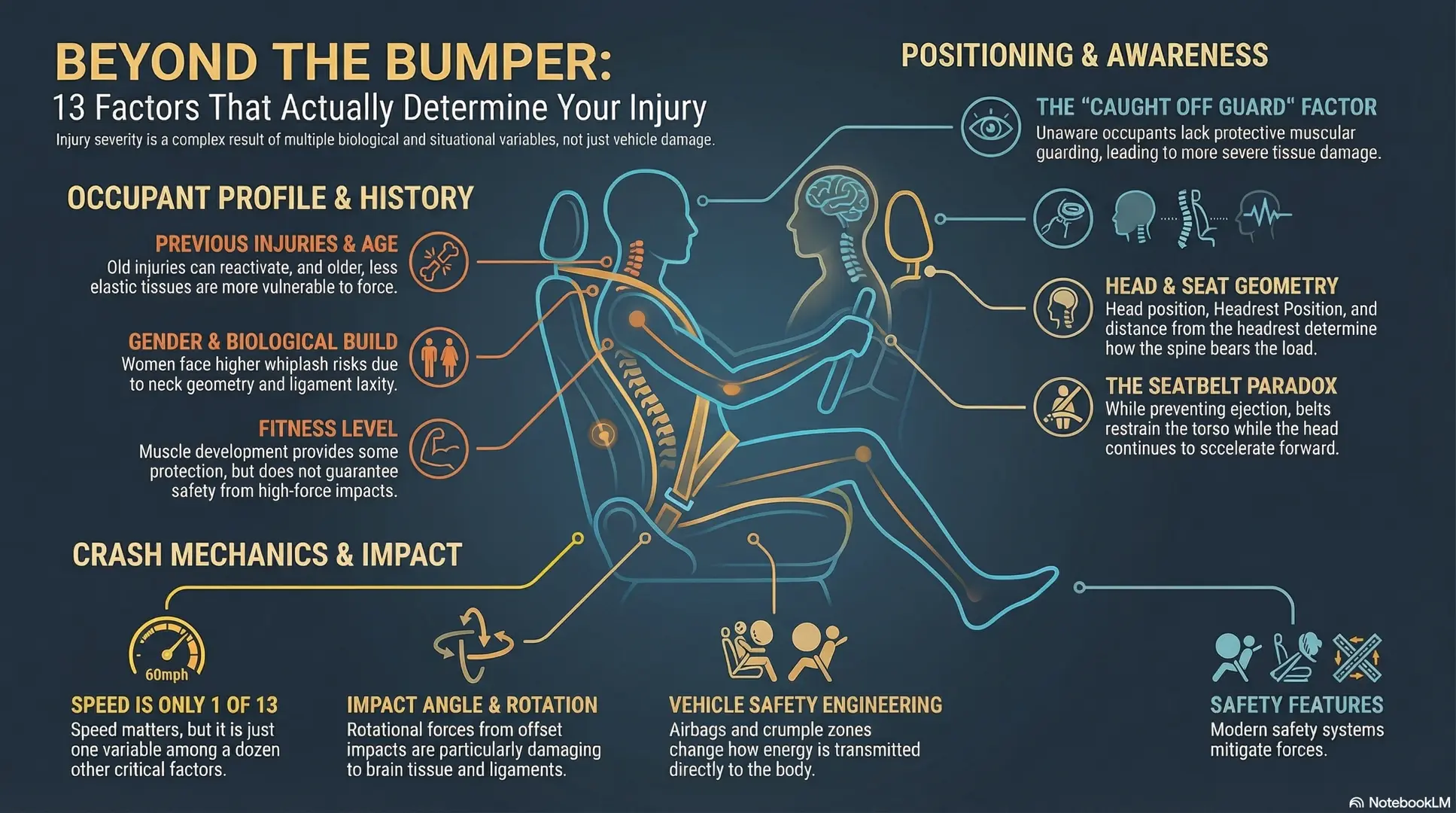
If vehicle damage doesn't predict injury, what does? Research has identified at least thirteen distinct risk factors that influence whether and how severely an occupant is injured in a collision. Only one of them relates to speed.
- Previous injuries — even old injuries that were completely asymptomatic before the crash can become reactivated
- Head position at the moment of impact — were you turned to check your mirror? Looking at your phone?
- Seat position — distance from the headrest, angle of the seat back, whether upright or reclined
- Gender — women are statistically at greater risk for whiplash injuries, partly due to differences in neck muscle mass, cervical spine geometry, and ligament laxity
- Age — older tissues are less elastic, less hydrated, and more vulnerable to force
- Body build and fitness level — muscular development around the cervical spine provides some protective effect, but is far from a guarantee
- Awareness of the impending impact — if you saw the collision coming and braced, your injury pattern will differ significantly from someone struck without warning
- Seatbelt use — critical for preventing ejection and limiting torso excursion, but seatbelts also create their own injury patterns
- Headrest position — a headrest positioned too low or too far back can actually worsen whiplash
- Vehicle safety features — airbag deployment, crumple zone design, seat engineering all affect force transmission
- Angle of impact — rear-end, side-impact, angular, and offset collisions all produce dramatically different injury patterns
- Rotational forces — angular or offset impacts introduce rotational acceleration, which is particularly damaging to brain tissue and cervical ligaments
- Speed — yes, speed matters. But it is one variable among thirteen.
With thirteen independent variables influencing injury outcomes, the idea that you can predict injury from vehicle damage alone isn't just wrong—it's laughable. It would be like predicting someone's life expectancy by knowing only their shoe size.
This is why two people in the same car, in the same crash, can have completely different injury outcomes. The driver who saw the impact coming and braced may walk away sore but functional. The passenger who was turned sideways looking at their phone may end up with a disc herniation, chronic headaches, and months of rehabilitation. Same car. Same crash. Same vehicle damage. Completely different injuries.
Research Evidence
- Stemper BD et al. (2003) — Cadaveric study demonstrating that female specimens exhibited significantly greater segmental angulations at C2-C3, C4-C5, C5-C6, and C6-C7 during rear impact loading (p<0.05).
- Stemper BD et al. (2016) — Comprehensive review identifying that cervical column slenderness, neck muscle morphometry, and sex-based anthropometric variations profoundly impact whiplash injury risk, explaining why occupant-specific factors dominate over vehicle damage in predicting outcomes.
- Tosonidis T et al. (2021) — Systematic review of 894 patients demonstrating that preexisting facet joint degeneration is a statistically significant negative prognostic indicator for long-lasting whiplash symptoms.
- Müller J et al. (2022) — Identified age, Quebec Task Force Grade II classification, and preexisting cervical degenerative changes as statistically significant risk factors, with 14.1% of patients developing symptoms lasting more than six months.
- Chapline JF et al. (2000) — Demonstrated that headrest position relative to the occupant's head is a significant and modifiable risk factor for neck pain following rear-end collisions.
The Defense Strategy: Half-Truths as Whole Arguments
Understanding the science makes the insurance defense strategy transparent. Here's how it works:
Step one: Hire a biomechanical engineer to calculate delta V from the vehicle damage.
Step two: Present delta V as the sole determinant of injury potential, while omitting delta T from the equation.
Step three: Compare the forces involved to everyday activities—"This impact was equivalent to plopping down in an office chair"—while ignoring that plopping in a chair involves voluntary, controlled movement with muscular bracing, not an unexpected ballistic acceleration of the head and neck.
Step four: Show photographs of the vehicle with minimal damage and invite the jury to conclude that if the car is fine, the person must be fine.
This strategy exploits a cognitive bias: people intuitively assume that damage should look the same regardless of what's being damaged. A hard hit should look like a hard hit. But this conflates the behavior of engineered steel structures with the behavior of biological tissue, and the two have nothing in common.
I've seen this play out in case after case. A 78-year-old patient who could play softball, golf, and pickleball before their crash—but couldn't after. The vehicle damage was minimal. The defense argued that the impact couldn't have caused significant injury. But the patient's function had changed completely. They went from active and independent to limited and in pain. Not because of aging. Not because of a pre-existing condition. Because of forces that their body absorbed in a fraction of a second during a collision that barely dented their bumper.
Function changed. That's the measure of injury. Not metal deformation.
Research Evidence
- Allen ME et al. (1994) — Compared whiplash accelerations with everyday activities and cautioned that such comparisons are misleading because voluntary daily movements involve anticipatory muscular bracing fundamentally different from the unexpected ballistic accelerations experienced in rear-end collisions.
- Castro WHM et al. (2001) — In a landmark placebo-controlled study, subjects who believed they had been in a rear-end collision (but had not) reported whiplash symptoms, demonstrating the complex interplay between expectation and symptom reporting—but crucially, none developed objective clinical findings, distinguishing genuine tissue injury from subjective complaint.
- Radanov BP et al. (1995) — Two-year follow-up study of 117 whiplash patients showing that psychological problems were consequences rather than causes of somatic symptoms.
The Crash Test Paradox
Here's an irony that most people never consider: all standardized crash tests are performed at 60 kilometers per hour—roughly 37 miles per hour. Vehicles are engineered, tested, and certified to protect occupants at this speed.
Most neighborhood collisions, parking lot accidents, and rear-end impacts at intersections occur at speeds well below 37 mph. At 10 or 15 mph, a modern vehicle is operating well within its engineered safety envelope. The bumper doesn't deform because it was designed to handle far more than this. The crumple zones don't activate because the forces don't reach their threshold.
But the human body doesn't have a "safety envelope" engineered for highway-speed impacts. The human body is vulnerable at forces far below what triggers any visible vehicle damage. When a vehicle absorbs a 15 mph impact without a scratch, it's not proving the impact was gentle. It's proving the vehicle is overengineered for that speed. The forces were real. The energy was real. It just went somewhere other than the sheet metal.
It went into the occupant.
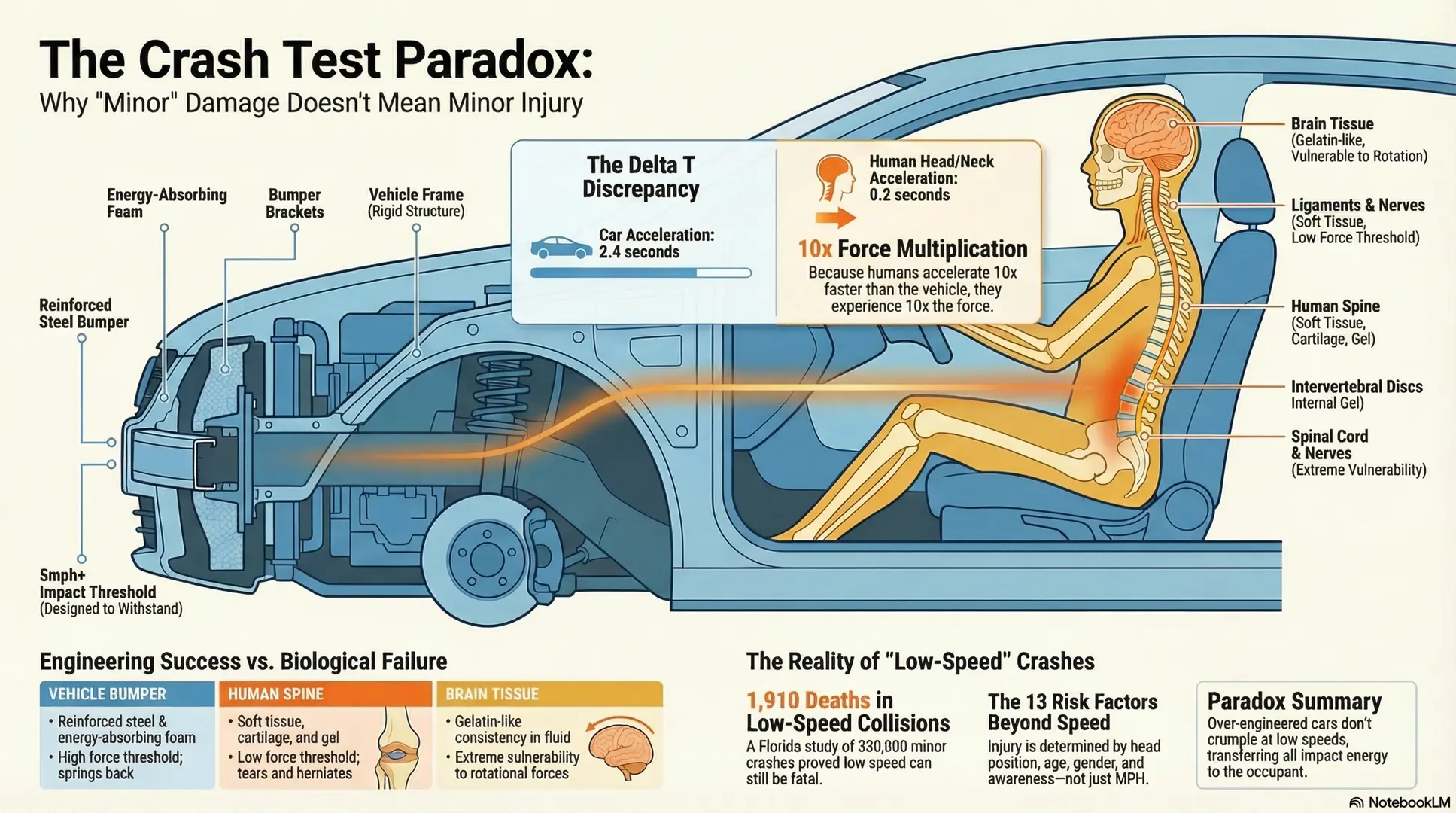
The better vehicles get at absorbing low-speed impacts without damage, the easier it becomes for insurance companies to argue those impacts can't cause injury. Automotive engineering advances are being weaponized against the very people they were designed to protect.
Research Evidence
- Farmer CM (2003) — Demonstrated that the trend toward stiffer seats increased neck responses compared to the yielding seats of the 1980s and 1990s, offering one explanation for the paradoxical increase in whiplash injuries despite improvements in vehicle crashworthiness.
- Jakobsson L et al. (2002) — Showed that the same delta-V produced with different peak accelerations generated very different dummy responses across five seat designs, demonstrating that vehicle engineering variables—not just speed—critically affect occupant injury biomechanics.
- Ivancic PC, Panjabi MM et al. (2005) — Validated a biofidelic cervical spine model demonstrating that a single application of whiplash acceleration can induce measurable soft tissue and ligamentous alterations to cervical spine structures, even at accelerations well below those used in standardized crash testing.
Reframing the Conversation
If you've been in a collision and been told that your injuries can't be real because your car looks fine, I want you to have the tools to see through that argument. Here's the framework:
The physics argument: "Delta V without delta T is half the equation. The head and neck experience ten times the acceleration of the vehicle. Presenting vehicle acceleration as occupant acceleration is a fundamental physics error."
The material science argument: "Human tissue and automotive steel have completely different material properties. The forces required to damage a bumper far exceed the forces required to damage ligaments, discs, and neural tissue. Comparing the two is like comparing the force needed to dent an anvil with the force needed to bruise an egg."
The epidemiological argument: "In Florida alone, 1,910 people died in low-speed crashes over a six-year period. 280,000 were injured. The claim that low-speed impacts can't cause injury is contradicted by hundreds of thousands of documented cases."
The clinical argument: "The patient's function changed after the collision. They could do things before the crash that they cannot do now. Functional change is the gold standard for measuring injury, not cosmetic assessment of vehicle panels."
The engineering argument: "Crash tests are conducted at 37 mph. Vehicles are designed to exceed that standard without damage. A car that shows no damage at 15 mph is demonstrating engineering success, not impact insignificance."
These aren't talking points. They're principles. And every single one of them is grounded in established science that has been published, replicated, and accepted in peer-reviewed literature.
Research Evidence
- Panjabi MM et al. (1998) — Quantified the mechanical changes occurring in cadaveric cervical spine specimens following experimental whiplash trauma, documenting that a single whiplash event produces measurable increases in intervertebral flexibility—objective evidence of soft tissue injury undetectable by standard imaging.
- Panjabi MM et al. (2004) — Documented non-physiologic cervical spine curvature patterns during simulated whiplash, demonstrating that the S-shaped deformation pattern can produce facet joint injury and ligament strain in ways that are invisible on static imaging.
- Pearson AM, Ivancic PC et al. (2004) — Identified specific facet joint kinematic abnormalities during simulated whiplash, providing direct biomechanical evidence for the injury mechanisms underlying chronic neck pain.
What This Means for You
If you're a patient dealing with pain after a "minor" collision, your experience is valid. The science supports you. The forces involved were real, the injury mechanisms are well-documented, and the fact that your car looks fine is irrelevant to what happened inside your body.
If you're an attorney representing someone whose case is being dismissed because of minimal vehicle damage, the evidence is overwhelming. The defense strategy depends on the jury not understanding physics, material science, or injury epidemiology. Educate them, and the argument collapses.
And if you're anyone who has ever looked at a fender bender and thought no big deal—I understand. I thought that too, once. Before I spent decades watching people's lives change from impacts that didn't leave a mark on their car.
Your body is not your car. Your injury is not measured in dents. And no photograph of an undamaged bumper can tell you what happened to the person sitting behind it.
The fundamental truth is this: vehicle damage and human injury are governed by completely different principles. One is about material deformation of engineered steel structures. The other is about tissue tolerance, force transmission, acceleration timing, and biological vulnerability. They are separate domains of physics, and conflating them is either profound ignorance or deliberate deception.
Research Evidence
- Watanabe Y et al. (2021) — Landmark 20-year prospective study demonstrating that whiplash injuries significantly impacted residual symptoms of shoulder stiffness, headache, and arm pain compared to initially asymptomatic controls, confirming the long-term clinical reality of whiplash injury.
- Meenen NM et al. (1994) — Found that pre-existing degenerative changes represent an area of increased vulnerability to trauma rather than a cause of symptoms.
Complete Reference List
- Allen ME et al. (1994) — Acceleration perturbations of daily living: a comparison to 'whiplash.' Spine. 1994;19(11):1285-1290.
- Castro WHM et al. (2001) — No stress—no whiplash? Prevalence of 'whiplash' symptoms following exposure to a placebo rear-end collision. Int J Legal Med. 2001;114(6):316-322.
- Chapline JF et al. (2000) — Neck pain and head restraint position relative to the driver's head in rear-end collisions. Accid Anal Prev. 2000;32(2):287-297.
- Curatolo M, Bogduk N et al. (2011) — The role of tissue damage in whiplash-associated disorders: discussion paper 1. Spine. 2011;36(25 Suppl):S309-S315.
- Evans RW (1992) — Some observations on whiplash injuries. Neurol Clin. 1992;10(4):975-997.
- Farmer CM (2003) — Seat properties affecting neck responses in rear crashes: a reason why whiplash has increased. Traffic Inj Prev. 2003;4(3):228-239.
- Ferrari R (1998) — Rear-end impacts: vehicle and occupant response. J Manipulative Physiol Ther. 1998;21(9):629-639.
- Grauer JN, Panjabi MM et al. (1997) — Whiplash produces an S-shaped curvature of the neck with hyperextension at lower levels. Spine. 1997;22(21):2489-2494.
- Ito S, Ivancic PC, Panjabi MM (2004) — Soft tissue injury threshold during simulated whiplash: a biomechanical investigation. Spine. 2004;29(9):979-987.
- Ivancic PC, Panjabi MM et al. (2005) — Biofidelic whole cervical spine model with muscle force replication for whiplash simulation. Eur Spine J. 2005;14(4):346-355.
- Ivancic PC et al. (2007) — Dynamic mechanical properties of intact human cervical spine ligaments. Spine J. 2007;7(6):659-665.
- Jakobsson L et al. (2002) — Dynamic performances of different seat designs for low to medium velocity rear impact. Traffic Inj Prev. 2002;3(2):153-160.
- Kohles SS et al. (2022) — A stochastic model validated with human test data causally associating target vehicle Delta V, occupant cervicocranial biomechanics, and injury during rear-impact crashes. Clin Biomech. 2022;100:105793.
- Linder A et al. (2020) — A proposed algorithm to assess concussion potential in rear-end motor vehicle collisions: a meta-analysis. Front Bioeng Biotechnol. 2020;8:493.
- McConnell WE et al. (1995) — Human head and neck kinematics after low velocity rear-end impacts—understanding 'whiplash.' SAE Technical Papers. 1995;952724:215-238.
- Meenen NM et al. (1994) — Whiplash injury of the cervical spine—on the role of pre-existing degenerative diseases. Unfallchirurgie. 1994;20(3):138-149.
- Müller J et al. (2022) — Risk factors for developing chronic whiplash disorders. Arch Orthop Trauma Surg. 2022;142(6):1029-1035.
- Panjabi MM et al. (1998) — Whiplash injuries and the potential for mechanical instability. Eur Spine J. 1998;7(6):484-492.
- Panjabi MM et al. (2004) — Cervical spine curvature during simulated whiplash. Clin Biomech. 2004;19(1):1-9.
- Pearson AM, Ivancic PC et al. (2004) — Facet joint kinematics and injury mechanisms during simulated whiplash. Spine. 2004;29(4):390-397.
- Radanov BP et al. (1995) — Long-term outcome after whiplash injury: a 2-year follow-up considering features of injury mechanism and somatic, radiologic, and psychosocial findings. Medicine (Baltimore). 1995;74(5):281-297.
- Robbins MC (2012) — Minor crashes and 'whiplash' in the United States. Eur Spine J. 2012;21(Suppl 5):S611-S617.
- Siegmund GP et al. (2001) — Mechanical evidence of cervical facet capsule injury during whiplash: a cadaveric study using combined shear, compression, and extension loading. Spine. 2001;26(19):2095-2101.
- Stemper BD et al. (2003) — Gender dependent cervical spine segmental kinematics during whiplash. J Biomech. 2003;36(9):1281-1289.
- Stemper BD et al. (2016) — Whiplash-associated disorders: occupant kinematics and neck morphology. J Orthop Sports Phys Ther. 2016;46(10):834-844.
- Svensson MY et al. (2012) — Driving Position Field Study, Differences with the Whiplash Protocol and Biomechanics Experimental Responses. Eur Spine J. 2012;21(Suppl 5):S559-S567.
- Tosonidis T et al. (2021) — Is preexisting cervical degeneration a risk factor for poor prognosis in whiplash-associated disorder? Int J Spine Surg. 2021;15(3):505-512.
- Watanabe Y et al. (2021) — The long-term impact of whiplash injuries on patient symptoms and the associated degenerative changes detected using MRI: a prospective 20-year follow-up study. Spine. 2021;46(9):E530-E537.
- Winkelstein BA et al. (2007) — Cervical facet capsular ligament yield defines the threshold for injury and persistent joint-mediated neck pain. J Biomech Eng. 2007;129(5):710-718.
- Yoganandan N et al. (2001) — Biomechanics of the cervical spine Part 2. Cervical spine soft tissue responses and biomechanical modeling. Clin Biomech. 2001;16(1):1-27.