Last Tuesday, a patient walked into my office six weeks after a rear-end collision. Stiff neck, foggy thinking, trouble remembering what day her next legal appointment was. I asked one question: "Have you been moving?"
She hadn't. Not since the accident.
I've started asking that question more often — not just because movement matters for the spine, but because of what the research now says about the brain. And what it says caught me off guard.
The Death of Brain Training
BBC Science Focus recently published a piece that should be required reading for anyone who's ever downloaded a brain-training app. The verdict: those games don't work.
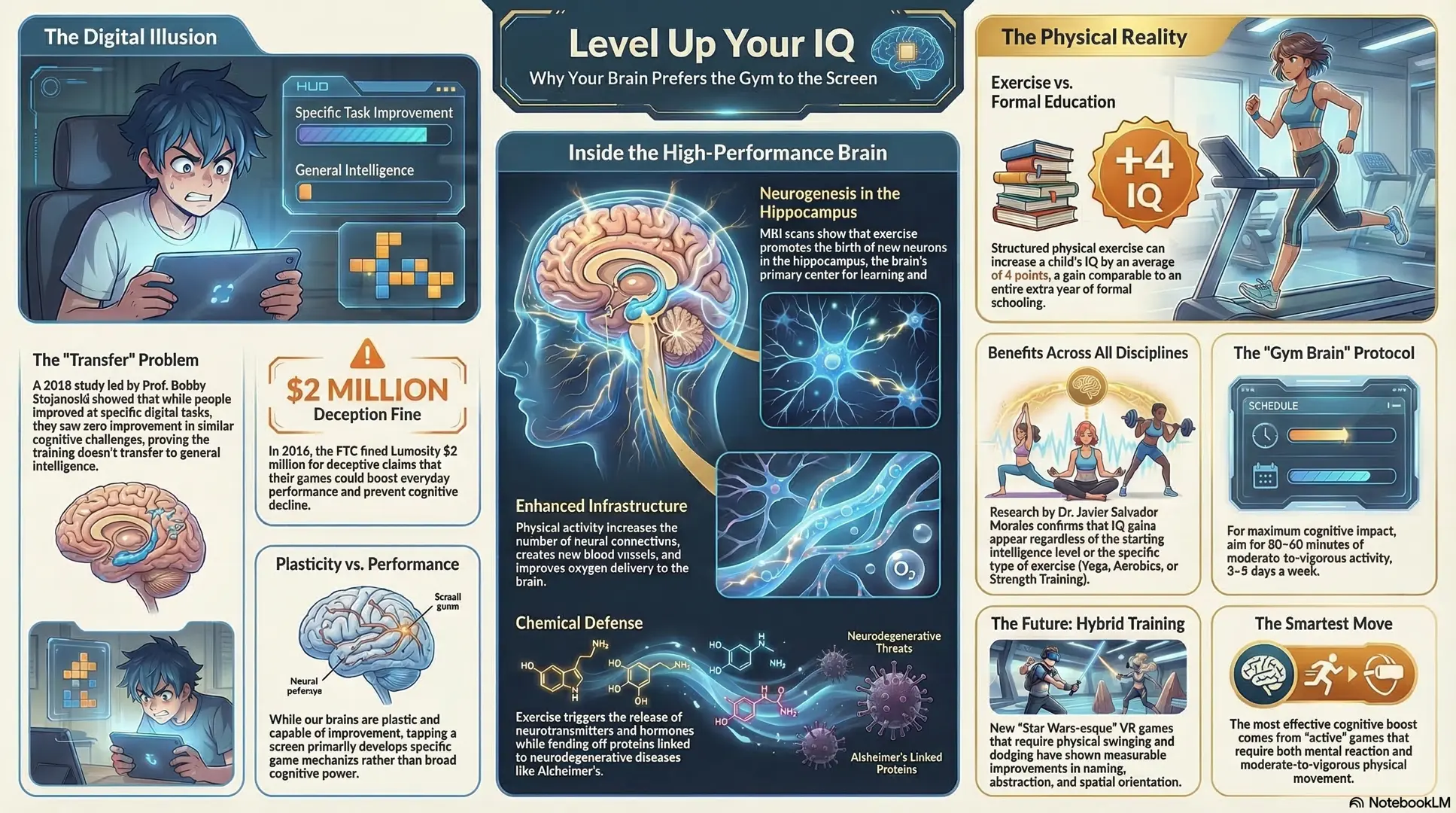
A 2018 study trained participants on cognitive tasks. They improved at the game — then showed zero transfer to actual cognitive performance. Prof. Bobby Stojanoski, the lead researcher, was blunt: "We don't see any improvements."
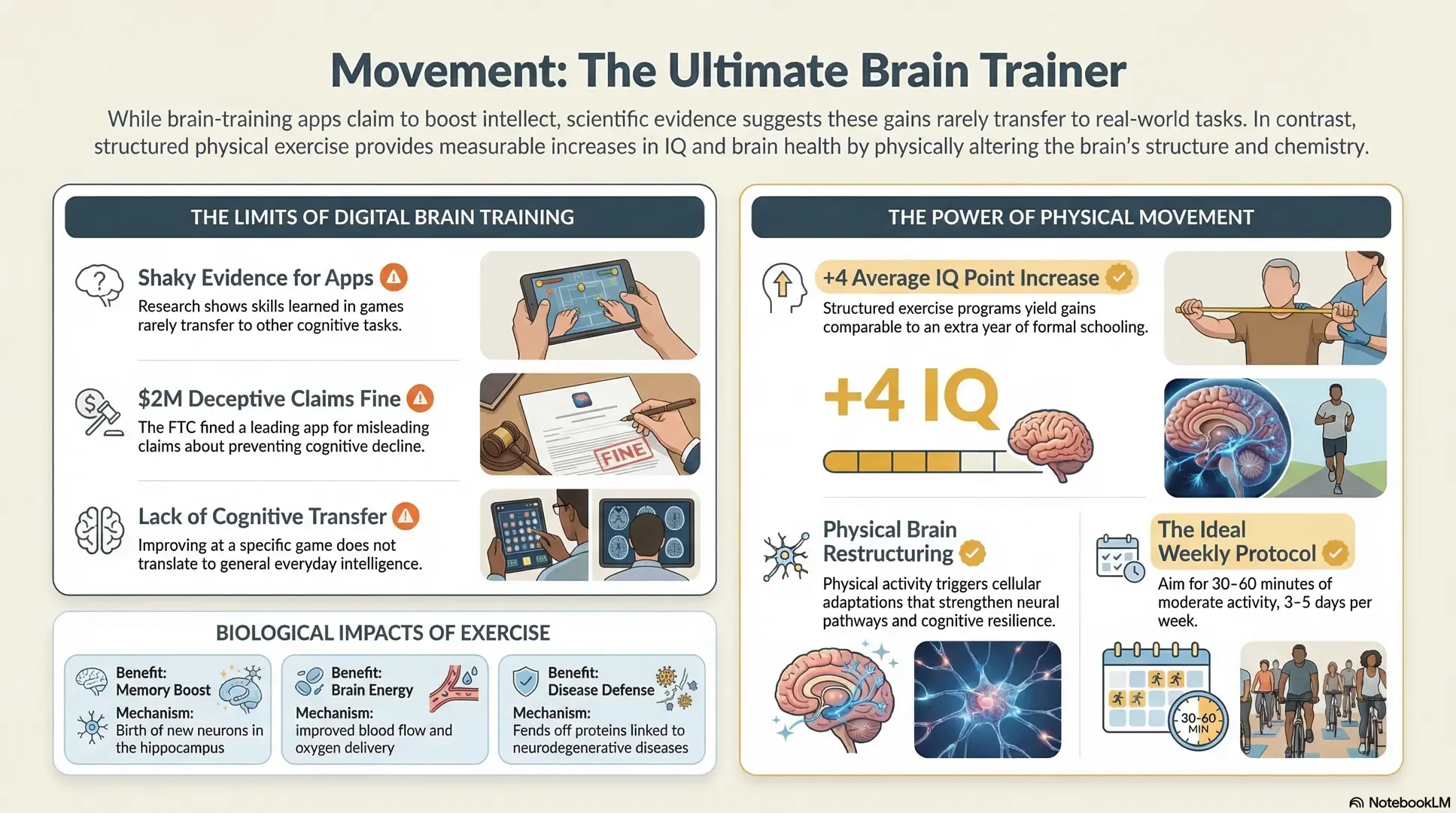
The Federal Trade Commission agreed, fining Lumosity $2 million in 2016 for deceptive advertising.
Did You Know
In 2016, the Federal Trade Commission fined Lumosity $2 million after ruling that its claims about brain training boosting everyday performance and preventing cognitive decline were deceptive.
So brain-training apps are out. What's in?
The answer has been in the gym, the trail, and the rehab clinic this whole time.
The Science Is Stacking Up
You might think of intelligence as fixed — something you're born with and stuck with. The research says otherwise.
+4 IQ Points
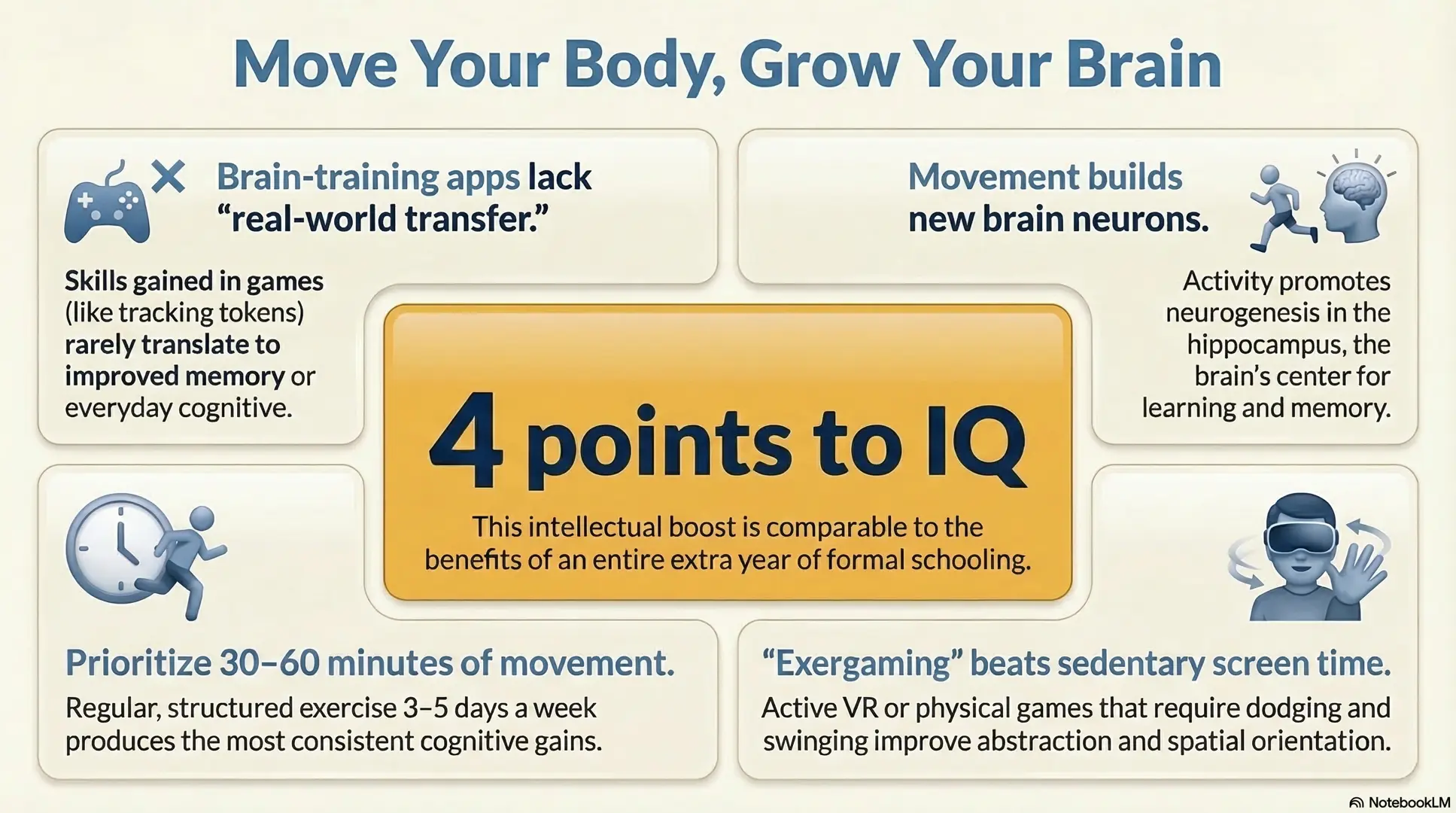
The average gain from structured exercise programs in children — comparable to an extra year of formal education
That's the headline finding from a 2024 meta-analysis published in Pediatrics by Morales and colleagues. Structured exercise programs increased children's IQ scores by an average of four points. Shift every student's IQ up by four points and you meaningfully change educational trajectories, career outcomes, and quality of life across an entire generation.
And this isn't just about children.
A meta-analytic review of 29 randomized controlled trials by Smith et al. (2010), encompassing over 2,000 participants, found that aerobic exercise produced significant improvements in attention and processing speed, executive function, and memory. These weren't observational associations — they were causal findings from controlled experiments.
What's Happening Inside Your Brain
The mechanism is elegant. When you exercise, your body releases a protein called brain-derived neurotrophic factor (BDNF) — think of it as fertilizer for your brain.
A 2018 review synthesized the evidence: exercise-mediated BDNF increases directly promote neurogenesis in the hippocampus — the brain region essential for learning and memory. New neurons. Literally born from movement.
Mandolesi et al. (2018) expanded on this: moderate-intensity exercise improves working memory and cognitive flexibility, while high-intensity exercise enhances processing speed. The BDNF response is significantly greater after vigorous exercise compared to low-intensity activity.
Key Takeaway
Even a single session of moderate-intensity exercise improves memory consolidation — mediated by increases in BDNF and endocannabinoid signaling (Schmitt et al., 2021, Scientific Reports).
MRI studies have documented that regular exercisers show larger hippocampal volumes, increased neural connections, enhanced cerebrovascular function, and reduced markers of neurodegeneration. A 2025 review in The Lancet described these as "neuroprotective mechanisms" — exercise literally shields your brain from aging through improved cerebral blood flow, reduced neuroinflammation, and enhanced neuroplasticity.
The Evidence at a Glance
| Study | Key Finding | Scope |
|---|---|---|
| Morales et al. (2024), Pediatrics | +4 IQ points from structured exercise | Children & adolescents |
| Smith et al. (2010), Psychosomatic Medicine | Improved attention, executive function, memory | 2,049 adults (29 RCTs) |
| Szuhany et al. (2015), J. Psychiatric Research | Exercise drives hippocampal neurogenesis via BDNF | Meta-analytic review |
| Mandolesi et al. (2018), Frontiers in Psychology | Intensity-dependent cognitive benefits | Comprehensive review |
| Schmitt et al. (2021), Scientific Reports | Single session improves memory consolidation | Healthy adults |
| The Lancet (2025) | Neuroprotective mechanisms of cardiorespiratory fitness | Lifespan review |
| Hillman et al. (2008), Nature Reviews Neuroscience | Exercise benefits cognition across entire lifespan | Lifespan review |
What I See in the Clinic
I know you might be thinking: "That's great for healthy people, but what about someone recovering from an injury?"
Here's what I've seen in over a thousand personal injury cases: the patients who follow a structured movement protocol — even gentle, progressive exercise — don't just recover faster from their musculoskeletal injuries. They report better sleep, improved mood, sharper concentration, and a greater sense of agency over their recovery.
Hillman, Erickson, and Kramer documented beneficial relationships between physical activity and cognitive performance across the entire human lifespan — from preadolescent children to older adults recovering from illness and injury.
The research is consistent: whether you're eight years old or eighty, whether you're healthy or healing — physical movement improves how your brain works.
Important
If you're recovering from an auto accident, don't wait for the pain to fully resolve before you start moving. Work with your chiropractor or provider to establish progressive, appropriate physical activity as part of your treatment plan.
Your Move
We spend billions on supplements, apps, and biohacks promising cognitive enhancement. Most of it is noise.
The signal is simple: structured, regular physical exercise — 30 to 60 minutes, 3 to 5 days per week, at moderate to vigorous intensity — is the single most evidence-backed intervention for improving brain function that exists outside of formal education.
It's not proprietary. It doesn't require a subscription. It requires showing up.
"The smartest thing you can do for your mind isn't downloading another app. It's lacing up your shoes."
— Dr. Ryan Todd Lloyd, D.C., Q.M.E.
If you've been in a car accident and want to protect both your body and your brain during recovery, we can help you build a treatment plan that includes progressive physical rehabilitation.