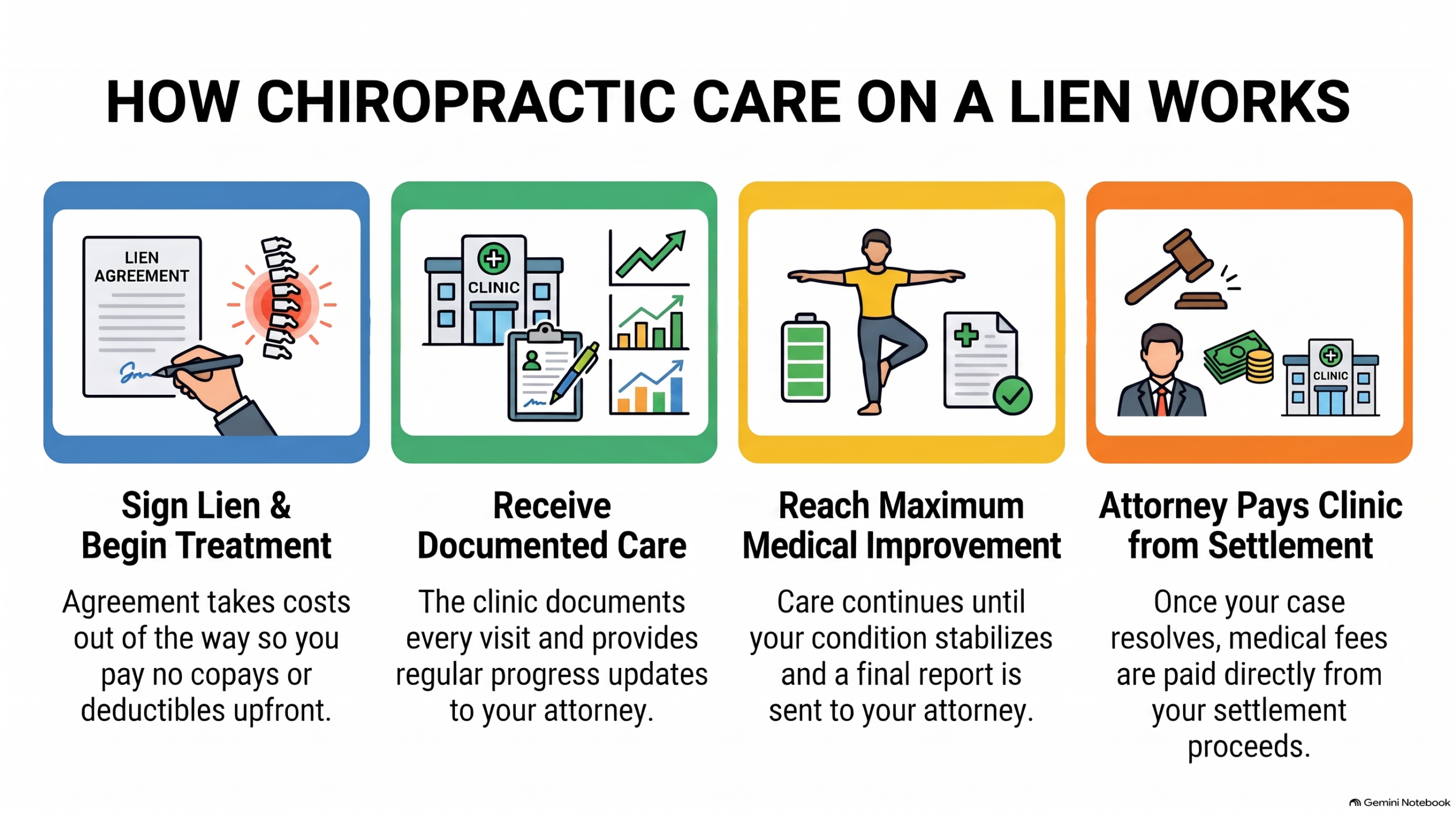
Treating on a lien means you get chiropractic care after an injury now and pay nothing while your case is open. When your personal injury case resolves, your attorney pays the clinic from the settlement. This post explains how that works at adjust.clinic, what care looks like, how California courts value lien bills, and the risks on each side.
What does treating on a lien mean?
Treating on a lien means care starts at your first visit, you get no bill while your case is open, the case resolves, and then your attorney pays the clinic from the settlement.
A medical lien is a written agreement that the clinic's fees will be paid from the proceeds of your personal injury settlement. You and your attorney both sign it. It takes the cost of care out of the way while you recover, so you are not dealing with copays, deductibles or bills at home. Our lien-based care page walks through each step and the lien terms, which we explain before you sign.
A lien usually requires a personal injury attorney, because payment comes from a legal settlement. If you do not have an attorney yet, call us at (707) 658-2534 and we can point you in the right direction.
What care looks like
Care on a lien is the same care any patient gets here: a thorough exam first, then a plan built on what the exam finds, and a referral out when the exam calls for more than chiropractic care. The exam is an orthopedic and neurological evaluation that documents every injury and sets the starting point for your plan. Care is movement-based and can include chiropractic adjustments, soft-tissue therapy and rehabilitation exercises, progressed as you recover.
Whether care starts conservatively or with a referral depends on the symptoms the exam turns up, and the loop below shows examples of where common symptoms point, not a diagnosis.
Neck or back pain after a crash with no numbness or weakness usually starts with conservative care, which is what traffic-injury, chiropractic and low back pain guidelines recommend.123 Some symptoms call for a referral first. Tingling in the arms or legs after a crash is one of the high-risk factors in the Canadian C-spine rule that calls for imaging of the neck.4 Nerve deficits that are severe or getting worse call for imaging and testing,3 and nerve signs with disability that last more than 3 months after the injury call for a physician referral.1 New trouble controlling the bladder or bowels, or numbness in the saddle area, can signal cauda equina syndrome, which needs emergency care.5 These are examples, not a complete list and not a self-check. When the exam calls for it, I refer patients for imaging such as an MRI, to pain management or to a medical doctor.
A scan is read together with the exam and your symptoms, not on its own. In a review of 33 studies of people with no back pain, disc changes on lower-back scans were common and became more common with age, and the authors concluded that scan findings need to be read alongside each person's clinical picture.6
Care continues until you reach maximum medical improvement, the point where your condition has stabilized and more treatment is not expected to bring significant further improvement.
How does the clinic work with your attorney?
The clinic keeps your attorney informed from the first visit to the final report. At intake we record the basics of the accident and your attorney's contact details, and we complete the lien paperwork before or at your first visit. During care, every visit is documented and your attorney receives progress updates. At maximum medical improvement, your attorney receives a final report. The For Attorneys page describes the reports in detail.
How do California courts value medical bills on a lien?
California courts look at what was actually paid or incurred for care and at the reasonable value of that care, not simply at the amount billed. Three appellate decisions shape how lien bills are treated. This is general information, not legal advice.
Howell v. Hamilton Meats & Provisions, Inc. (2011). The California Supreme Court held that an injured plaintiff whose medical expenses are paid through private insurance may recover no more than the amounts paid by the plaintiff or the insurer, or still owing, for the care received. Billed amounts that the providers had agreed to write down were not recoverable.a
Corenbaum v. Lampkin (2013). The Court of Appeal held that when providers have accepted less than the full billed amount as payment in full, the full billed amount is not relevant to damages for past medical care, future medical care or noneconomic damages, and an expert may not rely on it to value future care.b
Pebley v. Santa Clara Organics, LLC (2018). The plaintiff had health insurance but chose to treat outside his plan, mostly on a lien. The Court of Appeal held that an insured plaintiff who chooses to treat outside the plan is considered uninsured for measuring economic damages, so he could present his billed amounts as evidence. The defense was allowed to present expert testimony that the reasonable value of the care was lower, and the jury weighed both.c
For a lien bill, these cases mean the charges need to reflect a consistent fee schedule and reasonable local rates that can be supported with evidence, because the defense can challenge them.
What are the risks of care on a lien?
The main risks are time and uncertainty: the clinic is not paid until the case resolves, and the final amount can depend on how the case settles. Most of my patients' cases are pre-litigation, settled between the attorney and the insurance company without a trial, and those usually close sooner. Cases that go into litigation can take years. In my experience, local Sonoma County attorneys tend to close pre-litigation cases faster than firms in Southern California.
If the settlement is not enough to cover the medical bills, the clinic may reduce its bill, decided case by case. If a case does not settle, what happens next depends on the terms of the lien agreement, which we explain before you sign. Working with ethical attorneys and setting clear terms at the start keeps surprises to a minimum for you, your attorney and the clinic.
To start care on a lien, see our lien-based care page or call (707) 658-2534.
References
- Côté P, Wong JJ, Sutton D, et al. Management of neck pain and associated disorders: a clinical practice guideline from the Ontario Protocol for Traffic Injury Management (OPTIMa) Collaboration. Eur Spine J. 2016;25(7):2000-2022. PMID 26984876
- Bussières AE, Stewart G, Al-Zoubi F, et al. The treatment of neck pain-associated disorders and whiplash-associated disorders: a clinical practice guideline. J Manipulative Physiol Ther. 2016;39(8):523-564.e27. PMID 27836071
- Chou R, Qaseem A, Snow V, et al. Diagnosis and treatment of low back pain: a joint clinical practice guideline from the American College of Physicians and the American Pain Society. Ann Intern Med. 2007;147(7):478-491. PMID 17909209
- Stiell IG, Wells GA, Vandemheen KL, et al. The Canadian C-spine rule for radiography in alert and stable trauma patients. JAMA. 2001;286(15):1841-1848. PMID 11597285
- Gardner A, Gardner E, Morley T. Cauda equina syndrome: a review of the current clinical and medico-legal position. Eur Spine J. 2011;20(5):690-697. PMID 21193933
- Brinjikji W, Luetmer PH, Comstock B, et al. Systematic literature review of imaging features of spinal degeneration in asymptomatic populations. AJNR Am J Neuroradiol. 2015;36(4):811-816. PMID 25430861
Cases cited
- Howell v. Hamilton Meats & Provisions, Inc. (2011) 52 Cal.4th 541. Opinion
- Corenbaum v. Lampkin (2013) 215 Cal.App.4th 1308. Opinion
- Pebley v. Santa Clara Organics, LLC (2018) 22 Cal.App.5th 1266. Opinion
Ryan Lloyd, DC, QME