We checked every claim on two of our treatment pages against the original studies, and many did not hold up. No study shows that a chiropractic adjustment puts bones back in place, and the pop is most likely gas forming in the joint fluid. Below is what we changed and why, plus a checklist for judging any clinic's claims.
The five animations we built
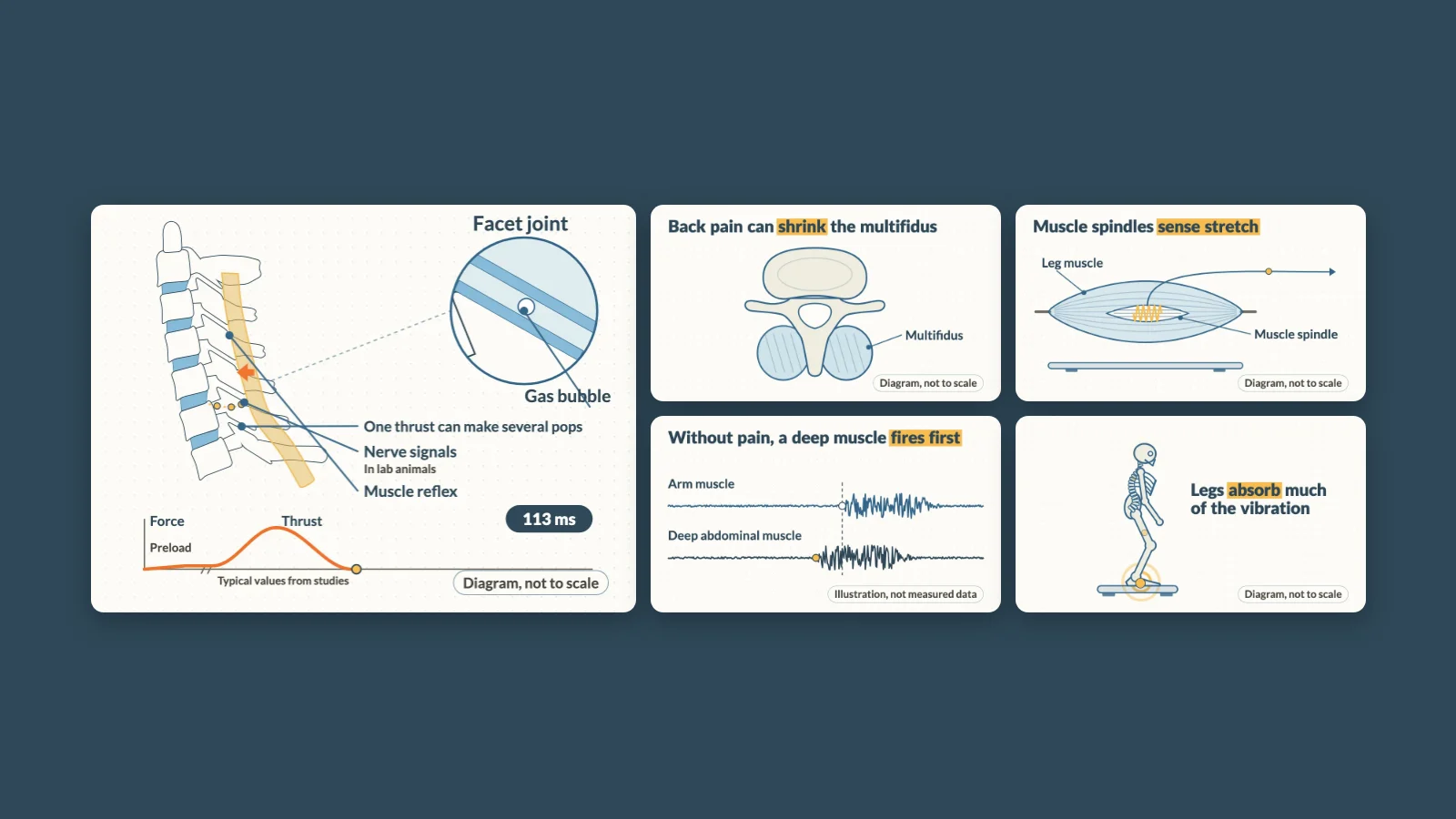
We built five short animations while fact-checking these pages, each drawn in code from the studies it shows. One slows down a neck adjustment, and four show what the research says about whole-body vibration.
Each animation started as a claims sheet. Every word on screen is listed there with the study behind it, and nothing else goes on screen. I signed off on the wording and the look of each one before it went live. You'll find each animation again further down, next to the point it explains.
Why fact-check our own website?
We fact-checked our own pages because they made promises the research does not support, and those pages carry my name. Patients read them when they are hurting after a crash and trying to decide what to do next. They deserve to know which parts of care rest on solid evidence and which parts are still guesses.
It started with an animation. In October 2026 I asked for short animations to sit in the four cards of our vibration therapy page. Our videos follow one firm rule: every word on screen has to trace back to a study we have opened and read. When we held the page's own text to that rule, much of it failed.
So we went through the page sentence by sentence. Then we did the same for our chiropractic adjustments page, which is being rewritten now. This post walks through both, with the animations we built along the way, because drawing something in slow motion forces you to know exactly what happens.
How we checked each claim
We pulled every sentence that made a clinical claim and traced it to the original research. A summary, a textbook or another clinic's website did not count. Each claim went through the same steps:
- Find the study. If the page cited nothing, we searched PubMed for the trials and reviews that test the claim.
- Open it. We read the abstract and, where it mattered, the full paper. On our old blog posts, a surprising number of references pointed to the wrong journal or said something different from the sentence they supported.
- Check who was studied. Results in people with neck or back pain carry more weight for our patients than results in healthy students, and far more than results in cats or rats.
- Check the comparison. "Better than nothing," "as good as other treatments" and "better than a convincing fake treatment" are three different claims.
- Check the size and the time. A change that lasts ten minutes is real, and it is also a very different promise from a lasting change.
- Sort the claim and rewrite it. Each claim landed in one of four tiers, and its new wording had to match its tier.
| Tier | What it means | How we may word it |
|---|---|---|
| A | Shown in people like our patients | As a finding, with its size and its comparison |
| B | Shown in other people (healthy volunteers, other conditions) | As a finding in that group, said plainly |
| C | Mechanism only (animal, cadaver or lab studies) | As how something works, never as a result you will get |
| D | Unsupported or contradicted | We don't say it |
For the vibration page we opened about 200 sources. For the adjustments page we opened more than 240. That sounds like a lot for two web pages. It is what it takes to say something short and true.
What our vibration page used to claim
Our vibration page claimed that the platform retrains balance and switches on deep muscles by itself, and that we measured balance on it. None of that held up. Here is some of the old wording, word for word:
- "Vibration triggers reflexive contraction, reactivating stabilizers without patient effort."
- After whiplash and concussion, "vibration therapy directly retrains those impaired pathways."
- "Balance and stability can be quantified on the vibration platform."
The last one was the easiest to catch: the platform in our clinic does not measure balance at all. That sentence described a feature we don't have. We also found no trial of vibration after whiplash, after concussion or after any car crash, so "directly retrains" was a promise with nothing under it.
Two older blog posts about vibration were worse. One built its case on a mouse study and a brain-clearance idea that has never been tested with vibration in people; 10 of its 27 references named the wrong journal. The other made 79 claims, and only 11 held up as written. We took both posts down on October 29, 2026, and their old links now lead to the corrected vibration page.
What the vibration research actually shows
The research supports a smaller, more useful story: vibration makes muscle sensors fire, the legs absorb most of it, and the muscles that matter after back pain respond to targeted exercise. We built four animations to show exactly that, each from the studies below it.
The deep back muscle can shrink, and exercise helps it recover
In 26 people with acute pain on one side of the low back, the multifidus, a deep muscle that runs between the vertebrae, was about 31% smaller on the painful side, at one level.4 In a randomized trial, it was still small 10 weeks after the pain eased in people who received usual care. In people who did specific exercise for that muscle, it recovered faster and more completely.5
Vibration has not been shown to do that job. In a 2018 trial in chronic low back pain, people on two kinds of vibration platform improved pain and strength, but neither group's multifidus got thicker.12 In a 2026 trial, adding vibration to motor control exercise added nothing to pain, stability or muscle activity.13 So "without patient effort" came off the page. The platform is one place to do the exercise.
Vibration makes muscle sensors fire
Your sense of where your body is comes partly from muscle spindles, small stretch sensors inside your muscles. When a relaxed muscle is vibrated, its spindle endings fire in step with each cycle of the vibration.6, 14 Standing on a vibration platform triggers stretch reflexes in the leg muscles.7
That is a real effect, and it is the honest version of "proprioceptive retraining." Firing a sensor is a long way from retraining a sense that was disturbed by a crash, and no one has tested vibration for that.
Muscle timing can change, with the right training
In people without back pain, a deep abdominal muscle, the transversus abdominis, switches on before the arm moves. In people with low back pain, it switched on late in every direction tested.8 A review of 27 studies found these delays in chronic low back pain, with no convincing evidence of them in acute pain.15 One session of targeted training moved the timing earlier, closer to people without pain.9
Vibration did not change muscle timing when it was added to that kind of training.13 So our page now says the platform is one setting for the exercises that do.
Most of the vibration stops in the legs
On three different platforms, tested in 8 healthy volunteers who were squatting, the legs cut the vibration about tenfold by the time it reached the knee and hip.10 How much reaches the head depends on how you stand. On one low-intensity platform, with six healthy adults, about 79% reached the head with the knees locked and about 10% with the knees deeply bent.11 Bending the knees reduced what reached the head at every frequency tested in another study.16
An international group of 51 experts discourages unsupervised vibration training.17 Short, supervised sessions with the knees softly bent are what we do, and that is what the page says now.
Where chiropractic marketing often goes wrong
The claims researchers flag most often on chiropractic websites are about conditions outside the muscles and joints, the idea that vertebrae slip out of place, and promises of results the research hasn't shown. Our pages had the last two.
Researchers have audited chiropractic websites several times. A review of 200 sites in five English-speaking countries, checked in 2008, judged that 190 of them made at least one claim that lacked sound evidence at the time, and claims about headache and migraine appeared on 90% of the sites.18 That review also counted neck pain and whiplash as unsupported, which a later chiropractic guideline treats differently, so read the 95% with care.19
More recent European studies looked only at conditions outside the muscles and joints. About a quarter of sampled Danish clinic websites and four in five French ones mentioned such conditions without a clear explanation, most often children's sleep, concentration and ear infections, and digestive problems.20, 21 When Danish researchers asked some of those chiropractors why, poor communication and websites that hadn't been kept up to date were common answers.22 An audit of 359 Australian chiropractors' websites and Facebook pages judged that 72% had material at risk of breaching national advertising rules, most often misleading statements.23
Early in the COVID-19 pandemic, posts claiming that spinal adjustments boost immunity rose sharply on Twitter.24 Chiropractic researchers answered with a statement against the claim, signed by 140 of them, and one Canadian regulator found such claims among its own members and had them corrected.25, 26
The misalignment idea
The idea that vertebrae slip out of place and cause problems, often called subluxation, still appears on many websites. It was on 28% of sampled Australian sites, and on a third of clinic websites in Alberta, Canada, some of which linked it to whiplash from car accidents.27, 28 In surveys, about one chiropractor in five described their care as centered on subluxation: 18.8% in Canada in 2010 and 21.2% in the United States between 2018 and 2020.29, 30 A review that tested subluxation against standard criteria for cause and effect found them, for the most part, unmet.31
Spinal X-rays to look for misalignment go with that idea. About half of the US chiropractors who answered one survey agreed that X-rays help detect subluxations.32 Reviews by chiropractic researchers found no evidence that routine or repeat X-rays help patients when there are no warning signs, though X-rays do have a place, such as checking for injury after trauma.33, 34 Scans also show wear in people with no pain at all: in studies of people without back pain, disc bulges showed up in 30% of 20-year-olds and 84% of 80-year-olds.35
Patients hear these ideas too. In a Belgian survey of 100 people, 49% said the pop during an adjustment was a vertebra going back into place.36 A 2022 review of 5 studies found no link between hearing a pop and pain relief.37
Our own site has the same idea. Our chest and rib page mentions "rib subluxations (ribs that have shifted slightly out of position)," and our adjustments page says a crash "misaligns" the spine and that an adjustment restores "alignment." Those sentences are the first to go.
What our adjustments page claims today
Our chiropractic adjustments page repeats several of the most common overclaims in our profession, and I am rewriting it now. Until the new version is live, here is what it says and what we found.
| What the page says | What the research shows |
|---|---|
| A crash's forces "compress and misalign spinal segments" | On X-ray, a straight or reversed neck curve was no more common in 488 people with fresh whiplash than in 495 people without it.38 On 3D X-ray, manipulation did not move the pelvic joint in any of 10 patients.39 |
| The adjustment works "by breaking through adhesions" | Adhesions inside spinal joints have been shown in rats whose spines were surgically fixed for weeks.40 We found no study showing them in people after a crash. |
| "Neurological Reset" | The nervous-system changes measured after one adjustment are small, and most fade within minutes.41, 42 |
| "Decompression of irritated nerve roots through restoration of normal joint spacing and alignment" | We found no study that measured the space around a nerve root after an adjustment. The small joints part by under a millimeter during the thrust and close again.1, 43 |
| Restricted segments are "identified through motion palpation" | Examiners agree well on where it hurts and poorly on which level feels stiff.44, 45 Aiming at the "right" level has not beaten adjusting a different one.46, 47 |
| Range-of-motion data that "insurance adjusters cannot dismiss as subjective" | Motion depends on effort and on how it is measured.48 Two examiners using the AMA Guides method on the same day produced impairment ratings from 0% to 18%.49 A change in neck motion needs to be about 5 to 10 degrees before it is likely real.50 |
Some of these phrases are common in chiropractic marketing. All of them go. The new page will describe what an adjustment does in the terms the evidence supports, which is the next section.
What happens during one adjustment
During a neck adjustment, a light push takes up the slack, then a quick thrust lasts about a tenth of a second. The small facet joints part by just under a millimeter, a gas bubble is thought to form in the joint fluid, and nearby muscles usually give a brief reflex. Drag the slider to watch it in slow motion.
The joint measurements come from a 2018 study that filmed 12 people with acute neck pain on X-ray video, 160 images a second, while a chiropractor adjusted them. The facet joints opened by an average of 0.9 millimeters during the thrust, at the treated level and the levels next to it.1 The timing in the animation is a composite of studies that measured the force of neck adjustments: a light preload, a fast rise to the peak, and a thrust that lasts about a tenth of a second.51, 52
The pop is probably gas, and you don't need it
The pop most likely comes from a gas cavity forming in the joint fluid as the joint surfaces separate. Real-time MRI of cracking knuckles showed the cavity appearing at the moment of the crack.53 Spinal pops have not been filmed the same way, and a CT study found no gas left in neck joints right after an adjustment, so the bubble in our animation forms and then fades.43
One thrust usually makes several pops. In the upper neck, people averaged 3.57 pops per thrust, and the pops were as likely to come from the side opposite the target.2 In the low back, pops landed on average 5.3 centimeters from the target, and only about half came from the target itself.54 Whether you hear a pop or not, people with low back pain and people with neck pain improved alike.55, 56
Nerves and muscles answer briefly
The capsules around the neck's facet joints contain nerve endings that sense movement and pain.57 Within 50 to 200 milliseconds of the thrust, nearby muscles usually give a reflex that lasts about a tenth to four tenths of a second.3 In lab studies in cats, a fast push made the back muscles' stretch sensors fire much harder than a slow push did, and the sensors often went quiet right afterward.58 That is a mechanism. It shows how an adjustment sends a burst of signals, and it is not a promise of a result.
Sensitivity to pressure can ease slightly in the minutes after an adjustment, and in pain-free volunteers the difference from a fake treatment was gone within about ten minutes.41, 42 None of this looks like a "reset." The measured changes are small and short, which is one reason guidelines pair adjustments with exercise.
So, do adjustments help?
Yes, modestly, and mainly as part of a plan that includes exercise. For chronic low back pain, a 2026 Cochrane review of 76 trials found little to no difference in pain between manipulation and other conservative treatments.59 Against fake manipulation and against no treatment it did better, but the certainty of those comparisons was low to very low.59 For acute low back pain, compared with fake or other treatments, pain improved by about one point on a 0 to 10 scale, along with a small to moderate gain in function, for up to six weeks.60
For neck pain after a car crash, a 2016 guideline for traffic injuries does not list manipulation on its own. It places manipulation or mobilization inside care that includes range-of-motion exercise and education, with a check of progress at every visit.61 That is how we use adjustments: as one part of exercise-based rehabilitation, adjusted to how you respond.
What you might feel afterward
Over the first few visits, about half of people notice a reaction. In a study of 1,058 new patients of 102 Norwegian chiropractors, 55% reported at least one over up to six treatments, mostly local discomfort, headache or tiredness. Reactions were mild or moderate in 85% of patients, and 74% of reactions were gone within 24 hours.62 Serious events are rare: in a UK survey of 50,276 neck manipulations, none were reported.63, 64
Important
A tear in a neck artery can start as neck pain or a headache, before any treatment. In people under 45, a chiropractic visit before this kind of stroke was about as strongly linked to it as a visit to a family doctor, which fits people seeking care for an artery tear's early pain.65 The American Heart Association asks clinicians to tell patients about this link before neck manipulation.66 Get emergency care for a sudden severe headache, trouble speaking or seeing, or weakness on one side.
How to fact-check any clinic's claims
You can check most health claims in a few minutes with the same questions we used. Try them on any clinic's website, including ours.
- Is there a study? A claim with no source is an opinion. If there is a source, search its title on PubMed and read the abstract.
- Who was studied? Look for people with your problem. Healthy volunteers, athletes, cats and cadavers tell you how something works, not how you will do.
- Compared with what? "Better than nothing" is a low bar. The useful question is how it compares with the other good options.
- How big, and for how long? A one-point change on a 10-point pain scale for six weeks is worth knowing. A change that lasts ten minutes is a different thing.
- Watch the verbs. Restores, resets, realigns, retrains and fixes are claims about outcomes. Ask for the study that showed it.
A good chiropractor will welcome these questions. You should be able to ask what the evidence says about your treatment and get a straight answer, including "we don't know yet."
What changes on our site
The vibration page went live in its corrected form on October 28, 2026, with the four animations above. The next day we corrected every other vibration claim across the site and took down the two old blog posts. The adjustments page is next, with the slow-motion animation, once I have confirmed the parts that describe my own practice.
We are also planning a video on vibration therapy from the same research. The rule for all of it stays the same: if we can't show you the study, we don't say it.
Frequently Asked Questions
Does a chiropractic adjustment put bones back in place?
No study shows that it does. On 3D X-ray, manipulation did not change the position of the pelvic joint in any of 10 patients. During a neck adjustment the small joints part by just under a millimeter and then close again.
What is the popping sound during an adjustment?
It most likely comes from a gas cavity forming in the joint fluid as the joint surfaces separate, which has been filmed in knuckles. One thrust usually makes several pops, and in the low back only about half come from the joint being aimed at.
Does an adjustment need to pop?
No. In studies of people with low back pain and people with neck pain, those who heard a pop and those who did not improved alike.
Is it normal to be sore after an adjustment?
Yes. Over the first few visits, about half of people notice soreness, a headache or tiredness, usually mild or moderate and usually gone within a day. Tell us about anything that feels severe or new.
References
- Anderst WJ, Gale T, LeVasseur C, et al. Intervertebral kinematics of the cervical spine before, during, and after high-velocity low-amplitude manipulation. Spine J. 2018;18(12):2333-2342. PMID 30142458
- Dunning J, Mourad F, Barbero M, et al. Bilateral and multiple cavitation sounds during upper cervical thrust manipulation. BMC Musculoskelet Disord. 2013;14:24. PMID 23320608
- Herzog W, Scheele D, Conway PJ. Electromyographic responses of back and limb muscles associated with spinal manipulative therapy. Spine (Phila Pa 1976). 1999;24(2):146-52; discussion 153. PMID 9926385
- Hides JA, Stokes MJ, Saide M, et al. Evidence of lumbar multifidus muscle wasting ipsilateral to symptoms in patients with acute/subacute low back pain. Spine (Phila Pa 1976). 1994;19(2):165-72. PMID 8153825
- Hides JA, Richardson CA, Jull GA. Multifidus muscle recovery is not automatic after resolution of acute, first-episode low back pain. Spine (Phila Pa 1976). 1996;21(23):2763-9. PMID 8979323
- Burke D, Hagbarth KE, Löfstedt L, et al. The responses of human muscle spindle endings to vibration of non-contracting muscles. J Physiol. 1976;261(3):673-93. PMID 135840
- Ritzmann R, Kramer A, Gruber M, et al. EMG activity during whole body vibration: motion artifacts or stretch reflexes? Eur J Appl Physiol. 2010;110(1):143-51. PMID 20419311
- Hodges PW, Richardson CA. Inefficient muscular stabilization of the lumbar spine associated with low back pain. A motor control evaluation of transversus abdominis. Spine (Phila Pa 1976). 1996;21(22):2640-50. PMID 8961451
- Tsao H, Hodges PW. Immediate changes in feedforward postural adjustments following voluntary motor training. Exp Brain Res. 2007;181(4):537-46. PMID 17476489
- Pel JJ, Bagheri J, van Dam LM, et al. Platform accelerations of three different whole-body vibration devices and the transmission of vertical vibrations to the lower limbs. Med Eng Phys. 2009;31(8):937-44. PMID 19523867
- Muir J, Kiel DP, Rubin CT. Safety and severity of accelerations delivered from whole body vibration exercise devices to standing adults. J Sci Med Sport. 2013;16(6):526-31. PMID 23453990
- Kim H, Kwon BS, Park JW, et al. Effect of Whole Body Horizontal Vibration Exercise in Chronic Low Back Pain Patients: Vertical Versus Horizontal Vibration Exercise. Ann Rehabil Med. 2018;42(6):804-813. PMID 30613073
- Karimi R, Shojaedin SS, Mimar R, et al. Effectiveness of motor control exercises with and without whole-body vibration on pain, postural stability, and trunk muscle activation in individuals with nonspecific low back pain: a randomized controlled trial. Disabil Rehabil. 2026;48(18):5815-5825. PMID 41652947
- Roll JP, Vedel JP. Kinaesthetic role of muscle afferents in man, studied by tendon vibration and microneurography. Exp Brain Res. 1982;47(2):177-90. PMID 6214420
- Knox MF, Chipchase LS, Schabrun SM, et al. Anticipatory and compensatory postural adjustments in people with low back pain: a systematic review and meta-analysis. Spine J. 2018;18(10):1934-1949. PMID 29906616
- Caryn RC, Hazell TJ, Dickey JP. Transmission of acceleration from a synchronous vibration exercise platform to the head. Int J Sports Med. 2014;35(4):330-8. PMID 24081617
- van Heuvelen MJG, Rittweger J, Judex S, et al. Reporting Guidelines for Whole-Body Vibration Studies in Humans, Animals and Cell Cultures: A Consensus Statement from an International Group of Experts. Biology (Basel). 2021;10(10). PMID 34681065
- Ernst E, Gilbey A. Chiropractic claims in the English-speaking world. N Z Med J. 2010;123(1312):36-44. PMID 20389316
- Bussières AE, Stewart G, Al-Zoubi F, et al. The Treatment of Neck Pain-Associated Disorders and Whiplash-Associated Disorders: A Clinical Practice Guideline. J Manipulative Physiol Ther. 2016;39(8):523-564.e27. PMID 27836071
- Jensen RK, Agersted MEI, Nielsen HA, et al. A cross-sectional study of website claims related to diagnoses and treatment of non-musculoskeletal conditions. Chiropr Man Therap. 2020;28(1):16. PMID 32228649
- Goncalves G, Fleuriau P, Cheron C, et al. Chiropractic website claims related to non-musculoskeletal conditions: a cross-sectional study. Chiropr Man Therap. 2021;29(1):39. PMID 34551800
- O'Neill S, Wahlqvist AB, Simonsen NK, et al. Digging deeper: exploring chiropractors online claims about non-musculoskeletal disorders. Chiropr Man Therap. 2021;29(1):50. PMID 34872561
- Simpson JK. At-risk advertising by Australian chiropractors and physiotherapists. Chiropr Man Therap. 2019;27:30. PMID 31210927
- Kawchuk G, Hartvigsen J, Harsted S, et al. Misinformation about spinal manipulation and boosting immunity: an analysis of Twitter activity during the COVID-19 crisis. Chiropr Man Therap. 2020;28(1):34. PMID 32517803
- Côté P, Bussières A, Cassidy JD, et al. A united statement of the global chiropractic research community against the pseudoscientific claim that chiropractic care boosts immunity. Chiropr Man Therap. 2020;28(1):21. PMID 32366319
- Kawchuk G, Hartvigsen J, Innes S, et al. The use of internet analytics by a Canadian provincial chiropractic regulator to monitor, evaluate and remediate misleading claims regarding specific health conditions, pregnancy, and COVID-19. Chiropr Man Therap. 2020;28(1):24. PMID 32393394
- Young KJ. Words matter: the prevalence of chiropractic-specific terminology on Australian chiropractors' websites. Chiropr Man Therap. 2020;28(1):18. PMID 32252798
- Marcon AR, Murdoch B, Caulfield T. The "subluxation" issue: an analysis of chiropractic clinic websites. Arch Physiother. 2019;9:11. PMID 31754460
- McGregor M, Puhl AA, Reinhart C, et al. Differentiating intraprofessional attitudes toward paradigms in health care delivery among chiropractic factions: results from a randomly sampled survey. BMC Complement Altern Med. 2014;14:51. PMID 24512507
- Gliedt JA, Perle SM, Puhl AA, et al. Evaluation of United States chiropractic professional subgroups: a survey of randomly sampled chiropractors. BMC Health Serv Res. 2021;21(1):1049. PMID 34610831
- Mirtz TA, Morgan L, Wyatt LH, et al. An epidemiological examination of the subluxation construct using Hill's criteria of causation. Chiropr Osteopat. 2009;17:13. PMID 19954544
- Cupler ZA, Gliedt JA, Perle SM, et al. Associations between demographics and clinical ideology, beliefs, and practice patterns: a secondary analysis of a survey of randomly sampled United States chiropractors. BMC Complement Med Ther. 2023;23(1):404. PMID 37946159
- Jenkins HJ, Downie AS, Moore CS, et al. Current evidence for spinal X-ray use in the chiropractic profession: a narrative review. Chiropr Man Therap. 2018;26:48. PMID 30479744
- Corso M, Cancelliere C, Mior S, et al. The clinical utility of routine spinal radiographs by chiropractors: a rapid review of the literature. Chiropr Man Therap. 2020;28(1):33. PMID 32641135
- Brinjikji W, Luetmer PH, Comstock B, et al. Systematic literature review of imaging features of spinal degeneration in asymptomatic populations. AJNR Am J Neuroradiol. 2015;36(4):811-6. PMID 25430861
- Demoulin C, Baeri D, Toussaint G, et al. Beliefs in the population about cracking sounds produced during spinal manipulation. Joint Bone Spine. 2018;85(2):239-242. PMID 28456600
- Moorman AC, Newell D. Impact of audible pops associated with spinal manipulation on perceived pain: a systematic review. Chiropr Man Therap. 2022;30(1):42. PMID 36195914
- Matsumoto M, Fujimura Y, Suzuki N, et al. Cervical curvature in acute whiplash injuries: prospective comparative study with asymptomatic subjects. Injury. 1998;29(10):775-8. PMID 10341902
- Tullberg T, Blomberg S, Branth B, et al. Manipulation does not alter the position of the sacroiliac joint. A roentgen stereophotogrammetric analysis. Spine (Phila Pa 1976). 1998;23(10):1124-8; discussion 1129. PMID 9615363
- Cramer GD, Henderson CN, Little JW, et al. Zygapophyseal joint adhesions after induced hypomobility. J Manipulative Physiol Ther. 2010;33(7):508-18. PMID 20937429
- Honoré M, Leboeuf-Yde C, Gagey O, et al. How big is the effect of spinal manipulation on the pressure pain threshold and for how long does it last? - secondary analysis of data from a systematic review. Chiropr Man Therap. 2019;27:22. PMID 31049195
- Aspinall SL, Leboeuf-Yde C, Etherington SJ, et al. Manipulation-induced hypoalgesia in musculoskeletal pain populations: a systematic critical review and meta-analysis. Chiropr Man Therap. 2019;27:7. PMID 30719281
- Cascioli V, Corr P, Till Ag AG. An investigation into the production of intra-articular gas bubbles and increase in joint space in the zygapophyseal joints of the cervical spine in asymptomatic subjects after spinal manipulation. J Manipulative Physiol Ther. 2003;26(6):356-64. PMID 12902964
- Seffinger MA, Najm WI, Mishra SI, et al. Reliability of spinal palpation for diagnosis of back and neck pain: a systematic review of the literature. Spine (Phila Pa 1976). 2004;29(19):E413-25. PMID 15454722
- Stochkendahl MJ, Christensen HW, Hartvigsen J, et al. Manual examination of the spine: a systematic critical literature review of reproducibility. J Manipulative Physiol Ther. 2006;29(6):475-85, 485.e1-10. PMID 16904495
- Nim CG, Downie A, O'Neill S, et al. The importance of selecting the correct site to apply spinal manipulation when treating spinal pain: Myth or reality? A systematic review. Sci Rep. 2021;11(1):23415. PMID 34862434
- McCarthy CJ, Potter L, Oldham JA. Comparing targeted thrust manipulation with general thrust manipulation in patients with low back pain. A general approach is as effective as a specific one. A randomised controlled trial. BMJ Open Sport Exerc Med. 2019;5(1):e000514. PMID 31673401
- Dvir Z, Prushansky T, Peretz C. Maximal versus feigned active cervical motion in healthy patients: the coefficient of variation as an indicator for sincerity of effort. Spine (Phila Pa 1976). 2001;26(15):1680-8. PMID 11474355
- Nitschke JE, Nattrass CL, Disler PB, et al. Reliability of the American Medical Association guides' model for measuring spinal range of motion. Its implication for whole-person impairment rating. Spine (Phila Pa 1976). 1999;24(3):262-8. PMID 10025021
- Fletcher JP, Bandy WD. Intrarater reliability of CROM measurement of cervical spine active range of motion in persons with and without neck pain. J Orthop Sports Phys Ther. 2008;38(10):640-5. PMID 18827326
- Gorrell LM, Nyirö L, Pasquier M, et al. Spinal manipulation characteristics: a scoping literature review of force-time characteristics. Chiropr Man Therap. 2023;31(1):36. PMID 37705030
- Kawchuk GN, Herzog W, Hasler EM. Forces generated during spinal manipulative therapy of the cervical spine: a pilot study. J Manipulative Physiol Ther. 1992;15(5):275-8. PMID 1613409
- Kawchuk GN, Fryer J, Jaremko JL, et al. Real-time visualization of joint cavitation. PLoS One. 2015;10(4):e0119470. PMID 25875374
- Ross JK, Bereznick DE, McGill SM. Determining cavitation location during lumbar and thoracic spinal manipulation: is spinal manipulation accurate and specific? Spine (Phila Pa 1976). 2004;29(13):1452-7. PMID 15223938
- Flynn TW, Fritz JM, Wainner RS, et al. The audible pop is not necessary for successful spinal high-velocity thrust manipulation in individuals with low back pain. Arch Phys Med Rehabil. 2003;84(7):1057-60. PMID 12881834
- Cleland JA, Flynn TW, Childs JD, et al. The audible pop from thoracic spine thrust manipulation and its relation to short-term outcomes in patients with neck pain. J Man Manip Ther. 2007;15(3):143-54. PMID 19066662
- McLain RF. Mechanoreceptor endings in human cervical facet joints. Spine (Phila Pa 1976). 1994;19(5):495-501. PMID 8184340
- Pickar JG, Kang YM. Paraspinal muscle spindle responses to the duration of a spinal manipulation under force control. J Manipulative Physiol Ther. 2006;29(1):22-31. PMID 16396726
- de Zoete A, Innocenti T, Petrozzi MJ, et al. Spinal manipulative therapy for adults with chronic low back pain. Cochrane Database Syst Rev. 2026;1(1):CD008112. PMID 41494147
- Paige NM, Miake-Lye IM, Booth MS, et al. Association of Spinal Manipulative Therapy With Clinical Benefit and Harm for Acute Low Back Pain: Systematic Review and Meta-analysis. JAMA. 2017;317(14):1451-1460. PMID 28399251
- Côté P, Wong JJ, Sutton D, et al. Management of neck pain and associated disorders: A clinical practice guideline from the Ontario Protocol for Traffic Injury Management (OPTIMa) Collaboration. Eur Spine J. 2016;25(7):2000-22. PMID 26984876
- Senstad O, Leboeuf-Yde C, Borchgrevink C. Frequency and characteristics of side effects of spinal manipulative therapy. Spine (Phila Pa 1976). 1997;22(4):435-40; discussion 440-1. PMID 9055373
- Thiel HW, Bolton JE, Docherty S, et al. Safety of chiropractic manipulation of the cervical spine: a prospective national survey. Spine (Phila Pa 1976). 2007;32(21):2375-8; discussion 2379. PMID 17906581
- Swait G, Finch R. What are the risks of manual treatment of the spine? A scoping review for clinicians. Chiropr Man Therap. 2017;25:37. PMID 29234493
- Cassidy JD, Boyle E, Côté P, et al. Risk of vertebrobasilar stroke and chiropractic care: results of a population-based case-control and case-crossover study. Spine (Phila Pa 1976). 2008;33(4 Suppl):S176-83. PMID 18204390
- Biller J, Sacco RL, Albuquerque FC, et al. Cervical arterial dissections and association with cervical manipulative therapy: a statement for healthcare professionals from the american heart association/american stroke association. Stroke. 2014;45(10):3155-74. PMID 25104849