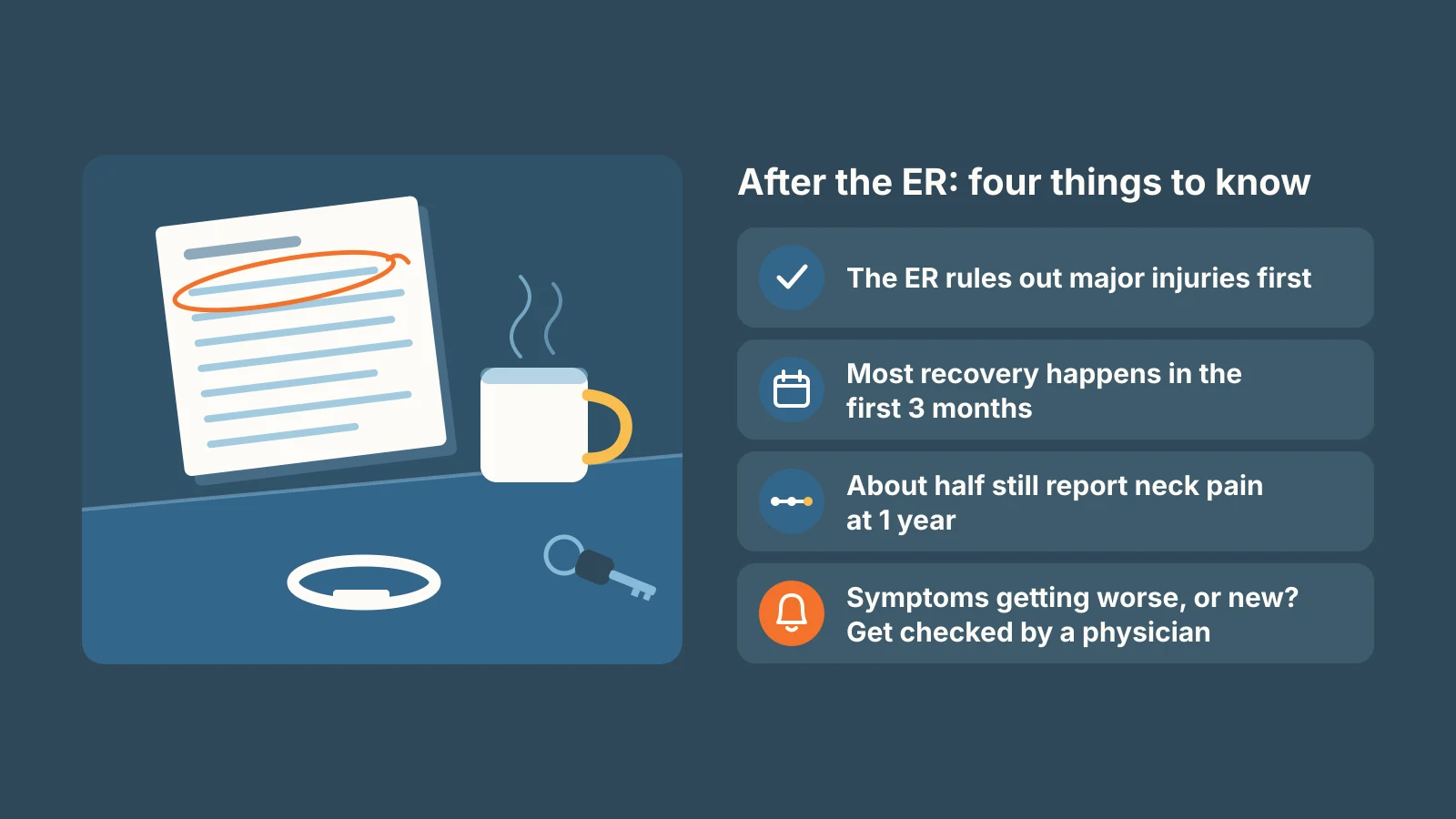
If your ER papers say "cervical strain" after a car accident, the doctor found an injury to the muscles and other soft tissues of your neck and ruled out the dangers the ER looks for first, like a fracture. The label doesn't say how serious your injury is. Research on crash-related neck injuries finds that about half of people still report neck pain a year later.1 That's reason enough to take the word "strain" seriously.
It's the morning after the crash. Your neck is stiff, the discharge papers are on the kitchen counter, and two words near the top say "cervical strain."
Strain sounds like something you'd get from carrying too many grocery bags at once. It sounds like the ER is telling you to shake it off.
I want to walk you through what those two words mean, what the ER was and wasn't looking for, and what you can do this week. You'll get plain answers, and when the research doesn't have an answer, I'll tell you that too.
Rather watch? I cover the same ground in this video.

What the ER was checking for
The emergency room has one urgent job after a crash: find or rule out the injuries that can't wait. In the neck, that means a broken bone or another serious injury to the spine.
A treatment guideline for crash-related neck pain spells out the order. Clinicians should first rule out major structural problems, and only then grade the neck injury itself.2 The ER handled step one. The word "strain" is what's left once step one comes back clear.
Here's what that looks like in numbers. In a study of 8,924 alert, stable adults seen in 10 Canadian ERs after a blow to the head or neck, 151 (1.7%) had an important injury to the bones of the neck.3 In that study, the large majority didn't have a serious injury to the neck bones, and that's genuinely good news.
What the research found
Researchers in 10 Canadian emergency departments followed 8,924 adults who came in alert and stable after blunt trauma to the head or neck. 151 of them, or 1.7%, had an important injury to the bones of the neck. From this study came the Canadian C-Spine Rule, the checklist many ERs use to decide who needs neck X-rays.3
That checklist starts with high-risk questions. Are you 65 or older? Was it a dangerous crash? Do you have tingling in your arms or legs? Any "yes" means you get imaging.3
So when your papers say your X-ray or CT was normal, that answers the question the ER was asking: is there a fracture or other serious injury? It's a good answer to that question. It doesn't measure the muscles and other soft tissues that are now sore. (I wrote more about this in The limits of a normal scan.)
Is cervical strain the same as whiplash?
For a car crash, they generally describe the same kind of injury. The names are different.
"Whiplash" describes how the injury happens: the head and neck are thrown one way and then the other. Researchers use the name whiplash-associated disorder, or WAD, for the group of neck symptoms that an accident like that sets off, such as a car crash.4
The words on hospital papers vary, and so do the words in research. One study of crash patients was titled "Acute cervical strain," and it described them as people with soft-tissue neck injuries from car accidents.5 A Norwegian trial of ER patients called the same kind of injury a "whiplash neck sprain."6
So if your papers say cervical strain after a crash, most of the research that can help you is filed under whiplash.
There's one more useful idea from that research. In 1995, a task force in Quebec created a way to grade whiplash injuries by what the doctor finds on exam. When researchers applied those grades to 380 ER patients after rear-end crashes, a higher grade on the ER chart meant a higher risk of still having symptoms 6 to 24 months later.7
What the research found
In 380 people seen in two Kingston, Ontario emergency departments after rear-end crashes, the higher the injury's grade on the ER chart, the higher the risk of symptoms 6, 12, 18 and 24 months later. The highest risk of long-term symptoms was in people whose necks had both tender spots and limited motion.7
The two words on your papers don't tell you which grade you are. That's part of why a follow-up exam matters.
Sprain or strain: what's the difference?
In medical terms, "strain" goes with muscles and "sprain" goes with ligaments, the tough bands that hold bones together at a joint. A review of neck and back pain lists muscle strain and ligament sprain as two separate sources of pain.8
If it helps to picture it: a strain is an overstretched rubber band, and a sprain is an overstretched strap holding two pieces together.
Here's the catch. A crash doesn't choose one tissue. And as you saw above, researchers have used both words, "strain" and "sprain," for crash-related neck injuries.5, 6 So the word on your papers is a starting label. It doesn't settle which tissues were hurt or how much.
That's what an exam after the ER is for. The guideline I mentioned says that once serious injury is ruled out, the neck injury should be graded.2 Grading looks at things like where your neck is tender and how well it moves.7
Why it can hurt more tomorrow
You've probably heard that people often feel fine right after a crash and then hurt a day or two later. Here's what the research can and can't say about that.
It's real enough that it's built into the ER checklist. The Canadian C-Spine Rule lists neck pain that starts later, not right away, as one of the signs of a lower risk of a serious neck-bone injury.3 So if your pain showed up the next morning, that's reassuring about fractures.
Lower risk of a fracture isn't the same thing as no injury, though. In one survey of drivers with crash-related neck injuries, complaints lasted longest when they began more than 24 hours after the crash.9 That survey had real limits: only 138 people answered, and the authors themselves said better studies are needed. So treat it as a reason not to brush off pain that arrives late, not as a prediction.
What researchers haven't measured well is how often symptoms start late. I couldn't find a reliable study that gives a number, so I won't give you one.
What about the car? People often judge an injury by the damage to their vehicle. In staged rear-end collisions at about 4 km/h and 8 km/h (roughly 2.5 and 5 mph), about 29% and 38% of the volunteers had whiplash symptoms, mostly neck symptoms and headaches.10
Those were healthy volunteers in deliberately gentle bumps. And in the big review of crash-injury research, few things about the crash itself, like its direction or the type of headrest, predicted who would recover.1 A bumper that looks fine tells you about the bumper. (More on that in Why vehicle damage doesn't predict your injury severity.)
How long does it take to heal?
Most of the change happens early. A review of 38 groups of people followed after car accidents found that a large share recover in the first 3 months, and after that, recovery rates level off. Pain and disability drop fast in the first months and show little improvement after 3 months.11
The other side of that is less comfortable. A large review by an international task force on neck pain concluded that about half of people with whiplash-associated disorders still report neck pain a year after the injury.1 In a Danish trial of 458 people after whiplash, 48% reported considerable neck pain at one year.12
So "strain" doesn't mean a few days of stiffness for everyone. Many people get better, mostly in the first 3 months. A large share don't.
The first 3 months are when most recovery happens. That's the window to take seriously.
Why do some people recover quickly and others don't? The research points to a few things you can recognize in yourself:
- How bad it is at the start. Greater pain, more symptoms and more trouble with daily activities early on predicted slower recovery.1
- Specific early signs. Pooled data from 11 groups of patients (3,193 people) linked lasting problems to high neck pain at the start (over 55 out of 100), headache at the start, a history of neck pain, expecting the worst (researchers call it catastrophizing), and not wearing a seat belt, among others.13
- How you respond after the injury. A passive coping style, low mood and fear of moving your neck were linked to slower or less complete recovery.1
None of these is a sentence. They're signals worth bringing up with whoever is treating you. (For more on the timeline, see Whiplash recovery timeline.)
Key takeaways
- "Cervical strain" means the ER ruled out the dangers it looks for first, like a fracture. It doesn't say how serious the soft-tissue injury is.2, 3
- For a car crash, cervical strain and whiplash describe the same kind of injury, so the whiplash research applies.4, 5
- Most recovery happens in the first 3 months, but about half of people with whiplash-associated disorders still report neck pain a year later.1, 11
- Keeping active and moving is what the guideline recommends, and trials comparing it with a soft collar have mostly favored staying active.2, 6, 14
- Pain that gets worse, or new symptoms, should be checked by a physician.2
What to do next
Here's what the evidence says about the next few days and weeks. It's the part most people want first, so I'll keep it practical.
Keep moving, gently
The crash-injury guideline says clinicians should reassure people that the typical course of these injuries is to get better, and should stress the importance of keeping active and moving.2
The trials back this up. In a Norwegian trial of 201 ER patients with neck sprain after a car accident, people told to carry on with their normal activities did better at 6 months than people given a soft collar and time off work for the first 14 days.6 In a Swedish trial of 97 people after crashes, frequent, gentle neck movements (moving well short of the point of strain) reduced pain more than rest, a soft collar and gradual self-mobilization, and they worked better when started early, within 96 hours.15
Remember that fear of moving your neck was linked to slower recovery.1 Gentle, comfortable movement is the opposite of that.
Think twice about the soft collar
If the ER gave you a soft collar, ask your doctor how long to use it. A 2021 review of four trials (409 people) found that every trial favored an active approach over a soft collar for pain, though the evidence was of low quality.14 The crash-injury guideline advises against a collar in the first 3 months.2
To be fair to the other side: one large trial found that a rigid collar followed by exercise, advice to act as usual, and an exercise program all had similar results at one year.12 Overall, the evidence doesn't show the collar helps, and the trials that compared it with staying active mostly favored staying active.
Get the injury graded
For the first 3 months, the guideline lists education combined with range-of-motion exercise, or with exercise plus manipulation or mobilization, as options.2 A chiropractic guideline for recent neck pain suggests similar options, including manipulation or mobilization and range-of-motion home exercise.16
At adjust.clinic, a first visit after a crash starts with a full exam of your neck, so we know what kind of injury we're working with. We use adjustments alongside gentle movement and home exercise. You can call us at (707) 658-2534 or learn more about chiropractic care for whiplash injuries.
Know when to go back right away
Get care now if
- You have tingling or numbness in your arms or legs.3
- Your symptoms are getting worse, or you have new symptoms.2
If it's an emergency, call 911.
The guideline is clear on the last point: people whose symptoms get worse, or who develop new physical or psychological symptoms, should be sent to a physician for further evaluation at any time.2
Frequently Asked Questions
Is a cervical strain the same as whiplash?
For a car crash, they describe the same kind of injury. Whiplash-associated disorder is the research name for the neck symptoms set off by a crash, and researchers have used "cervical strain" and "neck sprain" for the same injuries. Most of the research that can help you is filed under whiplash.
What's the difference between a sprain and a strain?
"Strain" goes with muscles, and "sprain" goes with ligaments, the bands that hold bones together at a joint. A crash can injure both, and research uses both words for crash-related neck injuries. An exam, not the label, tells you which tissues are involved.
How long does a cervical strain take to heal?
Most recovery happens in the first 3 months, and after that, recovery rates level off. A large review found that about half of people with whiplash-associated disorders still report neck pain a year later. Greater pain at the start is linked to slower recovery.
Should I wear a neck collar for a cervical strain?
Ask your doctor, but the evidence leans against it. Trials comparing a soft collar with staying active mostly favored staying active for pain, and a crash-injury guideline advises against a collar in the first 3 months. Gentle, comfortable movement is what the guideline recommends.
Is it normal for neck pain to start a day or more after a crash?
It happens often enough that the ER checklist for neck X-rays lists delayed neck pain as a sign of lower risk of a serious bone injury. Lower risk of a fracture isn't the same as no injury, so pain that starts late still deserves a check. Researchers haven't measured well how often it happens.
When should I go back to the doctor?
Go back if you have tingling or numbness in your arms or legs, if your symptoms are getting worse, or if you have new symptoms. A crash-injury guideline says worsening or new symptoms should be checked by a physician at any time. If it's an emergency, call 911.
References
- Carroll LJ, Holm LW, Hogg-Johnson S, et al. Course and prognostic factors for neck pain in whiplash-associated disorders (WAD): results of the Bone and Joint Decade 2000-2010 Task Force on Neck Pain and Its Associated Disorders. Spine (Phila Pa 1976). 2008;33(4 Suppl):S83-92. PMID 18204405
- Côté P, Wong JJ, Sutton D, et al. Management of neck pain and associated disorders: A clinical practice guideline from the Ontario Protocol for Traffic Injury Management (OPTIMa) Collaboration. Eur Spine J. 2016;25(7):2000-22. PMID 26984876
- Stiell IG, Wells GA, Vandemheen KL, et al. The Canadian C-spine rule for radiography in alert and stable trauma patients. JAMA. 2001;286(15):1841-8. PMID 11597285
- Pastakia K, Kumar S. Acute whiplash associated disorders (WAD). Open Access Emerg Med. 2011;3:29-32. PMID 27147849
- Greenfield J, Ilfeld FW. Acute cervical strain. Evaluation and short term prognostic factors. Clin Orthop Relat Res. 1977;(122):196-200. PMID 837607
- Borchgrevink GE, Kaasa A, McDonagh D, et al. Acute treatment of whiplash neck sprain injuries. A randomized trial of treatment during the first 14 days after a car accident. Spine (Phila Pa 1976). 1998;23(1):25-31. PMID 9460148
- Hartling L, Brison RJ, Ardern C, et al. Prognostic value of the Quebec Classification of Whiplash-Associated Disorders. Spine (Phila Pa 1976). 2001;26(1):36-41. PMID 11148643
- Meleger AL, Krivickas LS. Neck and back pain: musculoskeletal disorders. Neurol Clin. 2007;25(2):419-38. PMID 17445737
- Richter M, Otte D, Blauth M. Acceleration related injury of the cervical spine in restrained car drivers. Investigations on the trauma mechanism and severity of injury. Orthopade. 1999;28(5):414-423. PMID 28246956
- Brault JR, Wheeler JB, Siegmund GP, et al. Clinical response of human subjects to rear-end automobile collisions. Arch Phys Med Rehabil. 1998;79(1):72-80. PMID 9440422
- Kamper SJ, Rebbeck TJ, Maher CG, et al. Course and prognostic factors of whiplash: a systematic review and meta-analysis. Pain. 2008;138(3):617-629. PMID 18407412
- Kongsted A, Qerama E, Kasch H, et al. Neck collar, "act-as-usual" or active mobilization for whiplash injury? A randomized parallel-group trial. Spine (Phila Pa 1976). 2007;32(6):618-26. PMID 17413465
- Walton DM, Pretty J, MacDermid JC, et al. Risk factors for persistent problems following whiplash injury: results of a systematic review and meta-analysis. J Orthop Sports Phys Ther. 2009;39(5):334-50. PMID 19411766
- Christensen SWM, Rasmussen MB, Jespersen CL, et al. Soft-collar use in rehabilitation of whiplash-associated disorders - A systematic review and meta-analysis. Musculoskelet Sci Pract. 2021;55:102426. PMID 34271416
- Rosenfeld M, Gunnarsson R, Borenstein P. Early intervention in whiplash-associated disorders: a comparison of two treatment protocols. Spine (Phila Pa 1976). 2000;25(14):1782-7. PMID 10888946
- Bussières AE, Stewart G, Al-Zoubi F, et al. The Treatment of Neck Pain-Associated Disorders and Whiplash-Associated Disorders: A Clinical Practice Guideline. J Manipulative Physiol Ther. 2016;39(8):523-564.e27. PMID 27836071
This article is for general education only and is not medical advice. Reading it does not create a doctor–patient relationship with Ryan Lloyd, DC, QME, or adjust.clinic. Talk to your own doctor about your symptoms and care. If you have a medical emergency, call 911.