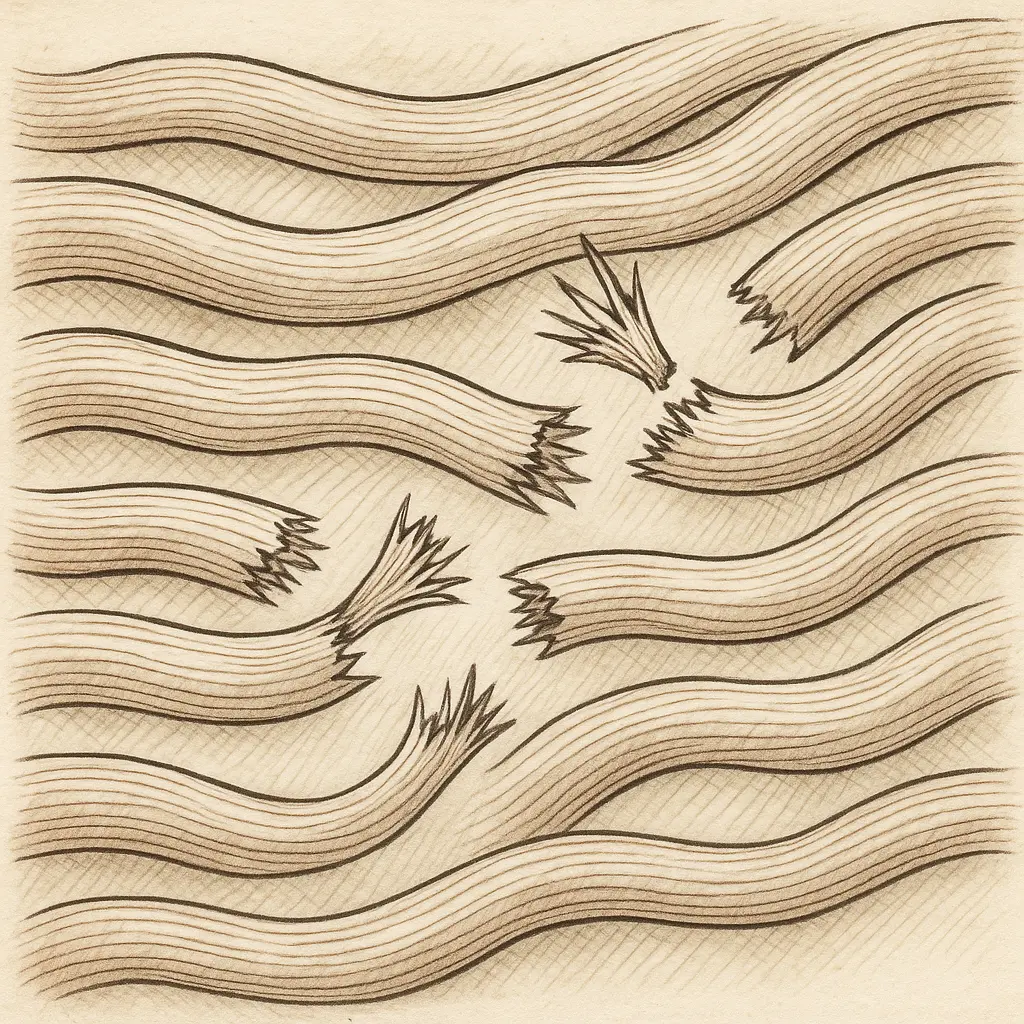
Soft tissue heals in three overlapping phases: inflammation in the first few days, repair over the following weeks, and remodeling that can last a year or more. Muscle, with a rich blood supply, heals fastest. Ligaments, tendons and discs get little blood, so they heal slower and less completely. Bone is different: it rebuilds itself with new bone, not scar.
Why a crash hurts several tissues at once
A crash loads many tissues in the same split second, so most people come out of one with several injuries layered together. Muscles, ligaments, the capsules around the small facet joints of the spine, and the discs can all be strained at once.
Laboratory crash simulations show how this happens in the neck. In cadaver spines on a sled, the neck first bent into an S-shape, with the upper neck flexing forward while the lower neck bent backward.1 The capsular ligaments around the facet joints stretched past their normal physiological range, and the largest strains, about 30 to 35 percent, were at C6-C7.2
Each of those tissues then heals on its own schedule. That is a big part of why recovery after a crash rarely follows one neat timeline, and it is why I explain healing tissue by tissue. The whiplash page covers what a neck injury from a crash involves, and the conditions we treat after car accidents page lists the rest.
The three phases of healing
Every injured tissue moves through the same three overlapping phases: inflammation, repair and remodeling. Each tissue moves through them at its own pace.3, 4, 5
A building site is the easiest way I know to picture it. First a clean-up crew clears the damage. Then a framing crew puts up a quick, rough structure to close the gap. Over the following months, that structure is reinforced and rebuilt along the lines of the loads it has to carry.
Inflammation: the clean-up
Inflammation starts within the first day. Bleeding from torn vessels forms a clot, and the area swells.3, 6 White blood cells arrive in waves: neutrophils first, then macrophages, which clear away dead tissue and debris.5 In skin wounds, this cell response is established within the first 24 hours and can last up to about two days.3
Repair: the quick patch
About two days after the injury, cells called fibroblasts move in and start laying down new collagen.5 This first collagen is mostly type III. It goes down quickly, in a disorganized mesh of thin fibrils.3, 6 In skin wounds the repair phase runs to about day 14; in tendons it lasts a few weeks.3, 7
The patch closes the gap, but it is still weak. Most of the strength comes later, in remodeling.8
Remodeling: the strengthening
Remodeling begins around two to three weeks after the injury and can continue for a year or more.3, 5 During this phase, type III collagen is broken down and replaced with type I collagen, which has more crosslinks and more tensile strength.5, 8 In tendons and ligaments, the new fibers also line up in the direction of the stress they carry.4, 5
The phases overlap. Repair starts while inflammation is still settling, and remodeling starts while repair is still under way.3 The end result in adult soft tissue is usually scar.9 It keeps getting stronger and more organized for months, yet its structure never fully returns to that of the original tissue.4, 8
Healing timelines by tissue
The same three phases run on very different clocks in different tissues. The table shows the main repair window for each tissue in this article and what "healed" means for it.
| Tissue | Main repair window | What "healed" looks like |
|---|---|---|
| Muscle Rich blood supply |
Repair 3–4 weeks; remodeling 3–6 months10 | Regrows its own fibers; large tears leave scar11 |
| Skin and loose connective tissue Rich blood supply |
Repair to about day 14; remodeling a year or more3 | Scar with up to 80% of the original strength (skin)8 |
| Tendon Poor blood supply |
Repair a few weeks; remodeling many months4, 7 | Scar that never matches the original tendon4 |
| Ligament Poor blood supply |
At least 6 weeks to 3 months (ankle); remodeling for months to years12, 13 | Weaker scar; some joints stay looser6, 12 |
| Spinal disc Almost no blood supply inside14 |
Outer ring heals slowly over months (animal studies)15 | Limited repair; the center barely repairs16 |
| Peripheral nerve Moderate blood supply |
Mild injury: days to 12 weeks; damaged fibers regrow about 1 mm a day17, 18 | Depends on the injury and the distance to regrow17 |
| Bone Rich blood supply |
Stable in weeks to months; remodeling for years19, 20 | New bone; usually regains its original strength21 |
These are ranges from published studies. Several come from animal research, which I point out where it matters. The size of the injury, your age and your general health all shift them.22
Why blood supply sets the pace
Blood supply explains much of the difference between tissues.4, 11 Healing needs oxygen, nutrients and cells, and blood delivers all of them.
- Muscle is well supplied, and it needs new blood vessels to grow back into the injured area. Without them, regeneration stays incomplete and the muscle scars.11
- Tendons and ligaments use about 7.5 times less oxygen than muscle, and that low metabolic rate means slow healing.4 An uninjured ligament has few blood vessels of its own.13
- Tendons and ligaments with almost no blood supply, such as the rotator cuff and the ligaments inside joints, generally cannot heal on their own.5
- The center of a spinal disc has no blood supply at any age. In adults, only the outermost layers of its outer ring keep blood vessels.14
Blood supply largely sets the speed. Two other things shape the result. Load matters: during remodeling, fibers line up with the forces they carry, and controlled activity helps repair while too much load too soon can stop it.4, 23 The type of tissue matters too. Bone, and much of muscle, can rebuild true tissue.11, 21 Ligaments, tendons and discs repair with scar.4, 6, 15
How muscle heals
Muscle heals faster and more completely than most soft tissues, because it has a rich blood supply and its own stem cells. These cells, called satellite cells, rebuild damaged muscle fibers.11 Minor strains usually heal on their own; severe injuries leave fibrous tissue that can limit how the muscle works.11
A typical muscle injury runs through inflammation in days 1 to 3, repair over 3 to 4 weeks and remodeling over 3 to 6 months, with the last two overlapping.10
What happens inside the muscle
Damaged fibers break down and are cleared in the first few days.11 Regeneration usually starts within 4 to 5 days, peaks at about two weeks and tapers off by three to four weeks.11 New blood vessels have to grow into the area for this to work, and new nerve-to-muscle connections appear within two to three weeks.11 Where the damage is large, fibrous scar fills the gap, and that scar is mechanically weaker than normal muscle.10, 11
What it means for recovery
One review recommends a short period of rest, about 3 to 7 days, so the early scar can gain strength, followed by movement within pain-free limits.10 Staying inactive longer brings its own problems: the healthy muscle around the injury wastes, and extra connective tissue builds up inside the muscle.10
After a crash, neck muscles can also tighten to guard injured joints. I explain that protective response in Protection at a Cost: Why Neck Muscles Guard After Whiplash.
How fascia and connective tissue heal
Fascial healing has barely been studied. A 2014 review of acutely injured fascia found few data on the quality of that healing, and concluded that much of its biology is still unknown.24
Some anatomy helps here. The superficial fascia under the skin is loose (areolar) connective tissue with a good blood supply. The deep fascia that wraps around muscles is dense connective tissue. The two layers are built differently.
The closest measured timings come from skin and the loose tissue beneath it, which is why the timeline row for this section is labeled "Skin and loose connective tissue." In skin wounds, repair runs to about day 14, and remodeling starts at two to three weeks and can last a year or more.3 The finished scar regains at most about 80 percent of the original strength.8
What it means for recovery
These layers can feel normal well before they finish remodeling. In my office, hands-on soft-tissue therapy is one part of care during that time, and how much of it a patient needs depends on what the exam finds.
How tendons heal
Tendons heal slowly, and the scar that forms stays weaker than the original tendon.4 They have a low metabolic rate and use far less oxygen than muscle, which slows every phase.4
After a tendon is surgically repaired, inflammation lasts about a week, repair a few weeks and remodeling many months.7 One review describes a consolidation stage from about 6 to 10 weeks, followed by maturation into scar-like tendon tissue over about a year.4
What happens inside the tendon
During repair, production of type III collagen peaks. From about six weeks, the cells and collagen fibers line up in the direction of stress, and a larger share of the new collagen is type I.4 Even so, healed tendon never matches intact tendon. In sheep, a spontaneously healed Achilles tendon broke at about 57 percent of normal force a year after the injury.4 Tendons with almost no blood supply, such as the rotator cuff, generally cannot heal on their own.5
What it means for recovery
Tendons need load to heal well, in the right amount. Removing load completely limits how organized the healing tendon becomes, and after surgical repair, immobilization can lead to adhesions. Too much load can disrupt the repair.7, 25 That balance is why I progress rehabilitation exercises in steps, based on how the tissue responds.
In a crash, bracing against the steering wheel can load the tendons of the shoulder and wrist, so those are the ones I check most closely when a patient describes bracing for impact.
How ligaments heal
Ligaments heal slowly, and the scar that forms is weaker and looser than the original ligament.6, 26 In people with ankle sprains, ligament healing took at least 6 weeks to 3 months.12
What happens inside the ligament
Most of what we know comes from animal studies. In the rabbit knee, a torn ligament heals in three phases: a blood clot and inflammation, then a disorganized scar, then remodeling.6 After a few weeks the new collagen lines up with the ligament, but it still contains more type III collagen than normal, and its fibrils stay small.6 In rats, inflammatory cells peak in the first five days and remodeling begins around days 11 to 14.13
The finished scar is weaker. Healed rabbit ligament breaks at about half the normal load and stretches under load about twice as much.6 Scar-like tissue can still be found two years after injury, and the ligament never fully recovers its original mechanical properties.13
The facet joint capsule
The small facet joints at the back of the neck are wrapped in a ligament-like capsule. In the sled simulations described above, these capsules stretched past their normal range, most at C6-C7.2 They matter after a crash. In a placebo-controlled study of people whose neck pain had lasted more than three months after whiplash, the facet joints were the source of the pain in 60 percent.27
What it means for recovery
Some people are left with a looser joint. Six months after an ankle sprain, 3 to 31 percent still had a positive anterior drawer test for laxity, and up to a year after the injury 7 to 42 percent still felt unstable.12 Movement helps the ligament itself. In dogs, a torn knee ligament healed best with free activity, and prolonged immobilization harmed healing.28
Neck injuries can also affect balance. I cover that in Dizzy After Whiplash? Why the Neck's Sensors Matter.
How spinal discs heal
Spinal discs heal the least of any tissue in this article. Adult discs have limited healing potential, so structural damage to a disc is largely irreversible.16
Blood supply is the reason. The center of the disc, the nucleus pulposus, has no blood supply at any age, and in adults only the outermost layers of the outer ring, the annulus fibrosus, keep blood vessels.14
What happens inside the disc
In animal studies, the outer ring heals first, and slowly. In dogs, tears filled with blood and debris that was gradually replaced by a thin layer of fibrous tissue over up to 22 weeks; in other animal work, changes in the inner fibers continued for up to a year.15 Another dog study found only limited healing at 3 to 12 weeks, with a defect that persisted.29 Tears in the outer ring heal with granulation tissue that brings in new blood vessels and nerve fibers.30
Disc collagen is replaced extremely slowly. Measurements in human disc tissue put its half-life at about 95 years between the ages of 20 and 40, and about 215 years between 50 and 80.31
What it means for recovery
That sounds grim, but a disc that cannot rebuild can still stop causing trouble. Herniated disc material often shrinks on its own. In a systematic review of lumbar herniations, 96 percent of sequestrations, 70 percent of extrusions, 41 percent of protrusions and 13 percent of bulges regressed without surgery.32
A crash can also make existing disc wear painful for the first time. I explain that in Degeneration Given a Voice: When a Crash Makes Old Disc Wear Hurt.
How nerves heal
How a nerve heals depends on how badly it was hurt. In a mild injury, the nerve's insulation is disrupted but its fibers stay intact, and it recovers within days to about 12 weeks with no regrowth needed.17, 18 This mild type is the most common nerve response to blunt trauma.18 When the nerve fibers themselves are damaged, they have to regrow, at about 1 millimeter a day.17
What happens inside the nerve
After the fibers are damaged, the part beyond the injury breaks down first, a process called Wallerian degeneration. In young rodents it starts within a day or two; human axons take several days.33 Regrowth begins once that clean-up is complete.34 Fibers regrow at about 1 to 2 millimeters a day, and sometimes 2 to 3 millimeters a day closer to the spine.17, 34
Distance sets the timeline. A nerve injured at the wrist has to regrow about 100 millimeters to reach the hand muscles, which takes at least 100 days. Injuries close to the neck, such as at the brachial plexus, can need more than two to three years.17 Muscles generally need to be reconnected within about 12 to 18 months.17
What it means after a crash
After a crash, nerve symptoms can come from a nerve root irritated or compressed near the spine, or from the nerves to the arm being stretched. Numbness, tingling or weakness spreading into an arm or leg points to this kind of injury, which I cover on the radiculopathy page. Recovery of an acutely compressed nerve can take anywhere from weeks to years.34
Brain injury follows a different process with its own timeline. The concussion page covers it.
How bone heals
Bone heals differently from every soft tissue in this article: it regenerates. Bone is one of the few tissues that can heal without forming a fibrous scar, and fracture repair usually restores the bone's original structure and strength.20, 21 About 10 percent of fractures don't heal normally.21
What happens inside the bone
The inflammatory response peaks within the first 24 hours and is over within about a week.20 A soft callus of cartilage then bridges the break and is gradually turned into bone. In animal models the soft callus peaks at 7 to 9 days and the hard callus at about 14 days.20 People take longer. A fracture usually becomes stable enough to carry normal loads several weeks or months after the injury.19 In one study of shin bone (tibia) fractures, union took 14 to 27 weeks, depending on how the fracture was treated.35
Remodeling starts as early as three to four weeks and can take years. Over that time the bone is reshaped back to its normal form, and the process may run faster in younger patients.19, 20
What it means for recovery
This is the comparison I use most with patients. A broken bone usually heals back to its original strength.21 A torn ligament heals into scar that works but stays weaker than before.6 In crashes, seat belts and airbags can bruise or break the ribs and sternum; the chest and rib injuries page covers those.
Why pain and healing don't line up
Pain and tissue healing are connected, but they don't keep the same schedule. Pain can settle while the tissue is still remodeling, and pain can last for months, partly through changes in how the nervous system processes pain.36, 37, 38
The International Association for the Study of Pain defines pain as an unpleasant sensory and emotional experience associated with actual or potential tissue damage, or resembling that experience. Its notes add that pain and the nerve signals coming from injured tissue are different phenomena.39
When pain settles first
Feeling better can come well before the tissue finishes healing. In athletes cleared to return to sport after a hamstring strain, 89 percent still showed abnormal signal on MRI.36 Remodeling runs for months in most soft tissues, so the weeks after pain fades are still a time to build activity back up gradually.3, 23
Key Takeaway
When the pain fades, keep building activity in steps. The injured tissue is usually still remodeling, and it gets stronger with load it can handle.
When pain persists
Pain can also last for months. After whiplash, people who still had moderate or severe symptoms at six months had already shown widespread sensitivity within the first month, a sign of changes in how the nervous system processes pain.37 A systematic review found evidence of this central sensitization in chronic whiplash, although its mechanisms are still unclear.38 I explain the nervous system's side of this in Bodies Remember What Minds Forget.
Lasting pain often has a physical source too. In the placebo-controlled study above, the facet joints accounted for 60 percent of persistent neck pain after whiplash.27 Lasting pain can have more than one cause, and it is real. A person's report of pain should be respected.39
What scans can and can't tell you
Imaging and symptoms don't always agree either. The hamstring study above found abnormal MRI signal in muscles that had stopped hurting.36 After a crash the mismatch can also run the other way, and I explain why a normal X-ray doesn't rule out a soft tissue injury in Beyond the X-Ray.
What speeds healing and what slows it
Start with activity, because it is the factor you adjust every day. A controlled, early return to activity helps restore function, prolonged rest can delay recovery, and loading healing tissue too much or too soon can stop repair.23
What helps
- Graded activity. Movement within what the tissue can handle, increased in steps as it recovers.7, 23 I explain why too much rest backfires in Movement Before Meaning.
- Enough food and protein. Avoid shortfalls in energy and protein. Protein is one of the most important nutrients for wound healing, and one review suggests intakes of 2 to 2.5 grams per kilogram per day may be warranted during immobilization.22, 40
- Managing stress. Psychological stress causes a substantial delay in wound healing, and stressed people are more likely to sleep poorly.22
What slows healing
- Smoking. In a review of surgical patients, smokers had about twice the odds of delayed wound healing and about 2.4 times the odds of poor bone or fistula healing.41
- Diabetes. People with diabetes show impaired healing of acute wounds.22
- Older age. Increased age is a major risk factor for impaired wound healing.22
- Alcohol. Alcohol exposure impairs wound healing and increases the risk of infection.22
- The wrong dose of load. Prolonged rest and premature or excessive loading can both hold repair back.23, 25
Where the evidence is mixed
Anti-inflammatory drugs (NSAIDs) are the main example. Their effect on bone and tendon healing is unclear: most of the research is in animals and cell cultures, and human studies are few.42 One review cautions that drastically reducing inflammation may not be ideal for recovery.40 Medication decisions belong with your physician, so ask before starting or stopping anything.
What to expect week by week
The phases map onto the weeks after a crash in a fairly predictable way, and care changes as they do. How you feel at each stage varies a lot from person to person.
| Time after the crash | What the tissue is doing | What care focuses on |
|---|---|---|
| Days 0–3 | Clot, swelling and clean-up cells clearing debris3, 5 | An exam to rule out serious injury, documenting every injury, pain relief and gentle movement43 |
| Weeks 1–6 | A quick patch of type III collagen; muscle regeneration peaks around two weeks3, 11 | Adding movement and load in steps, with joint and soft-tissue work as the exam calls for |
| Weeks 6–12 | Fibers line up with the pull; type I collagen replaces type III4 | Strength and endurance, and a stepwise return to normal activities |
| 3 months and beyond | Remodeling continues for months to years in ligament, tendon and disc4, 13, 15 | Reassessment, physician referral for nerve signs or disability lasting past 3 months, and deciding on maximum medical improvement43 |
A traffic-injury guideline asks clinicians to reassure patients that the typical course of neck pain after a crash (grades I to III) is benign and self-limited, and to stress the importance of staying active.43 For how long whiplash symptoms usually last, and what predicts a slower recovery, see Whiplash Recovery Timeline: How Long Until You're Pain-Free?
When healing stalls: red flags
Recovery can be slow and still be on track. Symptoms that get worse, or new physical or psychological symptoms, are different: the same guideline says they warrant referral to a physician at any point during care.43
Get emergency care right away for any of these:
- A severe or worsening headache, confusion, or loss of consciousness
- New numbness or weakness in an arm or leg
- Loss of bladder or bowel control
- Fever along with neck or back pain
My after a car accident guide covers what to do in the first days.
What "maximum medical improvement" means
Maximum medical improvement (MMI) is the point at which further treatment is not expected to produce significant functional gains. It marks a plateau. It does not always mean you are back to where you were before the crash.
The biology of healing explains why. Ligament scar stays weaker than the original, some sprained joints are still loose a year later, and an injured disc has limited ability to repair.6, 12, 16 When a lasting change like that limits function at MMI, a permanent impairment rating measures it.
I decide MMI from objective findings: range of motion that has stopped improving, stable neurological findings and consistent function from visit to visit.
Frequently Asked Questions
Does scar tissue ever go away?
No. Scar keeps remodeling for a year or more and gets stronger as type I collagen replaces type III. Its structure never fully returns to that of the original tissue, and in skin it regains at most about 80 percent of the original strength.
Why does an injury often hurt more the next day?
Because inflammation is still building. The inflammatory cell response is established within the first 24 hours and can last up to two days, and swelling comes with it.
Can a soft tissue injury be permanent?
Sometimes. Ligament and tendon scar stays weaker than the original tissue, and some people still have a loose or unstable ankle a year after a sprain. For typical neck pain after a crash, though, a traffic-injury guideline describes the course as benign and self-limited.
Do anti-inflammatory medicines slow healing?
The evidence is unclear. Studies of NSAIDs and bone or tendon healing are mostly in animals and cell cultures, and human studies are few. Ask your physician before starting or stopping any medication.
Does age slow healing?
Yes, on average. Increased age is a major risk factor for impaired wound healing, and bone remodeling may run faster in younger patients. Healing still follows the same three phases at any age.
Medically reviewed by Dr. Ryan Todd Lloyd, D.C., on October 11, 2026.
References
- Panjabi MM, Cholewicki J, Nibu K, et al.. Mechanism of whiplash injury. Clin Biomech. 1998;13(4-5):239-249. PMID 11415793
- Panjabi MM, Cholewicki J, Nibu K, Grauer J, Vahldiek M. Capsular ligament stretches during in vitro whiplash simulations. J Spinal Disord. 1998;11(3):227-232. PMID 9657548
- Gonzalez AC, Costa TF, Andrade ZA, Medrado AR. Wound healing: a literature review. An Bras Dermatol. 2016;91(5):614-620. PMID 27828635
- Sharma P, Maffulli N. Biology of tendon injury: healing, modeling and remodeling. J Musculoskelet Neuronal Interact. 2006;6(2):181-190. PMID 16849830
- Leong NL, Kator JL, Clemens TL, et al.. Tendon and ligament healing and current approaches to tendon and ligament regeneration. J Orthop Res. 2020;38(1):7-12. PMID 31529731
- Frank CB. Ligament structure, physiology and function. J Musculoskelet Neuronal Interact. 2004;4(2):199-201. PMID 15615126
- Thomopoulos S, Parks WC, Rifkin DB, Derwin KA. Mechanisms of tendon injury and repair. J Orthop Res. 2015;33(6):832-839. PMID 25641114
- Wilkinson HN, Hardman MJ. Wound healing: cellular mechanisms and pathological outcomes. Open Biol. 2020;10(9):200223. PMID 32993416
- Gurtner GC, Werner S, Barrandon Y, Longaker MT. Wound repair and regeneration. Nature. 2008;453(7193):314-321. PMID 18480812
- Baoge L, Van Den Steen E, Rimbaut S, et al.. Treatment of skeletal muscle injury: a review. ISRN Orthop. 2012;2012:689012. PMID 24977084
- Laumonier T, Menetrey J. Muscle injuries and strategies for improving their repair. J Exp Orthop. 2016;3(1):15. PMID 27447481
- Hubbard TJ, Hicks-Little CA. Ankle ligament healing after an acute ankle sprain: an evidence-based approach. J Athl Train. 2008;43(5):523-529. PMID 18833315
- Chamberlain CS, Crowley E, Vanderby R. The spatio-temporal dynamics of ligament healing. Wound Repair Regen. 2009;17(2):206-215. PMID 19320889
- Fournier DE, Kiser PK, Shoemaker JK, Battié MC, Séguin CA. Vascularization of the human intervertebral disc: a scoping review. JOR Spine. 2020;3(4):e1123. PMID 33392458
- Bron JL, Helder MN, Meisel HJ, Van Royen BJ, Smit TH. Repair, regenerative and supportive therapies of the annulus fibrosus: achievements and challenges. Eur Spine J. 2009;18(3):301-313. PMID 19104850
- Adams MA, Roughley PJ. What is intervertebral disc degeneration, and what causes it? Spine. 2006;31(18):2151-2161. PMID 16915105
- Grinsell D, Keating CP. Peripheral nerve reconstruction after injury: a review of clinical and experimental therapies. Biomed Res Int. 2014;2014:698256. PMID 25276813
- Chhabra A, Ahlawat S, Belzberg A, Andreseik G. Peripheral nerve injury grading simplified on MR neurography: as referenced to Seddon and Sunderland classifications. Indian J Radiol Imaging. 2014;24(3):217-224. PMID 25114384
- Loi F, Córdova LA, Pajarinen J, et al.. Inflammation, fracture and bone repair. Bone. 2016;86:119-130. PMID 26946132
- Marsell R, Einhorn TA. The biology of fracture healing. Injury. 2011;42(6):551-555. PMID 21489527
- Einhorn TA, Gerstenfeld LC. Fracture healing: mechanisms and interventions. Nat Rev Rheumatol. 2015;11(1):45-54. PMID 25266456
- Guo S, DiPietro LA. Factors affecting wound healing. J Dent Res. 2010;89(3):219-229. PMID 20139336
- Buckwalter JA. Activity vs. rest in the treatment of bone, soft tissue and joint injuries. Iowa Orthop J. 1995;15:29-42. PMID 7634042
- Lau FH, Pomahac B. Wound healing in acutely injured fascia. Wound Repair Regen. 2014;22 Suppl 1:14-17. PMID 24813359
- Killian ML, Cavinatto L, Galatz LM, Thomopoulos S. The role of mechanobiology in tendon healing. J Shoulder Elbow Surg. 2012;21(2):228-237. PMID 22244066
- Hildebrand KA, Frank CB. Scar formation and ligament healing. Can J Surg. 1998;41(6):425-429. PMID 9854530
- Lord SM, Barnsley L, Wallis BJ, Bogduk N. Chronic cervical zygapophysial joint pain after whiplash. A placebo-controlled prevalence study. Spine. 1996;21(15):1737-1744. PMID 8855458
- Woo SL, Inoue M, McGurk-Burleson E, Gomez MA. Treatment of the medial collateral ligament injury. II: Structure and function of canine knees in response to differing treatment regimens. Am J Sports Med. 1987;15(1):22-29. PMID 3812858
- Hampton D, Laros G, McCarron R, Franks D. Healing potential of the anulus fibrosus. Spine. 1989;14(4):398-401. PMID 2718042
- Guterl CC, See EY, Blanquer SB, et al.. Challenges and strategies in the repair of ruptured annulus fibrosus. Eur Cell Mater. 2013;25:1-21. PMID 23283636
- Sivan SS, Wachtel E, Tsitron E, et al.. Collagen turnover in normal and degenerate human intervertebral discs as determined by the racemization of aspartic acid. J Biol Chem. 2008;283(14):8796-8801. PMID 18250164
- Chiu CC, Chuang TY, Chang KH, et al.. The probability of spontaneous regression of lumbar herniated disc: a systematic review. Clin Rehabil. 2015;29(2):184-195. PMID 25009200
- Gaudet AD, Popovich PG, Ramer MS. Wallerian degeneration: gaining perspective on inflammatory events after peripheral nerve injury. J Neuroinflammation. 2011;8:110. PMID 21878126
- Menorca RM, Fussell TS, Elfar JC. Nerve physiology: mechanisms of injury and recovery. Hand Clin. 2013;29(3):317-330. PMID 23895713
- Eastaugh-Waring SJ, Joslin CC, Hardy JR, Cunningham JL. Quantification of fracture healing from radiographs using the maximum callus index. Clin Orthop Relat Res. 2009;467(8):1986-1991. PMID 19283438
- Reurink G, Goudswaard GJ, Tol JL, et al.. MRI observations at return to play of clinically recovered hamstring injuries. Br J Sports Med. 2014;48(18):1370-1376. PMID 24255767
- Sterling M, Jull G, Vicenzino B, Kenardy J. Sensory hypersensitivity occurs soon after whiplash injury and is associated with poor recovery. Pain. 2003;104(3):509-517. PMID 12927623
- Van Oosterwijck J, Nijs J, Meeus M, Paul L. Evidence for central sensitization in chronic whiplash: a systematic literature review. Eur J Pain. 2013;17(3):299-312. PMID 23008191
- Raja SN, Carr DB, Cohen M, et al.. The revised International Association for the Study of Pain definition of pain: concepts, challenges, and compromises. Pain. 2020;161(9):1976-1982. PMID 32694387
- Tipton KD. Nutritional support for exercise-induced injuries. Sports Med. 2015;45 Suppl 1:S93-S104. PMID 26553492
- Sørensen LT. Wound healing and infection in surgery. The clinical impact of smoking and smoking cessation: a systematic review and meta-analysis. Arch Surg. 2012;147(4):373-383. PMID 22508785
- Su B, O'Connor JP. NSAID therapy effects on healing of bone, tendon, and the enthesis. J Appl Physiol. 2013;115(6):892-899. PMID 23869068
- Côté P, Wong JJ, Sutton D, et al.. Management of neck pain and associated disorders: a clinical practice guideline from the Ontario Protocol for Traffic Injury Management (OPTIMa) Collaboration. Eur Spine J. 2016;25(7):2000-2022. PMID 26984876